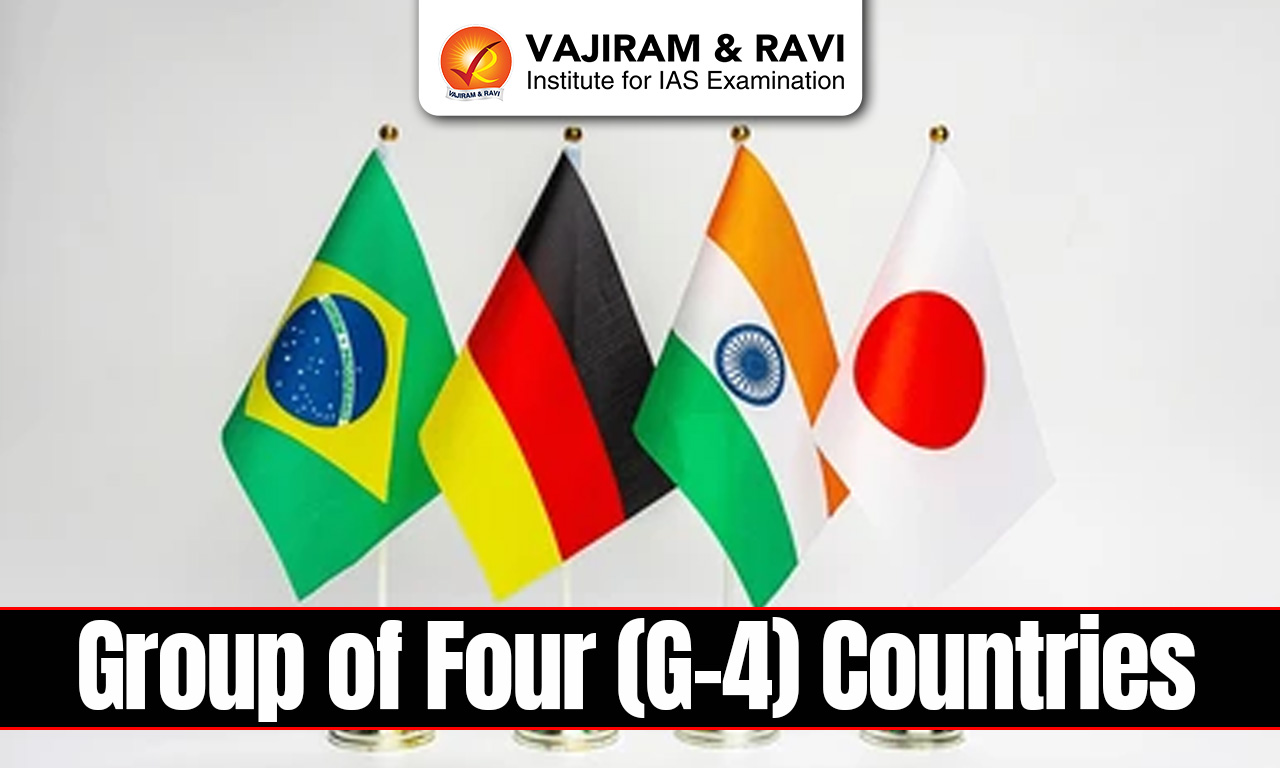
The Group of Four (G4) countries comprising India, Brazil, Germany, and Japan, is a group formed in 2005 to advocate for reforms in the United Nations Security Council (UNSC). The grouping supports expansion of the UNSC and seeks permanent membership for its members to make global governance more representative and effective.
Group of Four (G-4) Countries Background
The present structure of the United Nations Security Council (UNSC) reflects the geopolitical realities of the post-World War II era. It consists of five permanent members (P5) – United States, United Kingdom, France, Russia , China, with veto power and ten non-permanent members elected for two-year terms. While this structure was designed to ensure stability and avoid failures like the League of Nations, it has increasingly been criticised as outdated.
Over the decades, global power dynamics have shifted significantly, with emerging economies and developing countries playing a larger role in international affairs. However, regions such as Africa, Latin America, and parts of Asia still lack adequate representation in permanent membership. This imbalance has led to growing demands for reform. In this context, the G4 nations came together in 2005 to collectively push for a more inclusive and representative UNSC.
About Group of Four (G4) Countries
The Group of Four (G4) is a group of major emerging and developed countries that have come together to push for reforms in the United Nations Security Council and seek permanent membership.
- Formation: The G4 was formed in 2005 to promote UNSC reforms.
- Members: India, Brazil, Germany, and Japan.
- Nature: It is an informal diplomatic coalition based on mutual support.
- Core Principle: Each member supports the others’ bid for permanent membership.
- Engagement: G4 leaders and foreign ministers regularly meet, often on the sidelines of UN General Assembly sessions.


Group of Four (G4) Countries Objectives
The Group of Four (G4) countries aim to reform the United Nations Security Council to make it more inclusive, representative, and effective in addressing global challenges.
- The primary objective is to secure permanent seats in the UNSC for all four member countries.
- It seeks to make the UNSC more representative of current global political and economic realities.
- It supports expansion in both permanent and non-permanent categories.
- It advocates for greater representation of developing regions, particularly Africa.
- It calls for text-based negotiations within the UN framework to achieve concrete reforms.
Rationale Behind Group of Four (G4) Demand
- The G4 countries are among the largest economies and have significant global influence.
- They contribute substantially to the UN system, including peacekeeping operations and financial resources.
- They represent diverse regions and large populations, improving geographical balance.
- The current UNSC structure does not reflect contemporary geopolitical realities.
- Their inclusion is expected to enhance the legitimacy, accountability, and effectiveness of the UNSC.
Need for UNSC Reforms
The need for UNSC reform arises from the changing global order and the growing demand for a more inclusive and representative international decision-making system.
- The UNSC still reflects the power structure of 1945, which does not match present-day geopolitical realities.
- Only five permanent members hold veto power, which limits wider participation and fairness in decision-making.
- Entire regions such as Africa and Latin America do not have permanent representation in the Council.
- Emerging global challenges like terrorism, climate change, and cyber security require broader and more inclusive cooperation.
- Reform is essential to maintain the credibility, legitimacy, and effectiveness of the United Nations system.
Opposition to Group of Four (G4) Countries Grouping
The proposal of the G4 countries to become permanent members of the United Nations Security Council faces strong opposition due to political differences and competing national interests.
- The main opposition comes from the Uniting for Consensus (UfC) group, also known as the “Coffee Club,” which opposes any increase in permanent membership.
- Countries such as Italy, Pakistan, Mexico, and Argentina argue that adding more permanent members will make the Council less efficient.
- These countries instead support expanding only non-permanent seats, which they believe would ensure more rotation and wider representation.
- Regional rivalries also influence opposition, as some countries are unwilling to support the permanent membership of their regional competitors.
- In addition, some existing permanent members are cautious about reforms because expanding the Council may reduce their influence and weaken the impact of their veto power.

 Last updated on Oct, 2026
→ UPSC 2027 Notification will be released on 13 January 2027 at upsconline.nic.in.
→ Asian Games 2026 are being held in Aichi-Nagoya, Japan, from 19 September to 4 October.
→ Check Nobel Prize 2026 Winners List here.
→ Download PIB PRiSM Monthly Magazine 2026 here.
→ Check UPSC Monthly Current Affairs Magazine The Recitals here.
→ Check out the latest UPSC Syllabus here.
→ Download UPSC Model Answers for Mains 2026
→ UPSC Mains Question Paper 2026 is out now for Essay & GS Paper 1, 2, 3 & 4.
→ UPSC Calendar 2027 has been released.
→ Enroll in Vajiram & Ravi’s UPSC Mains Test Series 2027 for structured answer writing practice, expert evaluation, and exam-oriented feedback.
→ Join Vajiram & Ravi’s UPSC Mentorship Program 2027 for personalized guidance, strategy planning, and one-to-one support from experienced mentors.
→ Go through the UPSC Mains Previous Year Papers to enhance your preparation.
→ UPSC has released UPSC Toppers List 2025 with the Civil Services final result on its official website.
→ Also check Best UPSC Coaching in India
Group of Four (G-4) Countries FAQs
Q1. What is the G4 grouping in international relations?+
Q2. When was the G4 grouping formed and why?+
Q3. What are the main demands of the G4 grouping?+
Q4. Which countries oppose the G4 grouping and why?+
Q5. Why is India a strong candidate in the G4 grouping?+
Tags: g4 countries