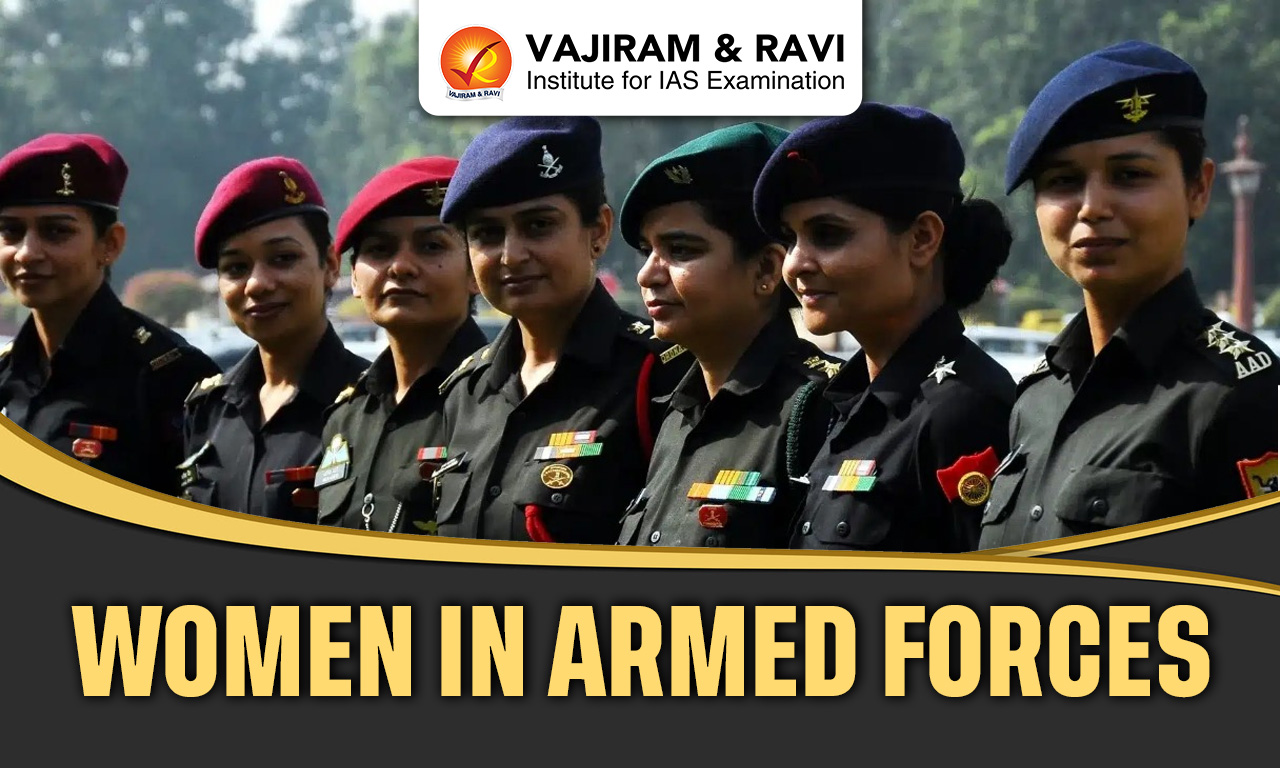
Women in the Indian Armed Forces have steadily increased their presence over the years, contributing to the defence and security of the country. Earlier, their roles were limited mainly to medical and support services, but today women serve in various branches of the Army, Navy, and Air Force. They are now taking up responsibilities in areas such as combat support, flying, and leadership positions. This growing participation reflects changing social attitudes, greater opportunities, and recognition of women’s capabilities in serving the nation.
Women in Indian Armed Forces
- International Women’s Day is a reminder of how women are growing and taking leadership roles in different fields, including defence services.
- In India, women are now becoming an important part of the Armed Forces, contributing not only in support roles but also in active and responsible positions.
- Their increasing participation shows that society is becoming more accepting of gender equality and recognizing the capabilities of women.
- Today, women officers are handling operational duties, leadership roles, and decision-making responsibilities, which reflects a major positive change in the defence system.
- This transformation has taken place over time due to policy changes, support from the judiciary, and efforts by the armed forces to create equal opportunities.
Historical Evolution of Women’s Role
- Pre-Independence Period
- The involvement of women in military services in India began in 1888 with the formation of the Indian Military Nursing Service, where women mainly worked as nurses and medical staff.
- During World War II (1942), the British Indian Army created the Women’s Auxiliary Corps, which allowed women to serve in non-combat roles like communication, clerical work, and administration.
- However, women were not allowed to fight in combat roles in the British Indian Army, unlike in some Western countries.
- A major exception was seen in the Rani of Jhansi Regiment of the Azad Hind Fauj led by Subhash Chandra Bose, where women actively participated in combat operations.
- Post-Independence Period
- After independence, the Army Act of 1950 restricted women from joining the armed forces in regular roles, except in certain special cases.
- In 1958, a major step was taken when women doctors were granted Permanent Commission in the Army Medical Corps, allowing them long-term service.
- A big change came in 1992, when women were allowed to join the armed forces as officers through the Women Special Entry Scheme (WSES), but only in selected non-combat branches.
- Under WSES, women were given short-term roles (5 years) and were not allowed in core combat areas like infantry and armoured corps.
- In 2006, the WSES was replaced by the Short Service Commission (SSC) scheme for women, giving them slightly better career opportunities, though still limited compared to men.
- In 2008, women were granted Permanent Commission in limited branches like Judge Advocate General (JAG) and Army Education Corps (AEC).
- A major breakthrough came in 2019, when the government expanded Permanent Commission to more branches, improving career stability for women officers.
- In 2020, the Supreme Court (in the Babita Puniya case) ordered that women officers must be given equal opportunity for Permanent Commission, marking a historic step towards gender equality.
- In 2021, women were allowed entry into the National Defence Academy (NDA), ensuring equal training opportunities from the beginning of their careers.
- In the Indian Air Force, women were first inducted as pilots in the 1990s, and in 2016, they were allowed into the fighter pilot stream, which was later made permanent.
- In the Indian Navy, women are now being deployed on warships and aviation roles, showing increased operational inclusion.


Key Milestones in Inclusion
- In 1958, a major step was taken when women doctors were granted permanent commission in the Army Medical Corps on equal terms with men.
- This marked the beginning of formal recognition of women’s long-term role in the Armed Forces.
- In 1992, a significant turning point came when women were allowed to join as officers in various branches of the Armed Forces.
- The Indian Army introduced the Women Special Entry Scheme (WSES), allowing women to serve in non-combat roles and also providing opportunities to widows of soldiers as a compassionate measure.
- In the same year, the Indian Navy inducted women officers for the first time, expanding their role beyond medical services.
- The Indian Air Force also started recruiting women as Short Service Commission officers in flying, technical, and non-technical branches.
- These developments in 1992 laid the foundation for the gradual expansion of women’s roles across all three services.
Recent Developments and Expanding Opportunities
- In recent years, several reforms have been introduced to increase the participation and growth of women in the Armed Forces.
- Women officers are now being considered for promotion to higher ranks such as Colonel, which was earlier limited.
- They are also being given command positions, allowing them to lead units and take important decisions.
- To ensure fairness, certain relaxations have been provided to women officers who could not complete specific training requirements during earlier phases of transition.
- Each branch of the Armed Forces – Army, Navy, and Air Force is taking steps to improve gender inclusion and provide equal career opportunities.
- These changes are helping women build long-term careers and contribute more effectively to national defence.
Indian Army
- The Indian Army has taken important steps to give women long-term career opportunities and stability.
- Women officers are now being granted Permanent Commission, which means they can serve for a full career instead of short-term service.
- This facility is now available in 12 different Arms and Services, which is a big expansion compared to earlier times.
- Apart from this, women have already been serving in the Army Medical Corps, Army Dental Corps, and Military Nursing Service.
- These changes show that the Army is slowly moving towards equal opportunities and recognizing the capability of women in leadership and long-term roles.
Indian Navy
- The Indian Navy is actively increasing the participation of women in operational roles, especially at sea.
- Women officers are now being posted onboard warships, which was not allowed earlier, showing a major step towards equality.
- They are also serving as Pilots and Naval Air Operations (NAO) officers, handling important aviation responsibilities.
- The Navy has opened almost all branches and specialisations for women, except submarines.
- It has also become the first service to recruit women under the Agnipath scheme, allowing them to join as officers and Agniveers.
- In the aviation field, women can now join the Remotely Piloted Aircraft (RPA) stream, and the first woman joined an RPA squadron in 2021.
- Another important step is that women cadets can now join the Indian Naval Academy through the 10+2 B.Tech entry scheme from 2024.
- Overall, the Navy is making strong efforts to include women in technical, operational, and leadership roles.
Indian Air Force
- The Indian Air Force was the first to induct women as pilots in the 1990s, although initially in support roles.
- A major reform came when women were allowed into combat roles, which started as an experiment in 2015 and became a permanent policy in 2022.
- Now, women can serve as fighter pilots and in other combat streams, on equal terms with men.
- Since 2017, women have also been getting opportunities in the flying branch through NCC Special Entry.
- Women are now being inducted through the National Defence Academy (NDA), with fixed seats in flying and ground duty branches up to 2027.
- Under the Agnipath scheme, women have joined as Agniveer Vayu, strengthening inclusion in the Air Force.
- These steps show that the Air Force is leading in providing equal and advanced opportunities to women.
Increasing Opportunities and Participation
- The number of women joining defence services is steadily increasing every year.
- In 2025, 17 women cadets graduated from NDA in May and 15 more in November, showing rising participation.
- By early 2026, a total of 158 women cadets had joined NDA since women were allowed entry in 2022.
- Among states, Haryana has the highest number of women cadets, followed by Uttar Pradesh and Rajasthan.
- The Army has also increased the number of seats for women from 80 to 144 in 2024, showing a major expansion in opportunities.
- These numbers clearly show that more women are choosing defence careers and being encouraged to join.
Women Breaking New Ground
- Women officers are now taking part in important missions, leadership roles, and international activities.
- In 2025, a tri-services all-women sailing expedition was conducted, where 11 women officers from Army, Navy, and Air Force completed a long sea journey to Seychelles.
- This mission showed teamwork, strength, and coordination among the three forces.
- Women are also gaining visibility in national events, such as participation in the Republic Day Parade and other ceremonial roles.
- Their growing presence reflects confidence, leadership, and equal participation in defence activities.
Awards and Recognition
- Women officers are being recognized at national and international levels for their contributions.
- In 2025, Major Swathi Shanthakumar received a UN award for her work in promoting gender equality and peacekeeping in South Sudan.
- The NCC Girls Contingent received an Army award for the first time during Army Day celebrations in 2025.
- Major Radhika Sen was awarded the title of Military Gender Advocate of the Year (2023) by the United Nations.
- These recognitions highlight the important role women are playing not only in India but also globally.
Global Role and Peacekeeping
- India is also promoting women’s participation in United Nations peacekeeping missions.
- By mid-2025, more than 154 Indian women personnel were serving in different UN missions across the world.
- India has already achieved about 22% representation of women in staff and observer roles in peacekeeping missions.
- This is in line with global goals to increase women’s participation in international security efforts.
- These contributions show that Indian women are playing an important role in promoting peace, security, and gender equality worldwide.
Women in Indian Armed Forces Major Policy Reforms
- Kargil Review Committee (1999):
- After the Kargil War, this committee studied the functioning of the defence system.
- It suggested that women should be given more opportunities in areas like logistics, engineering, and intelligence.
- This was one of the early steps that encouraged the expansion of women’s roles beyond traditional duties.
- Supreme Court Judgment (2020):
- The Supreme Court of India gave a landmark decision supporting gender equality in the Army.
- It directed the government to grant Permanent Commission to women officers, allowing them to serve full careers like men.
- This decision improved job security, promotion chances, and leadership opportunities for women.
- It also reinforced the idea that women are equally capable of handling responsibilities in the armed forces.
- Agnipath Scheme (2022):
- This scheme opened a new path for young men and women to join the armed forces as Agniveers for a short-term service.
- For the first time, women were included in this scheme across the Army, Navy, and Air Force.
- It has increased the number of women entering defence services at an early stage.
- Entry into National Defence Academy (NDA):
- Earlier, women were not allowed to join the NDA, which is a key training institution for officers.
- After a court decision, women cadets were allowed entry, marking a historic change.
- The first batches of women cadets are set to graduate in 2025, showing real progress in equal training opportunities.
- This step ensures that women and men now start their defence careers on the same platform.
- Rising Strength of Women Officers:
- The number of women officers in the armed forces has increased significantly over the years.
- It has grown from around 3,000 in 2014 to over 11,000 today, showing steady progress.
- This rise reflects better policies, increased awareness, and more opportunities for women.
- It also shows that more women are choosing defence as a career option.
- Military Nursing Service (MNS):
- The Military Nursing Service remains the only all-women corps in the armed forces.
- It has a long history of serving the nation, especially during wars and emergencies.
- Women in this service play a crucial role in providing medical care and support to soldiers.
- Even today, it continues to be an important part of the defence system, although women are now entering many other branches as well.
Women Leaders in Indian Armed Forces
- Sadhna Saxena Nair became the first woman to serve as Director General Medical Services (Army). Her achievement shows that women are now reaching top leadership positions in the Army.
- Ponung Doming made history as the first woman to command the world’s highest Border Task Force at very high altitude, showing great strength and leadership.
- Bhawana Kanth was the first Indian woman fighter pilot to qualify for combat missions and also took part in the Republic Day flypast, inspiring many.
- Annu Prakash has played an important role in maritime security, showing how women are contributing to protecting India’s coastline.
- Hansja Sharma became the first woman Rudra helicopter pilot in the Army and led an aviation squadron, marking a big achievement.
- Aastha Poonia became the first woman to enter the fighter stream of Naval Aviation, breaking barriers in a male-dominated field.
- Avani Chaturvedi was the first Indian woman fighter pilot to take part in an international air combat exercise, showing global-level capability.
- Shivangi Singh became India’s first woman Rafale fighter jet pilot, highlighting the growing role of women in advanced combat roles.
- Anjali Singh became the first Indian woman military diplomat posted abroad, showing leadership beyond combat roles.
- Dilna K and Roopa A completed a historic global sea journey, proving courage and leadership in the Navy.
Challenges Faced by Women in Indian Armed Forces
- Limited Combat Roles and Career Growth: Women still have restricted entry into frontline combat roles, especially in the Army, which affects their experience, promotions, and chances of reaching higher leadership positions.
- Infrastructure and Facility Gaps: Many remote and field postings lack proper accommodation, sanitation, and privacy for women, making daily life and work more difficult.
- Cultural and Social Barriers: Traditional mindsets and gender biases sometimes make it challenging for women to be fully accepted as leaders, forcing them to constantly prove their abilities.
- Work-Life Balance and Mental Stress: Managing demanding military duties along with family responsibilities, frequent transfers, and long separations can lead to stress and emotional challenges.
- Safety, Health, and Representation Issues: Concerns like sexual harassment, lack of gender-friendly equipment, and low representation of women in the forces continue to affect their overall experience and confidence.
Women in Indian Armed Forces Significance
- Promotes gender equality and women empowerment by giving equal opportunities in national defence.
- Ensures better use of talent and human resources, improving overall efficiency of the forces.
- Brings diverse perspectives in decision-making, which strengthens operational effectiveness.
- Enhances India’s global image as a country committed to inclusivity and modern values.
- Inspires social change and breaks stereotypes, encouraging more women to join defence and other fields.

 Last updated on Sep, 2026
→ UPSC 2027 Notification will be released on 13 January 2027 at upsconline.nic.in.
→ Asian Games 2026 are being held in Aichi-Nagoya, Japan, from 19 September to 4 October.
→ Check out the latest UPSC Syllabus here.
→ Download UPSC Model Answers for Mains 2026
→ UPSC Mains Question Paper 2026 is out now for Essay & GS Paper 1, 2, 3 & 4.
→ UPSC Calendar 2027 has been released.
→ Enroll in Vajiram & Ravi’s UPSC Mains Test Series 2027 for structured answer writing practice, expert evaluation, and exam-oriented feedback.
→ Join Vajiram & Ravi’s UPSC Mentorship Program 2027 for personalized guidance, strategy planning, and one-to-one support from experienced mentors.
→ Go through the UPSC Mains Previous Year Papers to enhance your preparation.
→ UPSC has released UPSC Toppers List 2025 with the Civil Services final result on its official website.
→ Also check Best UPSC Coaching in India
Women in Indian Armed Forces FAQs
Q1. What is the role of women in the Indian Armed Forces today?+
Q2. How has the role of women evolved over time?+
Q3. What are the key milestones in women’s inclusion in the Armed Forces?+
Q4. What opportunities are available for women in different forces?+
Q5. What are the major challenges faced by women in the Armed Forces?+
Tags: internal security women in indian armed forces