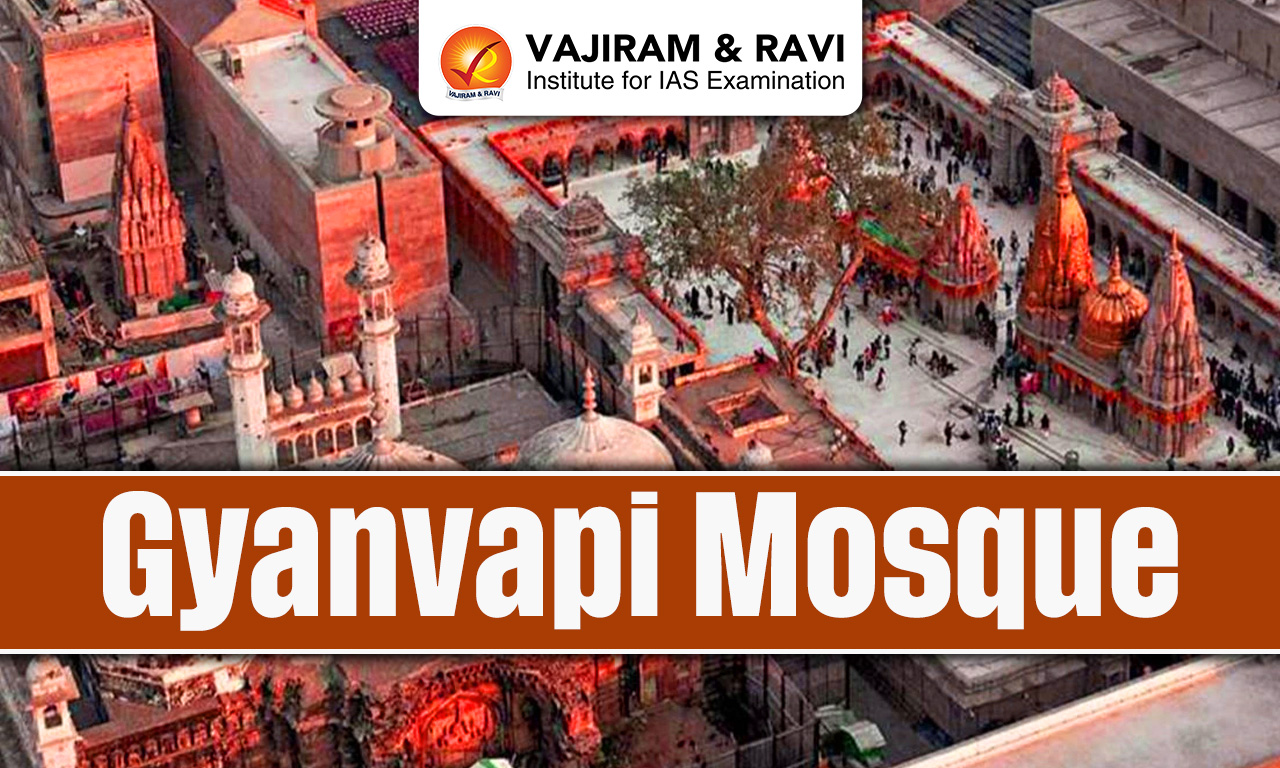
The Gyanvapi Mosque is a historic place of worship located in Varanasi, India. It is situated in a city known for its deep religious and cultural importance. The site is widely known because of historical beliefs that it was built on or near an earlier temple. Over time, it has become an important and sensitive place linked with religion, history, and ongoing discussions in India.
Gyanvapi Mosque Dispute Background
- The Gyanvapi Mosque is located in Varanasi, close to the Kashi Vishwanath Temple, one of the most important temples dedicated to Lord Shiva.
- The site has both religious and historical importance and has long been a point of disagreement between Hindu and Muslim communities.
- The Gyanvapi Mosque issue is associated with the belief that it was constructed in 1669 during the reign of Mughal emperor Aurangzeb, following the demolition of the Vishweshwar Temple dedicated to Lord Shiva.
- Historical accounts such as Maasir-i-Alamgiri also record the demolition of a temple during his rule. In addition, an inscription found at the site indicates that the mosque was built around the 20th year of Aurangzeb’s reign, approximately 1676–77 CE.
- Some historians support the view that the temple was destroyed during Mughal expansion, while others interpret the events differently, linking them to political conflicts of that time.
Gyanvapi Mosque Establishment
- In 1669, during the rule of Mughal emperor Aurangzeb, the existing temple structure was demolished.
- A mosque, later known as the Gyanvapi Mosque (also referred to in historical texts as Alamgiri Mosque), was built on or near the same site.
- Some historians suggest this action was politically motivated to assert Mughal authority over local resistance, while others link it to religious policies of that period.
- Parts of the earlier temple structure are believed to have been reused in constructing the mosque.


Findings of the ASI Report
- The Archaeological Survey of India conducted a scientific survey of the site and concluded that a large Hindu temple existed before the mosque.
- The report found pillars, sculptures, and architectural remains that are clearly linked to temple-style construction.
- Around 30+ inscriptions in scripts like Devanagari, Telugu, Kannada, and Grantha were discovered, suggesting reuse of temple materials.
- Several broken idols and sculptures of Hindu deities such as Shiva, Vishnu, Ganesha, and Hanuman were found in the complex.
- Important religious symbols like the trident (Trishul) and swastika were also identified on structures.
- The central part of the earlier temple appears to have been integrated into the present mosque structure.
- The report also mentioned that parts of the temple were damaged and reused during construction of the mosque.
Legal and Historical Disputes
- The site has been under legal dispute since 1991, with claims that a temple was demolished and a mosque built in its place.
- In 2021, the court ordered a survey of the site, including videography of the mosque complex.
- The survey aimed to document structures like the Shringar Gauri idol area and surrounding features.
- The Hindu side presented maps and claims showing the presence of older temple structures and sacred spots such as the Vishweshwar area, Nandi statue, Gyankoop (Mukti Mandap), and Vyas basement.
- The Muslim side argues that the site’s religious character should remain protected under the Places of Worship (Special Provisions) Act, 1991, which prevents changing the status of religious sites as they existed in 1947.
- The case remains sub judice, with courts yet to give a final ruling on ownership and historical interpretation.
Broader Historical and Political Context
- During the late Mughal period, there were multiple attempts to rebuild or restore temples in Varanasi, though many were unsuccessful.
- Under British rule, the site became a point of tension between communities, leading to legal restrictions and disputes over worship rights.
- In independent India, the issue gained renewed attention, especially after similar disputes like the Ayodhya case.
- Scholars remain divided; some see the destruction of temples as part of political consolidation, while others interpret it as religiously driven action.
- Today, the Gyanvapi issue continues to be a sensitive legal and historical matter involving archaeology, religion, and constitutional law.
Places of Worship (Special Provisions) Act, 1991
- Prohibition of Conversion (Section 3)
- This section clearly states that no place of worship in India can be converted from one religion to another.
- It also prevents any change within the same religious place that alters its religious identity.
- The aim is to maintain peace by stopping disputes over religious conversions of sites.
- Maintenance of Religious Character (Section 4(1))
- This provision ensures that every place of worship keeps its religious status as it existed on 15 August 1947.
- It means the identity of religious sites cannot be changed after Independence.
- The purpose is to preserve the historical and religious status quo of places of worship in India.
- Abatement of Pending Cases (Section 4(2))
- All legal cases related to changing the religious nature of a place of worship that existed before 15 August 1947 are discontinued.
- It also stops the filing of new cases on such matters.
- This provision aims to prevent long-standing disputes from continuing in courts.
- Exceptions to the Act (Section 5)
- The Act does not apply to ancient monuments and archaeological sites protected under the Ancient Monuments and Archaeological Sites and Remains Act, 1958.
- It also excludes disputes that were already resolved before the Act came into force.
- Any cases settled through mutual agreement or conversions that happened before 1991 are not covered.
- Importantly, the Act does not apply to the Ram Janmabhoomi–Babri Masjid dispute in Ayodhya and related legal matters.
- Penalties (Section 6)
- The Act also includes punishment for violations.
- Anyone who attempts to change the religious character of a protected place can face up to three years of imprisonment, along with fines.
- This provision ensures strict enforcement of the law and discourages violations.

 Last updated on August, 2026
→ UPSC Mains 2026 commenced on 21st August 2026 and will continue through 30th August 2026, as per the official examination schedule.
→ UPSC Mains Question Paper 2026 is out now for Essay & GS Paper 1, 2, 3 & 4.
→ UPSC Mains GS Paper 1 2026 is out now.
→ UPSC Mains GS Paper 2 2026 is out now.
→ UPSC Mains GS Paper 3 2026 is out now.
→ UPSC Mains GS Paper 4 2026 is out now.
→ UPSC Mains Indian Language Paper & English Compulsory Paper are out now.
→ Check out the latest UPSC Syllabus 2026 here.
→ UPSC Mains Admit Card 2026 is now out.
→ Enroll in Vajiram & Ravi’s UPSC Mains Test Series 2027 for structured answer writing practice, expert evaluation, and exam-oriented feedback.
→ Join Vajiram & Ravi’s UPSC Mentorship Program 2027 for personalized guidance, strategy planning, and one-to-one support from experienced mentors.
→ Go through the UPSC Mains Previous Year Papers to enhance your preparation.
→ Download UPSC Mains Essay Paper 2025, UPSC Mains GS Paper-I 2025, UPSC Mains GS Paper-II 2025, UPSC Mains GS Paper-III 2025, UPSC Mains GS Paper-IV 2025, UPSC Mains English (Compulsory) Paper 2025, UPSC Mains Hindi (Qualifying) Paper 2025 here.
→ UPSC has released UPSC Toppers List 2025 with the Civil Services final result on its official website.
→ UPSC Calendar 2027 has been released.
→ Also check Best UPSC Coaching in India
Gyanvapi Mosque FAQs
Q1. What is the Gyanvapi Mosque?+
Q2. Why is the Gyanvapi Mosque in the news or discussion?+
Q3. Where is the Gyanvapi Mosque located?+
Q4. What does the ASI report say about the site?+
Q5. What kind of evidence was found during the survey?+
Tags: gyanvapi mosque