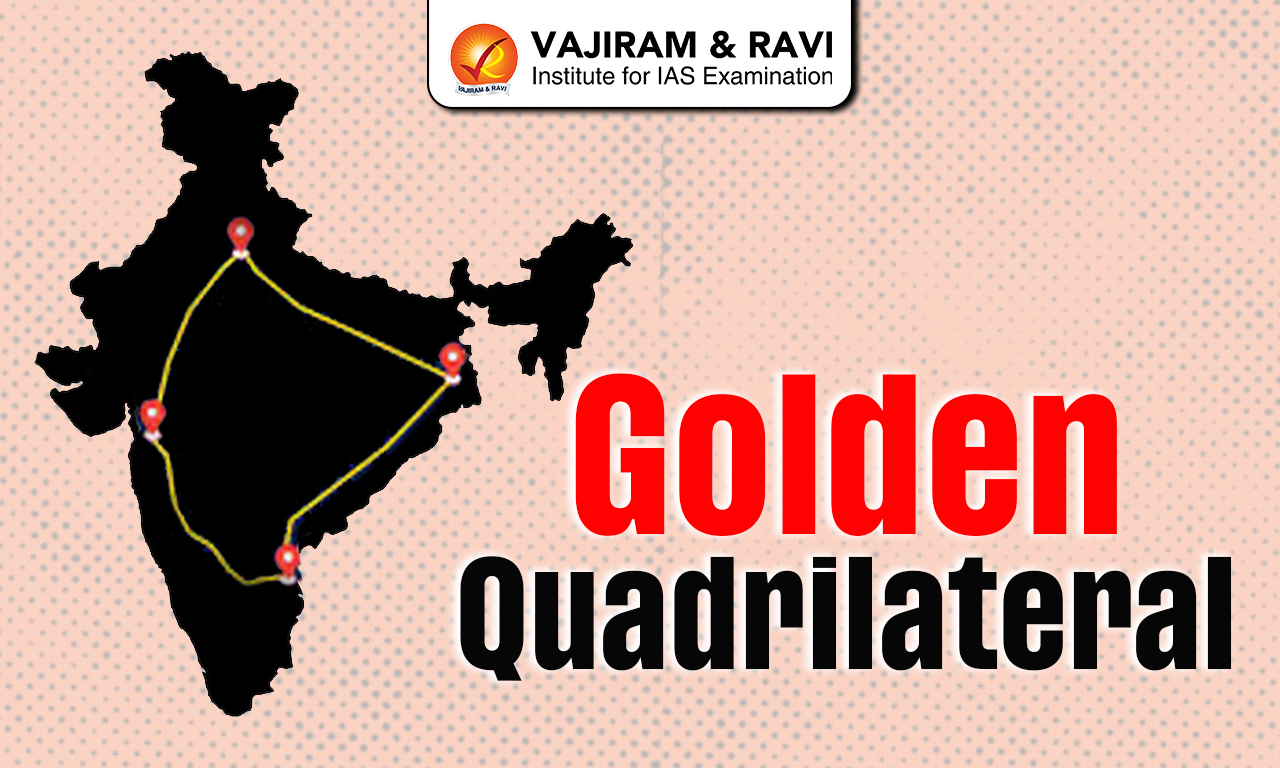
The Golden Quadrilateral is one of the most important road networks in India. It connects major cities across the country, making travel and transport faster and easier. Linking different regions, it helps people, goods, and services move smoothly from one place to another. Overall, it plays a key role in supporting trade, development, and better connectivity in everyday life.
About Golden Quadrilateral
- The Golden Quadrilateral is one of the biggest road development projects in India, designed to improve connectivity across the country.
- It connects four major cities – Delhi, Mumbai, Chennai, and Kolkata forming a large four-sided (quadrilateral) road network.
- It is about 5,846 kilometres long, making it one of the biggest highway networks in Asia.
- The main aim of this project is to make travel faster, smoother, and safer for both people and goods moving between different parts of the country.
- It is a part of the larger National Highways Development Project, which focuses on improving the overall road system of India.
- The highways built under this project are wide, well-maintained, and suitable for high-speed travel, which helps in reducing travel time significantly.
- It plays an important role in boosting trade, as goods can be transported quickly between major industrial and commercial centers.
- The project has also helped in the growth of industries, businesses, and towns located along these highways by improving accessibility.
Major Routes and Cities Covered by the Golden Quadrilateral
The Golden Quadrilateral connects four major metropolitan cities of India – Delhi, Mumbai, Chennai, and Kolkata forming a large loop across the country.
| Major Routes and Cities Covered | ||
|
Corridor |
Major Route (Key Cities) |
Approximate Length |
|
Delhi – Kolkata |
Delhi → Kanpur → Varanasi → Dhanbad → Kolkata |
~1,450 km |
|
Kolkata – Chennai |
Kolkata → Bhubaneswar → Visakhapatnam → Chennai |
~1,680 km |
|
Chennai – Mumbai |
Chennai → Bengaluru → Pune → Mumbai |
~1,290 km |
|
Mumbai – Delhi |
Mumbai → Vadodara → Ahmedabad → Udaipur → Jaipur → Delhi |
~1,400 km |


States and Cities Benefited by the Golden Quadrilateral
- States Covered: The Golden Quadrilateral passes through around 13 states of India, including Delhi, Haryana, Uttar Pradesh, Bihar, Jharkhand, West Bengal, Odisha, Andhra Pradesh, Tamil Nadu, Karnataka, Maharashtra, Gujarat, and Rajasthan. These states benefit from better road connectivity and faster transportation.
- Major Cities Connected: The network links many important cities such as Delhi, Jaipur, Ahmedabad, Mumbai, Pune, Bengaluru, Chennai, Visakhapatnam, Bhubaneswar, Kolkata, Kanpur, and Varanasi, making travel between these cities quicker and easier.
- Overall Impact: This wide network connects around 15 major industrial, agricultural, and cultural centres, helping in smooth movement of goods and people and supporting economic growth across different regions.
Background and Objectives of Golden Quadrilateral
- The Golden Quadrilateral was launched in 1999 as part of the National Highways Development Project by the Government of India under Atal Bihari Vajpayee, with the aim of improving road connectivity across the country.
- Its main goal was to connect the four major cities of India and ensure smooth movement of people and goods between different regions, making travel faster and more efficient.
- The project also aimed to reduce travel time, fuel use, and transportation costs, which benefits both daily commuters and businesses.
- Another important objective was to promote economic growth by improving access to smaller towns and underdeveloped areas along the highways.
- It focused on improving road safety and developing modern highways with better design, wider lanes, and improved facilities.
- The project was implemented by the National Highways Authority of India under the Ministry of Road Transport and Highways, making it a key step in strengthening India’s transport system.
Features of the Golden Quadrilateral
- The Golden Quadrilateral has wide 4-6 lane highways with dividers for smooth and safe traffic movement.
- Bypasses and flyovers help reduce congestion by allowing vehicles to avoid crowded city areas.
- Roads are built using modern standards with proper signs, markings, and drainage systems.
- Toll plazas and service lanes are provided for maintenance and local traffic management.
- It is well connected to ports, industrial areas, and logistics hubs for easy transport of goods.
- Bridges and underpasses ensure uninterrupted traffic flow and improve safety.
Construction and Implementation of Golden Quadrilateral
- The Golden Quadrilateral project was officially started in 2001 as part of Phase I of the National Highways Development Project to improve major highways across India.
- The construction work was carried out in different phases, with multiple contractors working on various sections at the same time to speed up the process.
- The project was funded through different sources, including government support, loans, a special fuel tax (cess), and financial help from international organizations like the World Bank and the Asian Development Bank.
- It was first planned to be completed by 2004, but several challenges like land acquisition issues, environmental approvals, and construction delays slowed down the progress.
- Despite these difficulties, most of the project was completed by around 2012, and later improvements and expansions continued under new highway development programmes.
Importance and Benefits of Golden Quadrilateral
- Economic Integration: The Golden Quadrilateral has improved the movement of goods and raw materials across India, helping industries and agriculture stay well connected.
- Reduced Travel Time and Cost: It has significantly reduced travel time between major cities, which also lowers fuel consumption and transportation expenses.
- Boost to Trade and Industry: Faster and more reliable transport has supported the growth of industries like manufacturing, agriculture, textiles, and tourism.
- Industrial Corridor Development: It has supported major projects like the Delhi–Mumbai Industrial Corridor and Chennai–Bengaluru Industrial Corridor, encouraging investment and development.
- Employment Generation: The project created many job opportunities during construction as well as in maintenance and related activities.
- Urban and Rural Development: Better connectivity has helped small towns and rural areas grow by linking them with big cities and markets.
- Support to Agriculture: Farmers can transport their crops quickly to cities and ports, reducing wastage and increasing their income.
- Improved Transport Efficiency: It has increased the speed and efficiency of transportation, especially benefiting truck movement across the country.
- Better Road Safety and Comfort: Modern road design and infrastructure have improved safety and made travel more comfortable.
- National Growth and Connectivity: Overall, it has strengthened connectivity and played an important role in economic growth and national integration.
Challenges Faced by the Golden Quadrilateral
- Land Acquisition Issues: Acquiring land for highway construction was often slow due to disputes over compensation and delays in official procedures.
- Environmental Concerns: Construction activities led to problems like cutting of trees, disturbance to wildlife, and increased pollution in some areas.
- Maintenance Requirements: Due to heavy traffic, roads need regular repair and maintenance, which can be costly and time-consuming.
- Funding and Cost Problems: Limited funds and rising construction costs caused delays and affected the smooth progress of the project.
- Toll Management Issues: In the early stages, there were concerns about lack of transparency and irregularities in toll collection and contracts.
- Uneven Regional Impact: Some regions, especially along the north-south and east-west corridors, did not benefit as much as expected in terms of development.
- Slow Transport Speed: Despite improvements, average truck speeds in India are still relatively low, leading to higher fuel use and longer travel time.
- Broader Infrastructure Challenges: Issues like governance, climate concerns, and difficulties in managing large infrastructure projects continue to affect overall efficiency.
Golden Quadrilateral Modernisation and Expansion
- Widening of Highways: Many busy sections of the Golden Quadrilateral are being upgraded from four lanes to six or even eight lanes to handle increasing traffic more smoothly.
- Better Connectivity with Major Projects: The network is being linked with large government programmes like Bharatmala Project and Sagarmala Project to improve connections with ports, industries, and logistics hubs.
- Use of Smart Technology: Modern systems such as FASTag, GPS tracking, and digital monitoring are being introduced to make travel faster, reduce waiting time at toll plazas, and improve traffic management.
- Development of Economic Corridors: New industrial and economic corridors are being developed along the route to attract factories, businesses, and investments, which will create jobs and boost regional development.

 Last updated on Oct, 2026
→ UPSC 2027 Notification will be released on 13 January 2027 at upsconline.nic.in.
→ Check Nobel Prize 2026 Winners List here.
→ Download PIB PRiSM Monthly Magazine 2026 here.
→ Check UPSC Monthly Current Affairs Magazine The Recitals here.
→ Check out the latest UPSC Syllabus here.
→ Download UPSC Model Answers for Mains 2026
→ UPSC Mains Question Paper 2026 is out now for Essay & GS Paper 1, 2, 3 & 4.
→ UPSC Calendar 2027 has been released.
→ Enroll in Vajiram & Ravi’s UPSC Mains Test Series 2027 for structured answer writing practice, expert evaluation, and exam-oriented feedback.
→ Join Vajiram & Ravi’s UPSC Mentorship Program 2027 for personalized guidance, strategy planning, and one-to-one support from experienced mentors.
→ Go through the UPSC Mains Previous Year Papers to enhance your preparation.
→ UPSC has released UPSC Toppers List 2025 with the Civil Services final result on its official website.
→ Also check Best UPSC Coaching in India
Golden Quadrilateral FAQs
Q1. What is the Golden Quadrilateral?+
Q2. Why was the Golden Quadrilateral built?+
Q3. When was the project started and by whom?+
Q4. What is the total length of the Golden Quadrilateral?+
Q5. What are the main benefits of the Golden Quadrilateral?+
Tags: economy economy notes golden quadrilateral