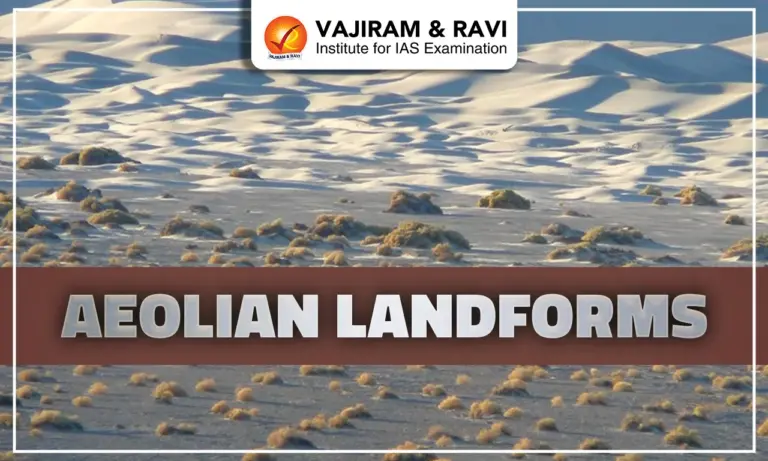
Aeolian landforms are land features shaped by the action of wind, especially in arid and semi-arid regions where rainfall is low and vegetation cover is sparse. The term Aeolian comes from the term- “Aeolus”- the Greek god of winds. These landforms are formed through wind processes such as erosion, transportation, and deposition. In India, aeolian activity is most visible in the Thar Desert of Rajasthan, covering about 2,00,000 sq. km of area.
Aeolian Landforms
Aeolian landforms are shaped through processes of erosion, transportation, and deposition by wind. Wind plays a significant role in desert regions, carrying fine particles over long distances and shaping both small-scale features like ripples and large-scale features like dunes. According to the Geological Survey of India (GSI), about 61% of India’s arid land is affected by aeolian processes, making them crucial in India’s desert ecology and land use.
Aeolian Landforms Types
Aeolian landforms are broadly divided into erosional landforms (formed by removal of material) and depositional landforms (formed by accumulation of material).
| Aeolian Landforms Types | ||
| Types | Examples | Description |
|
Erosional Landforms |
Yardangs, Deflation Hollows, Mushroom Rocks, Ventifacts |
Created when wind removes or sculpts materials |
|
Depositional Landforms |
Sand Dunes, Loess, Ripple Marks, Barchans, Longitudinal Dunes |
Formed by deposition of wind-blown sediments |





Aeolian Processes in Geography
Aeolian Processes play a central role in shaping desert landscapes. These processes together create distinct erosional and depositional landforms. The main processes include:
- Deflation: The removal of loose particles like dust, silt, and sand by strong winds.
- Abrasion: The wearing down of rock surfaces by wind-driven sand particles.
- Attrition: Breaking down of particles when they collide with each other during transport.
- Transportation: Wind carries sediments in three ways:
- Suspension (fine particles carried over long distances)
- Saltation (bouncing movement of sand grains)
- Surface Creep (rolling of coarse particles along the ground)
Erosional Aeolian Landforms
Erosional landforms are created when wind removes or sculpts material.
- Yardangs
- Yardangs are streamlined ridges carved by wind abrasion.
- They are elongated in the direction of prevailing winds.
- Famous examples are found in the Sahara Desert (Egypt, Libya) and Thar Desert near Jaisalmer.
- Deflation Hollows
- Large depressions formed by wind removal of loose materials.
- When the depression deepens below the water table, oases may form.
- Example: Qattara Depression in Egypt, one of the largest in the world.
- Mushroom Rocks (Pedestal Rocks)
- Rocks shaped like mushrooms due to stronger erosion at the base compared to the top.
- Common in Jaisalmer and Barmer districts of Rajasthan.
- Created due to differential abrasion by sand-laden winds.
- Ventifacts
- Stones or pebbles polished and faceted by wind abrasion.
- Found in cold deserts of Ladakh and also in parts of the Thar Desert.
- Zeugen
- Tabular masses of soft rock overlain by harder rock.
- Wind erodes the softer part, leaving flat-topped ridges.
- Example: Sahara Desert.
- Demoiselles
- Rock pillars formed when softer rock erodes, leaving behind harder rock caps.
- They look like “rock statues” or “earth pillars”.
- Found in deserts as well as in some glacial regions.
- Inselbergs (Isolated Hills)
- Steep-sided isolated hills rising abruptly from desert plains.
- Although partly fluvial in origin, wind action enhances their prominence.
- Example: Inselbergs in Kalahari Desert; in India, Arawalli outcrops in western Rajasthan.
- Blowouts (Deflation Basins)
- Shallow depressions created by strong winds removing loose sand.
- Common in Thar Desert.
- Desert Pavement
- Surface covered by pebbles and gravel after finer particles are blown away.
- Example: Southwestern USA deserts; also seen in parts of Rajasthan.
Depositional Aeolian Landforms
When wind loses energy, it deposits sediments, forming characteristic landforms. These depositional landforms are vital for understanding desert dynamics and soil distribution.
- Sand Dunes
Sand dunes are the most common aeolian depositional landforms. Their shapes depend on wind direction, speed, and sand availability.
- Barchans (Crescent-shaped Dunes):
-
-
- Formed by unidirectional winds.
- The convex side faces the wind, with slip faces on the leeward side.
- Found in Jaisalmer and Bikaner(Rajasthan).
-
- Seif or Longitudinal Dunes:
-
-
- Long parallel ridges aligned with prevailing winds.
- Can extend for several kilometers.
- Seen in the western Thar Desert.
-
- Transverse Dunes:
-
-
- Formed perpendicular to prevailing winds when sand supply is abundant.
- Found near Barmer in Rajasthan.
-
- Parabolic Dunes:
-
-
- U-shaped dunes formed in coastal areas with vegetation anchoring their arms.
- Found along the Odisha and Tamil Nadu coasts.
-
- Star Dunes:
-
- Pyramid-shaped dunes formed by multi-directional winds.
- Common in large deserts like the Sahara but rare in India.
- Loess Deposits
- Fine dust and silt carried by wind and deposited over large areas.
- Loess creates highly fertile soils.
- The Loess Plateau in China is the best example globally.
- In India, thin loess deposits are found in parts of Ladakh and Kashmir valleys.
- Ripple Marks
- Small-scale ridges formed on sand surfaces due to wind action.
- Common on sand dunes in Rajasthan deserts and coastal beaches across India.
- Sand Sheets (Ergs or Sand Seas)
- Vast flat areas covered by sand with little vegetation.
- Example: Rub al-Khali (Saudi Arabia); in India, Marusthali in Rajasthan.
- Draas (Mega Dunes)
- Very large dunes that can be several kilometers in length and hundreds of meters in height.
- Found in the Sahara Desert; smaller forms in the Thar Desert.
- Loess Plateau
- Large accumulation of loess forming a plateau.
- Example: Loess Plateau in China (world’s thickest loess deposits).
Aeolian Landforms in India
India presents a variety of aeolian features, mainly in arid and semi-arid zones. According to the National Remote Sensing Centre (ISRO), over 40,000 sq. km in Rajasthan is dominated by active sand dunes, showing the intensity of aeolian activity.
-
- Thar Desert (Rajasthan): Extensive dune fields, yardangs, mushroom rocks covering nearly 60% of India’s arid land.
- Rann of Kutch (Gujarat): Seasonal desert with aeolian deposits.
- Cold Deserts (Ladakh and Spiti): Ventifacts and small sand dunes formed by strong cold winds.
- Coastal Regions (Odisha, Tamil Nadu, Gujarat): Parabolic dunes and ripple marks are common.
Aeolian Landforms Significance
Aeolian landforms have geographical, ecological, and economic importance as listed below:
- Agriculture: Loess deposits form some of the world’s most fertile soils.
- Tourism: Sand dunes in Jaisalmer and Bikaner are major tourist attractions.
- Wind Energy: Desert landscapes with high wind speeds are suitable for wind farms.
- Cultural Value: Desert communities adapt their lifestyle around these landforms.
- Hazards: Shifting dunes and dust storms can damage infrastructure and reduce soil fertility.
Aeolian Landforms Global Context
Globally, Aeolian Landscapes are found in deserts, semi-arid regions, and sandy coasts. Comparing India’s aeolian landforms with global examples helps in understanding their diversity and distribution.
| Aeolian Landforms Global Context | |
| Region | Notable Features |
|
Sahara Desert |
Yardangs, star dunes, deflation hollows |
|
Gobi Desert (China & Mongolia) |
Longitudinal dunes, ventifacts |
|
Loess Plateau (China) |
World’s thickest loess deposits |
|
Atacama Desert (Chile) |
Mushroom rocks, barchans |
|
Great Victoria Desert (Australia) |
Large sand ridge systems |
Aeolian Landforms UPSC
Aeolian landforms are a product of wind erosion and deposition, shaping landscapes in deserts and coastal regions. In India, they are prominently visible in the Thar Desert, Rann of Kutch, Ladakh, and coastal belts. From yardangs and mushroom rocks to sand dunes and loess deposits, these features reflect the dynamic interaction between wind and sediments. While these landforms enrich physical geography, they also pose challenges of desertification and land degradation.

 Last updated on March, 2026
→ UPSC Final Result 2025 is now out.
→ UPSC has released UPSC Toppers List 2025 with the Civil Services final result on its official website.
→ Anuj Agnihotri secured AIR 1 in the UPSC Civil Services Examination 2025.
→ UPSC Marksheet 2025 is now out.
→ UPSC Notification 2026 & UPSC IFoS Notification 2026 is now out on the official website at upsconline.nic.in.
→ UPSC Calendar 2026 has been released.
→ Check out the latest UPSC Syllabus 2026 here.
→ UPSC Prelims 2026 will be conducted on 24th May, 2026 & UPSC Mains 2026 will be conducted on 21st August 2026.
→ The UPSC Selection Process is of 3 stages-Prelims, Mains and Interview.
→ Prepare effectively with Vajiram & Ravi’s UPSC Prelims Test Series 2026 featuring full-length mock tests, detailed solutions, and performance analysis.
→ Enroll in Vajiram & Ravi’s UPSC Mains Test Series 2026 for structured answer writing practice, expert evaluation, and exam-oriented feedback.
→ Join Vajiram & Ravi’s Best UPSC Mentorship Program for personalized guidance, strategy planning, and one-to-one support from experienced mentors.
→ Shakti Dubey secures AIR 1 in UPSC CSE Exam 2024.
→ Also check Best UPSC Coaching in India
Aeolian Landforms FAQs
Q1. What are Aeolian landforms?+
Q2. Which is the best example of Aeolian Landforms in India?+
Q3. What is the difference between erosional and depositional aeolian landforms?+
Q4. Where are Parabolic Dunes found in India?+
Q5. Where are Ventifacts found in India?+
Tags: aeolian landforms