Ammonia Latest News
Officials explained that ammonia spikes in the Yamuna are a chronic winter issue, generally occurring between 15 and 22 times a year.
About Ammonia
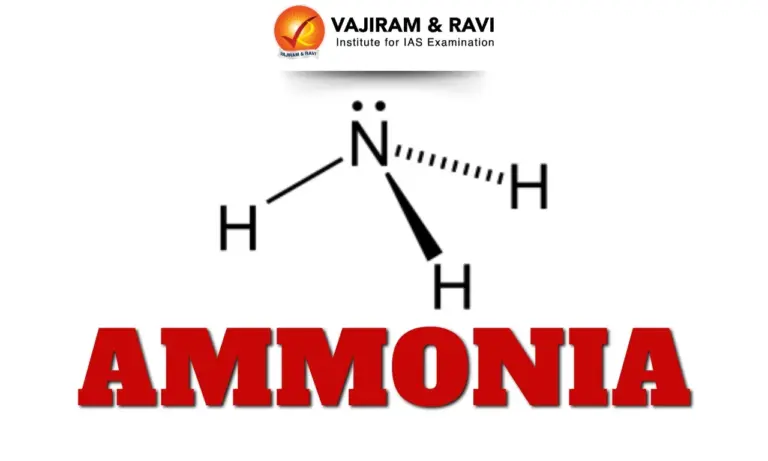
- It is a colorless, pungent gas composed of nitrogen and hydrogen with the formula NH3.
- It is the simplest stable compound of these elements and serves as a starting material for the production of many commercially important nitrogen compounds.
- It exists naturally in humans and in the environment.
- In the environment, ammonia is part of the nitrogen cycle and is produced in soil from bacterial processes.
- Ammonia is also produced naturally from decomposition of organic matter, including plants and animals.
- Industrial production: Manufactured mainly by the Haber–Bosch process (from nitrogen and hydrogen).
- Ammonia gas can be dissolved in water. This kind of ammonia is called liquid ammonia or aqueous ammonia. Once exposed to open air, liquid ammonia quickly turns into a gas.
- Uses:
- The major use of ammonia is as a fertilizer.
- Ammonia is a basic building block for ammonium nitrate fertilizer, which releases nitrogen, an essential nutrient for growing plants.
- About 90 percent of ammonia produced worldwide is used in fertilizer.
- Additional uses include as a refrigerant, stabilizer, neutralizer, and purifier — particularly in food transport and water treatment applications.
- It can also be used in the manufacture of plastics, explosives, fabrics, dyes, and pharmaceuticals.
- The major use of ammonia is as a fertilizer.
- Exposure to high levels of ammonia in air may be irritating to a person’s skin, eyes, throat, and lungs and cause coughing and burns.
- To prevent the release of toxic fumes, ammonia should not be mixed with other chemicals (especially chlorine bleach).
Source: HT






 Last updated on March, 2026
→ UPSC Final Result 2025 is now out.
→ UPSC has released UPSC Toppers List 2025 with the Civil Services final result on its official website.
→ Anuj Agnihotri secured AIR 1 in the UPSC Civil Services Examination 2025.
→ UPSC Marksheet 2025 is now out.
→ UPSC Notification 2026 & UPSC IFoS Notification 2026 is now out on the official website at upsconline.nic.in.
→ UPSC Calendar 2026 has been released.
→ Check out the latest UPSC Syllabus 2026 here.
→ UPSC Prelims 2026 will be conducted on 24th May, 2026 & UPSC Mains 2026 will be conducted on 21st August 2026.
→ The UPSC Selection Process is of 3 stages-Prelims, Mains and Interview.
→ Prepare effectively with Vajiram & Ravi’s UPSC Prelims Test Series 2026 featuring full-length mock tests, detailed solutions, and performance analysis.
→ Enroll in Vajiram & Ravi’s UPSC Mains Test Series 2026 for structured answer writing practice, expert evaluation, and exam-oriented feedback.
→ Join Vajiram & Ravi’s Best UPSC Mentorship Program for personalized guidance, strategy planning, and one-to-one support from experienced mentors.
→ Shakti Dubey secures AIR 1 in UPSC CSE Exam 2024.
→ Also check Best UPSC Coaching in India
Ammonia FAQs
Q1. What is ammonia?+
Q2. What is the chemical formula of ammonia?+
Q3. Does ammonia occur naturally in the human body and environment?+
Q4. How is ammonia produced naturally in the environment?+
Q5. Which industrial process is mainly used to manufacture ammonia?+
Tags: amonia prelims pointers upsc current affairs upsc prelims current affairs