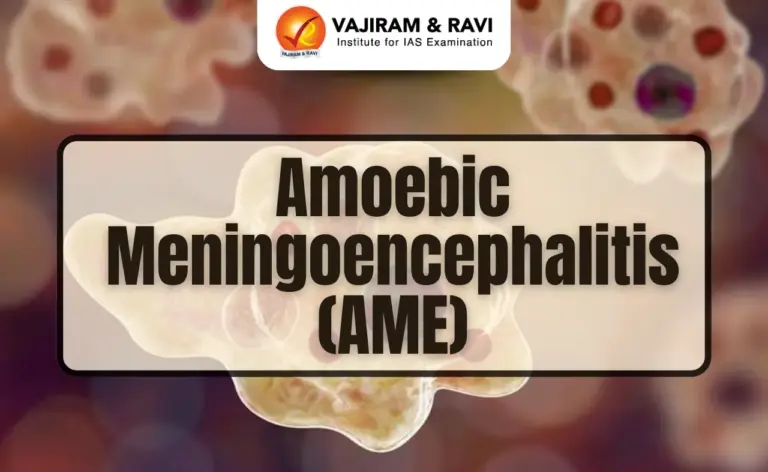
Amoebic Meningoencephalitis Latest News
The Kerala State Public Health Laboratory, one of the apex referral laboratories in Kerala, recently developed its own molecular diagnostic test kits to identify five common species of free-living amoeba (FLA) which are toxic to humans and which can cause amoebic meningoencephalitis.
About Amoebic Meningoencephalitis
- It is an infection of the brain and the membranes covering the brain (which are called the meninges).
- It is caused by free-living amoebae (a microscopic single-celled organism) found in water.
- This is a very rare, but serious disease with a mortality rate of more than 95%.
- It affects mainly young, active people.
- It is classified into two main types: Primary Amebic Meningoencephalitis (PAM) and Granulomatous Amebic Encephalitis (GAE).
- PAM is caused by Naegleria fowleri, while GAE is typically associated with Acanthamoeba species and Balamuthia mandrillaris.
- PAM tends to progress rapidly and is often fatal within a few days, whereas GAE develops more slowly but is equally deadly if not treated promptly.





Amoebic Meningoencephalitis Transmission
- The amoeba that causes the infection occurs in shallow surface waters and incorrectly maintained swimming pools, hot tubs, and spas, particularly in warm climates.
- Swimming in salt water has not been associated with this disease.
- Infection occurs when infected water enters the nose. This can happen when diving, jumping, or swimming in freshwater.
- The amoeba then invades the brain and meninges through the nose.
Amoebic Meningoencephalitis Symptoms
- sore throat
- headache and pain in the forehead
- hallucinations (sensory experiences that are created in the mind)
- confusion
- nausea and vomiting
- high fever
- neck stiffness and pain
- disturbances of taste and smell
- seizures (fits)
Amoebic Meningoencephalitis Treatment
Swift diagnosis and treatment with specific antibiotics may be useful, but recovery is rare.
Amoebic Meningoencephalitis FAQs
Q1. What is Amoebic Meningoencephalitis?
Ans. An infection of the brain and meninges caused by amoebae.
Q2. Which form of Amoebic Meningoencephalitis is caused by Naegleria fowleri?
Ans. Primary Amebic Meningoencephalitis (PAM)
Q3. What is the mortality rate for Amoebic Meningoencephalitis?
Ans. More than 95%.
Source: TH

 Last updated on March, 2026
→ UPSC Final Result 2025 is now out.
→ UPSC has released UPSC Toppers List 2025 with the Civil Services final result on its official website.
→ Anuj Agnihotri secured AIR 1 in the UPSC Civil Services Examination 2025.
→ UPSC Marksheet 2025 is now out.
→ UPSC Notification 2026 & UPSC IFoS Notification 2026 is now out on the official website at upsconline.nic.in.
→ UPSC Calendar 2026 has been released.
→ Check out the latest UPSC Syllabus 2026 here.
→ UPSC Prelims 2026 will be conducted on 24th May, 2026 & UPSC Mains 2026 will be conducted on 21st August 2026.
→ The UPSC Selection Process is of 3 stages-Prelims, Mains and Interview.
→ Prepare effectively with Vajiram & Ravi’s UPSC Prelims Test Series 2026 featuring full-length mock tests, detailed solutions, and performance analysis.
→ Enroll in Vajiram & Ravi’s UPSC Mains Test Series 2026 for structured answer writing practice, expert evaluation, and exam-oriented feedback.
→ Join Vajiram & Ravi’s Best UPSC Mentorship Program for personalized guidance, strategy planning, and one-to-one support from experienced mentors.
→ Shakti Dubey secures AIR 1 in UPSC CSE Exam 2024.
→ Also check Best UPSC Coaching in India
Tags: amoebic meningoencephalitis prelims pointers upsc current affairs upsc prelims current affairs