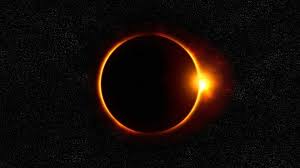
About Annular solar eclipse:
- It is often referred to as the “ring of fire.
- This eclipse happens when the moon is at or near its farthest point from Earth in its orbit.
- The moon appears smaller than the sun in the sky and does not fully cover it, creating a striking visual effect.
- The moon appears as a dark disk superimposed on the larger, bright face of the sun, forming a glowing ring or “ring of fire.”
- The path of this upcoming eclipse will span several countries in North, Central, and South America.
Types of eclipses
- Total solar eclipse: It happens when the sun, moon and Earth are in a direct line. The dark silhouette of the Moon completely covers the intense bright light of the Sun. Only the much fainter solar corona is visible during a total eclipse which is known as a Totality.
- Partial solar eclipse: It happens when the shadow of the moon appears on a small part of the sun.
Q1) What is Solar Eclipse?
A solar eclipse occurs when the Moon passes between the Earth and the Sun, obscuring all or part of the Sun from view.
Source: What is ‘ring of fire’ solar eclipse that is set to occur in October?


 Last updated on Oct, 2026
→ UPSC 2027 Notification will be released on 13 January 2027 at upsconline.nic.in.
→ Check Nobel Prize 2026 Winners List here.
→ Download PIB PRiSM Monthly Magazine 2026 here.
→ Check UPSC Monthly Current Affairs Magazine The Recitals here.
→ Check out the latest UPSC Syllabus here.
→ Download UPSC Model Answers for Mains 2026
→ UPSC Mains Question Paper 2026 is out now for Essay & GS Paper 1, 2, 3 & 4.
→ UPSC Calendar 2027 has been released.
→ Enroll in Vajiram & Ravi’s UPSC Mains Test Series 2027 for structured answer writing practice, expert evaluation, and exam-oriented feedback.
→ Join Vajiram & Ravi’s UPSC Mentorship Program 2027 for personalized guidance, strategy planning, and one-to-one support from experienced mentors.
→ Go through the UPSC Mains Previous Year Papers to enhance your preparation.
→ UPSC has released UPSC Toppers List 2025 with the Civil Services final result on its official website.
→ Also check Best UPSC Coaching in India