


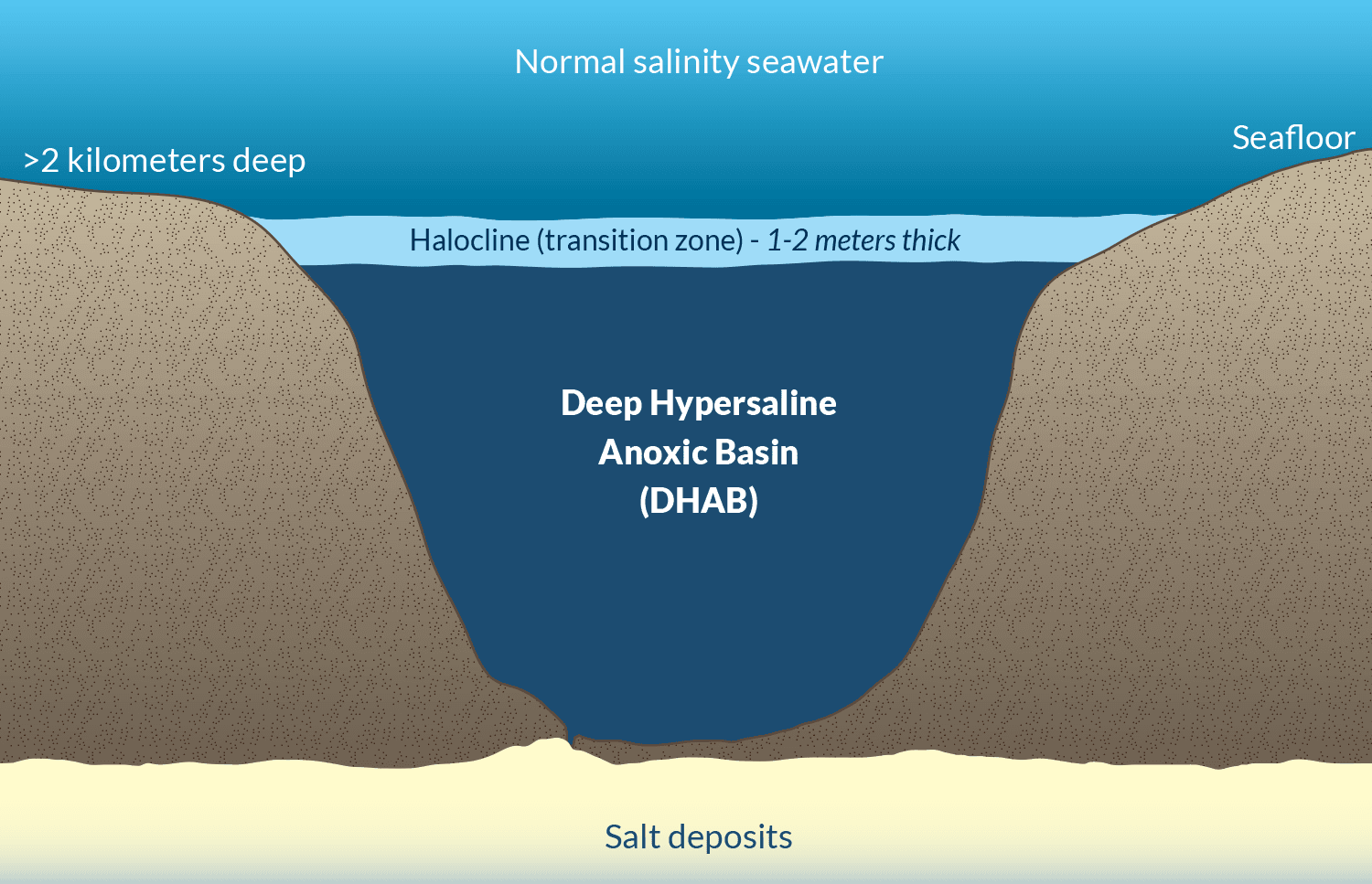
About Anoxic Marine Basins
- An anoxic basin is a body of water without oxygen.
- Permanent anoxic basins form when there is a strong layering of the water column created in a cup-like formation on the ocean floor.
- The layering is caused by density differences due to salt concentration or temperature.
- Once stratification occurs, circulation with the rest of the ocean is minimized, and microorganisms consume the oxygen in the water.
- In most anoxic basins, the water is extremely stagnant and can have mixing times of many thousand years.
- They range from a few hundred meters to several kilometers across and from 10 meters to 500 meters deeper than the surrounding seafloor.
- They can’t support animal life, and are populated primarily by microbes and some very specialized fungi with different metabolisms than creatures in oxygen-rich environments.
- Some of them rely on molecules such as nitrate for respiration, and some get their carbon from gases like carbon dioxide (CO2) and methane (CH4) instead of eating other organisms or particles of organic matter.
- Many anoxic basins also contain toxic chemicals, which are produced by geothermal activity or by microbes living in the basins.
- Some also contain salt domes, big mounds of hardened salt.
- In some anoxic basins, methane and other gases collect in reservoirs beneath the seafloor.
- The gases can percolate upward, pushing up domes of sediment on the seafloor that are called mud volcanoes.
- The gases can burst through the soft sediments, creating “mini-eruptions” of wispy columns of sediment-filled water.
Q1) What is carbon sequestration?
Carbon sequestration is the capturing, removal and storage of carbon dioxide (CO2) from the earth’s atmosphere. It’s recognised as a key method for removing carbon from the earth’s atmosphere and is one of the many approaches being taken to tackle climate change.
Source:Anoxic marine basins are among the best candidates for deep-sea carbon sequestration, say scientists


 Last updated on Oct, 2026
→ UPSC 2027 Notification will be released on 13 January 2027 at upsconline.nic.in.
→ Check Nobel Prize 2026 Winners List here.
→ Download PIB PRiSM Monthly Magazine 2026 here.
→ Check UPSC Monthly Current Affairs Magazine The Recitals here.
→ Check out the latest UPSC Syllabus here.
→ Download UPSC Model Answers for Mains 2026
→ UPSC Mains Question Paper 2026 is out now for Essay & GS Paper 1, 2, 3 & 4.
→ UPSC Calendar 2027 has been released.
→ Enroll in Vajiram & Ravi’s UPSC Mains Test Series 2027 for structured answer writing practice, expert evaluation, and exam-oriented feedback.
→ Join Vajiram & Ravi’s UPSC Mentorship Program 2027 for personalized guidance, strategy planning, and one-to-one support from experienced mentors.
→ Go through the UPSC Mains Previous Year Papers to enhance your preparation.
→ UPSC has released UPSC Toppers List 2025 with the Civil Services final result on its official website.
→ Also check Best UPSC Coaching in India








