What’s in Today’s Article?
- Why in News?
- Birsa Munda and his Contributions
- Who are the PVTGs?
- Initiatives Launched at the 3rd Janjatiya Gaurav Diwas
Why in News?
- The PM of India launched a Rs 24,000-crore project for vulnerable tribal groups on the birth anniversary of tribal icon Birsa Munda (‘Janjatiya Gaurav Diwas’ – Nov 15) from Jharkhand’s Khunti district.
- The PM Janjati Adivasi Nyaya Maha Abhiyan is meant to ensure last-mile welfare scheme delivery and protection for Particularly Vulnerable Tribal Groups (PVTGs).





Birsa Munda and his Contributions
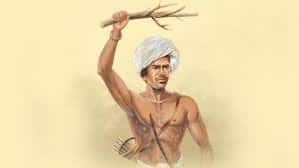
- Birsa Munda (15 Nov 1875 – 9 June 1900) was a freedom fighter and a tribal leader, whose spirit of activism in the late 19th century, is remembered to be a strong mark of protest against British rule in India.
- He belonged to the Munda tribe (of Chotanagpur plateau) and his revolt mainly concentrated in the Munda belt of Khunti, Tamar, Sarwada and Bandgaon of Jharkhand.
- Having gained awareness of the British colonial ruler and the efforts of the missionaries to convert tribals to Christianity, Birsa started the faith of ‘Birsait’.
- Soon members of the Munda and Oraon community started joining the Birsait sect and it turned into a challenge to British conversion activities.
- During the Ulgulan movement (1899), Munda encouraged the tribals to refuse following colonial laws and drive out foreigners using weapons and guerrilla warfare.
- He also aided societal reform by confronting religious superstition, earning him the titles ‘Bhagwan’ (God) and ‘Dharati Aba’ (Father of the Earth) from his followers.
- Thus, Birsa Munda is known to have mobilised the tribal community against the British and had also forced the colonial officials to introduce laws protecting the land rights of the tribals.
- In recognition of his impact on the national movement,
- Janjatiya Gaurav Divas is celebrated (since 2021) on November 15th.
- The state of Jharkhand was created on his birth anniversary in 2000.
Who are the PVTGs?
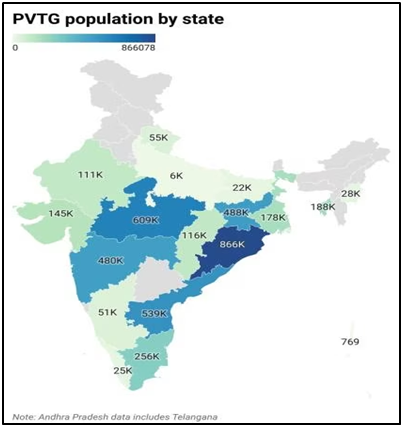
- According to the Ministry of Tribal Affairs (MoTA), India has 75 PVTGs, who are characterised by –
- Pre-agriculture level of technology,
- Stagnant or declining population,
- Extremely low literacy, and
- Subsistence level of economy.
- PVTGs were recognised as a separate category based on the findings of the 1961 Dhebar Commission.
- In 1975, there were 52 PVTGs and, by 1993, the list had been expanded to 75 out of 705 Scheduled Tribes (STs) across 18 states and Union Territories.
- Data from the MoTA and the 2011 Census shows that Odisha has the largest population of PVTGs at 8.66 lakh, followed by MP at 6.09 lakh and Andhra Pradesh (including Telangana) at 5.39 lakh.
- The total PVTG population is more than 40 lakh and the largest PVTG is Odisha’s Saura community, numbering 5.35 lakh.
Initiatives Launched at the 3rd Janjatiya Gaurav Diwas
- PM Janjati Adivasi Nyaya Maha Abhiyan (PM- JANMAN):
- The 24,000-crore rupee scheme aims to benefit and saturate the families and habitations with basic facilities.
- Under PM JANMAN, the government will reach out to tribal groups and primitive tribes most of whom still dwell in the forests.
- This will protect the tribes on the verge of extinction and nurture them.
- Visksit Bharat Sankalp Yatra: A nationwide programme to reach out to all villages and include those eligible for various central schemes.
- PM Kisan Scheme: PM also released Rs 18,000 crore as the 15th installment of PM Kisan scheme for over 8 crore farmers across the country.
Q1) What is the PM Kisan Scheme?
The PM Kisan Scheme is a central sector scheme launched on 24th February 2019 to supplement the financial needs of all land-holding farmers subject to certain exclusion criteria of higher income status.
Q2) What was the role of tribal uprising in the Indian freedom struggle?
Many tribal leaders and communities fought against British rule and their oppressive policies. These uprisings were often led by traditional tribal leaders whose privileges had been curtailed by colonialism.
Source: PM Modi launches Rs 24,000- crore scheme for vulnerable tribal groups | IE

 Last updated on March, 2026
→ UPSC Final Result 2025 is now out.
→ UPSC has released UPSC Toppers List 2025 with the Civil Services final result on its official website.
→ Anuj Agnihotri secured AIR 1 in the UPSC Civil Services Examination 2025.
→ UPSC Marksheet 2025 is now out.
→ UPSC Notification 2026 & UPSC IFoS Notification 2026 is now out on the official website at upsconline.nic.in.
→ UPSC Calendar 2026 has been released.
→ Check out the latest UPSC Syllabus 2026 here.
→ UPSC Prelims 2026 will be conducted on 24th May, 2026 & UPSC Mains 2026 will be conducted on 21st August 2026.
→ The UPSC Selection Process is of 3 stages-Prelims, Mains and Interview.
→ Prepare effectively with Vajiram & Ravi’s UPSC Prelims Test Series 2026 featuring full-length mock tests, detailed solutions, and performance analysis.
→ Enroll in Vajiram & Ravi’s UPSC Mains Test Series 2026 for structured answer writing practice, expert evaluation, and exam-oriented feedback.
→ Join Vajiram & Ravi’s Best UPSC Mentorship Program for personalized guidance, strategy planning, and one-to-one support from experienced mentors.
→ Shakti Dubey secures AIR 1 in UPSC CSE Exam 2024.
→ Also check Best UPSC Coaching in India