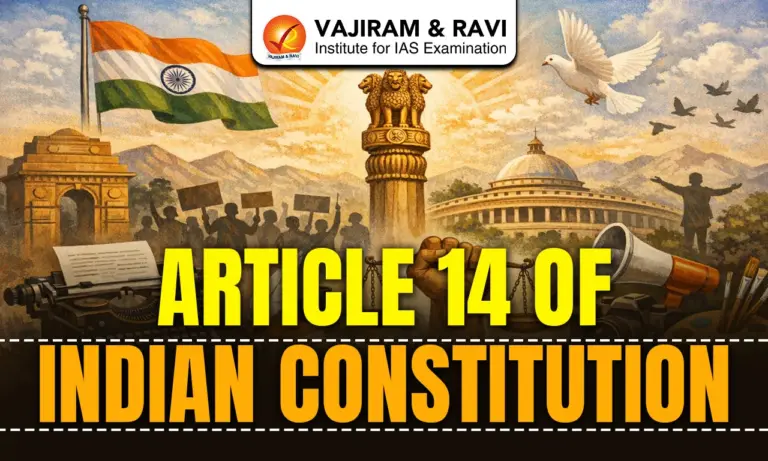
Article 14 of Indian Constitution guarantees the Right to Equality. It states that all people are equal before the law and must be treated equally by the State. This means no person is above the law, and everyone gets the same legal protection. However, Article 14 also allows the government to make reasonable classifications to treat different groups differently when there is a valid reason. The main aim of Article 14 is to ensure fairness, justice and non-discrimination in governance.
Article 14 of Indian Constitution
It states that the State shall not deny to any person equality before the law or the equal protection of the laws within the territory of India.
Equality Before the Law
- Equality Before the Law is a concept of British origin and is a negative concept, which means it mainly prevents special privileges. It says that the law must treat everyone equally and that similar cases should be treated in a similar manner.
- This principle means that no person is given special advantages because of birth, religion, status, or position. All individuals, whether rich or poor, powerful or ordinary, government official or common citizen, are equally subject to the ordinary law of the land.
- It also means that no one is above the law. Everyone must follow the same laws, and all are tried by the same ordinary courts. However, equality before law does not mean absolute equality, because complete equality among human beings is not practically possible. It simply ensures fairness and the absence of special privileges.





Rule of Law
- The idea of equality before law is part of the broader concept of Rule of Law, which was explained by A.V. Dicey in England. Rule of Law means that the law is supreme and everyone must follow it. It ensures that the government also acts according to law and does not misuse its power.
- Dicey gave three main elements of Rule of Law:
- Supremacy of Law (Absence of Arbitrary Power): This means that no person can be punished except for breaking a law. The government cannot act according to its own will or use power arbitrarily. Law is above everyone.
- Equality Before Law: This means all persons, rich or poor, powerful or ordinary, officials or common citizens, are equally subject to the ordinary law of the land and tried in ordinary courts.
- Primacy of Individual Rights: Dicey said that individual rights are protected by courts, and the Constitution is based on these rights.
- However, in the Indian system, only the first two elements fully apply. In India, the Constitution is the source of individual rights, not the result of court decisions.
- In Bachhan Singh v. State of Punjab, the Supreme Court stated that Rule of Law in India is based on three basic principles: law-making must be done by a democratically elected legislature; even the legislature cannot have unlimited power; and there must be an independent judiciary to protect citizens from misuse of power by the legislature and executive.
Equal Protection of the Laws
- Equal Protection of the Laws is a positive concept of equality taken from the American Constitution. It means that the State must treat people equally in similar situations.
- It ensures that people who are in the same circumstances are given the same rights and are subject to the same responsibilities. In simple words, equals should be treated equally, without discrimination. The same laws must apply in the same way to persons who are similarly placed.
- However, this does not mean that everyone must be treated exactly the same. If people are different in their situation, they can be treated differently. The Supreme Court has held that Article 14 does not apply when equals and unequals are treated differently.
- Article 14 does not allow class legislation (laws that unfairly favour a particular group), but it permits reasonable classification. This means the government can classify people, objects, or situations for valid reasons, as long as the classification is not arbitrary or unfair.
- This right is available to all persons, including citizens, foreigners, and even legal persons like companies.
Exceptions to Rule of Law and Equality
- Although Rule of Law and Article 14 of Indian Constitution guarantee equality before law, there are certain exceptions in the Indian system.
- First, equality before law does not mean that private citizens and public officials have the same powers. For example, a police officer has the legal power to arrest a person, but an ordinary citizen generally does not have this power.
- Second, the Rule of Law does not prevent some groups from being governed by special laws. For example, members of the armed forces are governed by military laws, and professionals like doctors and lawyers follow rules made by their respective professional bodies.
- Third, ministers and executive authorities are sometimes given discretionary powers by law. This means they can act according to their judgment within the limits of the law.
- Apart from these, the Constitution also provides certain specific exceptions to equality:
- Under Article 361, the President of India and the Governor enjoy certain immunities from court proceedings while in office.
- Under Article 361A, no person can be punished for publishing a true report of Parliamentary or State Legislature proceedings.
- Under Articles 105 and 194, Members of Parliament and State Legislatures enjoy certain privileges for what they say or do inside the House or its committees.
- Under Article 31C, laws made to implement certain Directive Principles (Article 39(b) and (c)) cannot be challenged on the ground that they violate Article 14.
- Foreign diplomats and sovereigns also enjoy diplomatic immunity from civil and criminal proceedings. Similarly, the United Nations and its agencies have diplomatic immunity.
Thus, while equality and Rule of Law are fundamental principles, the Constitution allows reasonable exceptions in special situations.
Doctrine of Anti-Arbitrariness
- The scope of Article 14 was greatly expanded by the Supreme Court through the doctrine of anti-arbitrariness. In the case of E.P. Royappa v. State of Tamil Nadu (1974), the Court held that Article 14 not only ensures equality before law but also protects people from arbitrary actions of the State.
- Arbitrariness means acting according to personal will or without proper reason. The Court said that equality and arbitrariness cannot exist together. If a government action is arbitrary, it violates Article 14.
Thus, Article 14 acts as a safeguard against misuse of power by the executive and ensures that all State actions must be fair, reasonable, and non-arbitrary.
Classification Test
In Ram Krishna Dalmia v. Justice Tendolkar (1958), the Supreme Court laid down the Classification Test under Article 14. It held that the State can make reasonable classification if it satisfies two conditions: first, the classification must be based on an intelligible differentia that clearly distinguishes those included from those excluded; and second, this differentia must have a rational nexus with the objective of the law. If these conditions are met, the law does not violate equality before law.
Doctrine of Legitimate Expectation
- The Doctrine of Legitimate Expectation means that a person can expect fair treatment from a public authority if there is a clear promise or a consistent past practice. This expectation must be reasonable, and it ensures that the government does not act arbitrarily.
- In Vishaka v. State of Rajasthan, the Supreme Court issued guidelines to prevent sexual harassment at the workplace, linking Articles 14, 19(1)(g), and 21 to the right to a safe working environment.
- In Javed v. State of Haryana, the Court upheld the two-child norm for Panchayat elections, stating that the classification was reasonable and did not violate Article 14.
Article 14 of Indian Constitution Case Laws
Over time, the Supreme Court has greatly expanded the scope of Article 14 of the Indian Constitution, making it one of the most powerful guarantees of equality in the Constitution.
- State of U.P. v. Deoman Upadhyaya (1960): Justice Subba Rao stated that Article 14 has both negative and positive aspects. It includes equality before law and equal protection of laws.
- S.G. Jaisinghani v. Union of India (1967): The Court held that absence of arbitrary power is essential to the Rule of Law. Executive discretion must have clear limits, otherwise it violates Article 14.
- Maneka Gandhi v. Union of India (1978): The Supreme Court held that Articles 14, 19, and 21 are interconnected. Any law affecting personal liberty must be fair, reasonable, and non-arbitrary. This greatly expanded the scope of Article 14.
- A.K. Kraipak v. Union of India (1969): The Court held that principles of Natural Justice, such as the rule against bias and the right to fair hearing, are part of Article 14. This ensured fairness in administrative actions.
- Indra Sawhney v. Union of India (1993): The Court upheld reservations for backward classes and held that Article 16 is a part of Article 14. It said reasonable classification, including reservation, is allowed to achieve equality.
- Vishaka v. State of Rajasthan (1997): The Court held that sexual harassment at the workplace violates Articles 14, 19, and 21. It laid down guidelines to protect working women until a law was made.
- NALSA v. Union of India (2014): The Court recognized transgender persons as a “third gender” and held that Article 14 applies to all persons, including transgender individuals.
- Shayara Bano v. Union of India (2017): The Supreme Court declared instant triple talaq unconstitutional, stating that it violates gender equality under Article 14.
Geographical Application of Law under Article 14 of Indian Constitution
- The words “within the territory” in Article 14 of Indian Constitution do not mean that the same law must apply uniformly across the whole country. Different laws can apply to different States or even to different regions within a State, if there are valid reasons based on local conditions.
- In Krishna Singh v. State of Rajasthan, the Supreme Court upheld the Marwar Land Revenue Act, 1949, which applied only to the Marwar region of Rajasthan. The Court held that it did not violate Article 14 because special local conditions justified a separate law for that area.

 Last updated on April, 2026
→ UPSC Final Result 2025 is now out.
→ UPSC has released UPSC Toppers List 2025 with the Civil Services final result on its official website.
→ Anuj Agnihotri secured AIR 1 in the UPSC Civil Services Examination 2025.
→ UPSC Marksheet 2025 is now out.
→ UPSC Notification 2026 & UPSC IFoS Notification 2026 is now out on the official website at upsconline.nic.in.
→ UPSC Calendar 2026 has been released.
→ Check out the latest UPSC Syllabus 2026 here.
→ UPSC Prelims 2026 will be conducted on 24th May, 2026 & UPSC Mains 2026 will be conducted on 21st August 2026.
→ The UPSC Selection Process is of 3 stages-Prelims, Mains and Interview.
→ Prepare effectively with Vajiram & Ravi’s UPSC Prelims Test Series 2026 featuring full-length mock tests, detailed solutions, and performance analysis.
→ Enroll in Vajiram & Ravi’s UPSC Mains Test Series 2026 for structured answer writing practice, expert evaluation, and exam-oriented feedback.
→ Join Vajiram & Ravi’s Best UPSC Mentorship Program for personalized guidance, strategy planning, and one-to-one support from experienced mentors.
→ Shakti Dubey secures AIR 1 in UPSC CSE Exam 2024.
→ Also check Best UPSC Coaching in India
Article 14 of Indian Constitution FAQs
Q1. What does Article 14 of Indian Constitution state?+
Q2. What is Equality before Law?+
Q3. What is Equal Protection of Laws?+
Q4. What is the Classification Test?+
Q5. What is the Doctrine of Anti-Arbitrariness?+
Tags: Article 14 of Indian Constitution polity polity notes