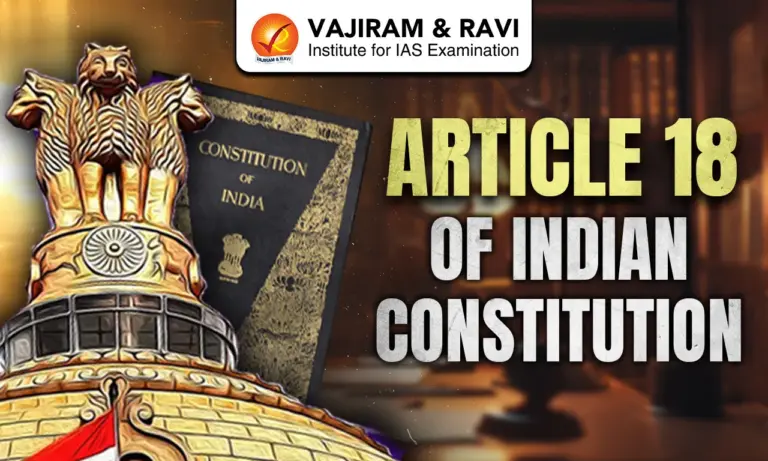
Article 18 of the Constitution of India abolishes titles and reflects the country’s strong commitment to equality and democratic values. After independence, India rejected the colonial system of hereditary and honorific titles like Zamindar, Rai Bahadur, Lambardar, etc. that created artificial social hierarchies. The provision ensures that status in India is based on merit and service, not on titles granted by the State or foreign powers.
Article 18 of Indian Constitution
Article 18 forms part of Part III of the Constitution under Fundamental Rights. It eliminates the practice of granting titles that could disturb Equality Before Law guaranteed under Article 14. The provision contains four clauses dealing with the conferment and acceptance of titles, foreign honours, presents and emoluments. While prohibiting titles, it clearly protects military and academic distinctions. The Article 18 of Indian Constitution applies to citizens, non-citizens holding public office and all persons serving in offices of profit or trust under the State.
Provisions of Article 18 of Indian Constitution
Article 18 of Indian Constitution contains four distinct clauses that regulate titles and foreign recognitions.
- Article 18 (1): The State cannot grant any title except military or academic distinctions. This restriction applies to both Union and State Governments and prohibits civil titles that create social hierarchy or privileged classes.
- Article 18 (2): Indian citizens are completely barred from accepting titles from foreign States. This prevents divided loyalty and ensures that citizenship remains free from external influence or symbolic allegiance.
- Article 18 (3): Non-citizens holding an office of profit or trust under the State cannot accept foreign titles without prior approval of the President of India, ensuring executive oversight.
- Article 18 (4): Any person holding an office of profit or trust under the State must obtain Presidential consent before accepting any present, emolument, or office from a foreign State.




What are “Titles”?
Honorific titles are special designations granted to individuals to mark status, loyalty, service, or social position rather than academic or military merit. During colonial and feudal periods, titles such as Sir, Maharaj, Rai Bahadur, Khan Bahadur, Zamindar, Taluqdar, Lambardar, Seth, Sawai, Patil, Menon, etc. were used to indicate privilege, authority or administrative recognition that eventually promoted social distinctions.
Article 18 of Indian Constitution Case Laws
Judicial interpretation clarified the scope of “titles” under Article 18 of Indian Constitution.
- Balaji Raghavan v. Union of India: The Supreme Court held that Bharat Ratna, Padma Vibhushan, Padma Bhushan and Padma Shri are not “titles” if not used as prefixes or suffixes and if they confer no hereditary privilege. The Court directed that national awards must not be misused as titles. If used improperly as honorific prefixes, the award could be forfeited to maintain constitutional discipline.
- Indira Jaising v. Supreme Court of India: The Court ruled that designation of Senior Advocate is a professional distinction based on merit and not a prohibited title under Article 18. Judicial reasoning emphasized that recognition of excellence without hereditary benefit or legal privilege does not violate equality or the abolition of titles.
Article 18 of Indian Constitution Exceptions
Article 18 of Indian Constitution allows limited exceptions consistent with equality principles.
- Military Distinctions: Gallantry awards such as Param Vir Chakra, Maha Vir Chakra and Ashoka Chakra are valid because they recognize bravery and national service, not social superiority.
- Academic Distinctions: University degrees including doctorates and honorary academic recognitions are permitted as they reward scholarly achievement and intellectual contribution.
- Presidential Consent for Foreign Titles: Non-citizens serving in offices of profit or trust may accept foreign titles only after obtaining approval from the President of India.
- Acceptance of Foreign Presents: Public office holders may receive foreign gifts or emoluments strictly with Presidential sanction, ensuring transparency and preventing conflict of interest.
- National Awards: Civilian decorations instituted in 1954, including Bharat Ratna and Padma awards, are valid because they are non-hereditary and do not grant legal status or privilege.
- Non-Justiciable Character: Dr. B.R. Ambedkar explained that non-acceptance of titles operates as a condition of citizenship rather than a claimable individual right, emphasizing duty over privilege.
Article 18 of Indian Constitution International Comparison
Different constitutional systems address “titles” under Article 18 of Indian Constitution in varied ways.
- Britain: The United Kingdom continues hereditary and life peerages, knighthoods and honorific titles, reflecting a monarchical tradition unlike India’s republican equality model.
- United States: The U.S. Constitution under Article I, Section 9 prohibits the federal government from granting titles of nobility and restricts office holders from accepting foreign gifts without Congressional consent.
- France: France abolished feudal titles after the French Revolution, emphasizing égalité, similar to India’s rejection of aristocratic distinctions in 1950.

 Last updated on April, 2026
→ UPSC Final Result 2025 is now out.
→ UPSC has released UPSC Toppers List 2025 with the Civil Services final result on its official website.
→ Anuj Agnihotri secured AIR 1 in the UPSC Civil Services Examination 2025.
→ UPSC Marksheet 2025 is now out.
→ UPSC Notification 2026 & UPSC IFoS Notification 2026 is now out on the official website at upsconline.nic.in.
→ UPSC Calendar 2026 has been released.
→ Check out the latest UPSC Syllabus 2026 here.
→ UPSC Prelims 2026 will be conducted on 24th May, 2026 & UPSC Mains 2026 will be conducted on 21st August 2026.
→ The UPSC Selection Process is of 3 stages-Prelims, Mains and Interview.
→ Prepare effectively with Vajiram & Ravi’s UPSC Prelims Test Series 2026 featuring full-length mock tests, detailed solutions, and performance analysis.
→ Enroll in Vajiram & Ravi’s UPSC Mains Test Series 2026 for structured answer writing practice, expert evaluation, and exam-oriented feedback.
→ Join Vajiram & Ravi’s Best UPSC Mentorship Program for personalized guidance, strategy planning, and one-to-one support from experienced mentors.
→ Shakti Dubey secures AIR 1 in UPSC CSE Exam 2024.
→ Also check Best UPSC Coaching in India
Article 18 of Indian Constitution FAQs
Q1. What does Article 18 of the Indian Constitution prohibit?+
Q2. Are military and academic awards allowed under Article 18?+
Q3. Can an Indian citizen accept a foreign honour under Article 18 of Indian Constitution?+
Q4. Do national awards like Bharat Ratna violate Article 18 of Indian Constitution?+
Q5. Is Presidential consent required in certain cases under Article 18 of Indian Constitution?+
Tags: article 18 of indian constitution constitution