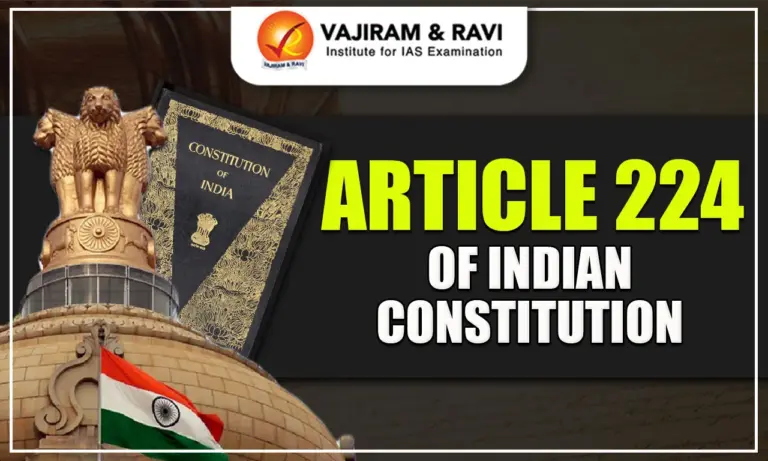
Article 224 of the Constitution of India deals with the temporary appointment of additional and acting judges by the President of India for not more than 2 years in the High Court in order to help with the high workload and manage pending cases. In this article, we are going to cover all about Article 224, its interpretation and its significance.
Article 224 of the Constitution of India
The Constitution of India states the following about Article 224:
Appointment of additional and acting Judges
- If by reason of any temporary increase in the business of High Court or by reason of arrears of work therein, it appears to the President that the number of the Judges of that Court should be for the time being increased,the President may, in consultation with the National Judicial Appointments Commission, appoint duly qualified persons to be additional Judges of the Court for such period not exceeding two years as he may specify .
- When any Judge of a High Court other than the Chief Justice is by reason of absence or for any other reason unable to perform the duties of his office or is appointed to act temporarily as Chief Justice, the President may, in consultation with the National Judicial Appointments Commission, appoint a duly qualified person to act as a Judge of that Court until the permanent Judge has resumed his duties.
- No person appointed as an additional or acting Judge of a High Court shall hold office after attaining the age of sixty-two years.
Note: “The information above has been sourced from the official website, i.e., Indian Code. While the content has been presented here for reference, no modifications have been made to the original laws and orders.”
Article 224 of the Constitution of India Interpretation
Article 224 of the Constitution of India talks about appointing a temporary High Court Judge by the President of India after consulting with the Chief Justice of India. This is done in order to downsize the workload of the pending cases. These temporary judges appointments are only for some time and cannot be exceeded for more than 2 years. The goal of introducing article 224 is to help the judiciary in delivering justice on time.





Article 224 of Indian Constitution Landmark Cases
Article 224 of the Indian Constitution, provides for the appointment of temporary or additional judges in High Courts to manage rising caseloads, has been discussed in several landmark judgments:
- S.P. Gupta v. Union of India (1981) – Known as the “Judges Transfer Case,” it emphasized judicial independence and addressed the appointment and transfer of judges, indirectly reflecting the intent behind Article 224 regarding fair and transparent judicial appointments.
- All India Judges Association v. Union of India (1992) – This case focused on improving the service conditions of judges and enhancing judicial efficiency. It relates to Article 224 as it highlights the need for timely justice, which the Article supports by permitting temporary judge appointments to handle heavy case backlogs.
- Supreme Court Advocates-on-Record Association v. Union of India (1993) – This judgment introduced the Collegium System for judicial appointments, reinforcing the importance of autonomy in the judiciary. While primarily about appointment mechanisms, it aligns with the objectives of Article 224 concerning temporary judicial postings.
Article 224 of Constitution of India Importance
Article 224 of the Constitution of India is important due to the following reasons:
- The High Court gets overloaded with cases and hence in order to help sort them, the President of India appoints temporary judges for not more than 2 years in order to assist in delivering justice on time.
- This helps in managing the large number of cases efficiently while balancing and maintaining proper legal standards.
- The swift handling of cases helps in ensuring that people continue to have trust in fair and quick decision making.

 Last updated on March, 2026
→ UPSC Final Result 2025 is now out.
→ UPSC has released UPSC Toppers List 2025 with the Civil Services final result on its official website.
→ Anuj Agnihotri secured AIR 1 in the UPSC Civil Services Examination 2025.
→ UPSC Marksheet 2025 is now out.
→ UPSC Notification 2026 & UPSC IFoS Notification 2026 is now out on the official website at upsconline.nic.in.
→ UPSC Calendar 2026 has been released.
→ Check out the latest UPSC Syllabus 2026 here.
→ UPSC Prelims 2026 will be conducted on 24th May, 2026 & UPSC Mains 2026 will be conducted on 21st August 2026.
→ The UPSC Selection Process is of 3 stages-Prelims, Mains and Interview.
→ Prepare effectively with Vajiram & Ravi’s UPSC Prelims Test Series 2026 featuring full-length mock tests, detailed solutions, and performance analysis.
→ Enroll in Vajiram & Ravi’s UPSC Mains Test Series 2026 for structured answer writing practice, expert evaluation, and exam-oriented feedback.
→ Join Vajiram & Ravi’s Best UPSC Mentorship Program for personalized guidance, strategy planning, and one-to-one support from experienced mentors.
→ Shakti Dubey secures AIR 1 in UPSC CSE Exam 2024.
→ Also check Best UPSC Coaching in India
Article 224 of Indian Constitution FAQs
Q1. What is Article 224 of the Constitution?+
Q2. What is Article 244 of the Indian Constitution?+
Q3. What is Article 224 and 224-A?+
Q4. Why are temporary judges appointed in the High Court?+
Q5. What is Article 225 of the Indian Constitution?+
Tags: article 224 of indian constitution