

What’s in Today’s Article?
- Why in News?
- What is Article 371A of the Indian Constitution?
- Significance of the Article 371A
- Rat-hole Mining in Nagaland and Challenges in its Regulation
Why in News?
- Article 371A of the Constitution of India has been the major hurdle in the Nagaland government’s efforts to regulate small-scale illegal coal mining activities in the State.
- The State government has been under pressure to regulate coal mining activities after six miners died in an explosion in a rat-hole mine in the Wokha district.




What is Article 371A of the Indian Constitution?
- When Nagaland (erstwhile Naga Hills and Tuensang Area) was given the status of a State by the Constitution (13th Amendment) Act 1962 in the Indian Union, Article 371A was inserted into Part XXI of the Constitution.
- Article 371A allows Special Constitutional Provisions to the State and thus reads:
- Notwithstanding anything in this Constitution, no Act of Parliament in respect of
- Religious or social practices of the Nagas,
- Naga customary law and procedure,
- Administration of civil and criminal justice involving decisions according to Naga customary law,
- Ownership and transfer of land and its resources,
- Shall apply to the State of Nagaland unless the Legislative Assembly of Nagaland by a resolution so decides.
- Notwithstanding anything in this Constitution, no Act of Parliament in respect of
Significance of the Article 371A
- The Constitution of India is a Federation with a strong unitary bias towards the Centre.
- However, to accommodate the large diversity of the country, its federalism is asymmetrical, and Article 371A is an example of such asymmetry.
- The Article is not only a Constitutional right and legal mechanism but also resonates with a political process – a political barometer that represents the will of the people.
- The Article is seen as one of the recourses that safeguard the collective rights of the Nagas.
- However, there were concerns that Article 371(A) impedes the State’s development.
- Article 371(A) states that land and its resources in the State belong to the people and not the government.
- Due to this provision, the landowners usually do not allow the government to carry out any development activities on their plot.
Rat-hole Mining in Nagaland and Challenges in its Regulation
- Data from Nagaland’s Geology and Mining Department say the State has 492.68 million tonnes of coal reserves but dispersed erratically and inconsistently in small pockets spread over a large area.
- Nagaland’s coal mining policy, first notified in 2006, allows rat-hole mining as the coal deposits are too scattered for large-scale and coordinated operations.
- Small Pocket Deposit Licence may be granted only to individual landowners for undertaking rat-hole mining and shall not be granted to any company.
- However, rat-hole mining can be undertaken only with the consent of the departments concerned, including that of Forest and Environment.
- Officials claimed the State government awarded several rat-hole mining leases with proper forest and environment clearances and definite mining plans.
- This has not stopped people from operating such mines illegally.
- The unique land rights conferred under Article 371A have made regulating illegal coal mining activities more challenging.
- Therefore, residents in coal-bearing areas depend on illegal mining for sustenance and they need to be educated on the adverse effects of such activities.
Q1) What is rat-hole mining?
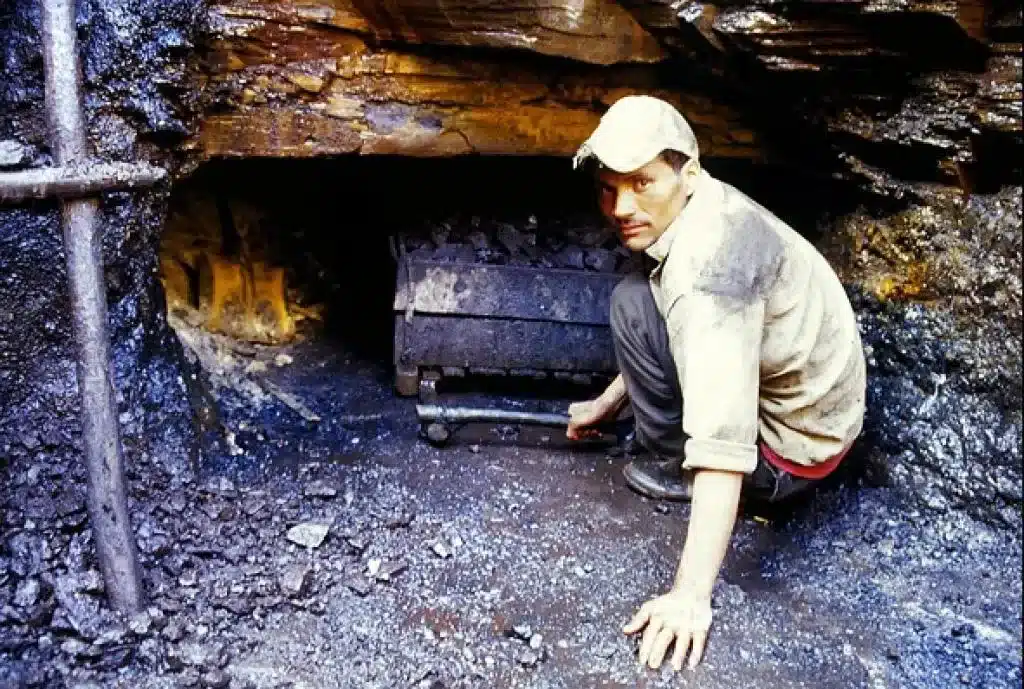
Rat-hole mining is a hazardous way of extracting coal by creating small tunnels just large enough for a person to crawl through. The National Green Tribunal (NGT) banned the practice of rat-hole mining in India in 2014.
Q2) What is Part XXI of the Indian Constitution?
Part XXI of the Constitution is an amalgamation of various articles with temporary, transitional, and special provisions for India’s 12 states. In this, several amendments have been included from Article 371 A to J.
Source: Coal mining regulations hit Article 371A wall in Nagaland | MorungExpress
Last updated on February, 2026
→ UPSC Notification 2026 is now out on the official website at upsconline.nic.in.
→ UPSC IFoS Notification 2026 is now out on the official website at upsconline.nic.in.
→ UPSC Calendar 2026 has been released.
→ UPSC Final Result 2025 is expected to be released in the second week of April 2026.
→ Check out the latest UPSC Syllabus 2026 here.
→ Join Vajiram & Ravi’s Interview Guidance Programme for expert help to crack your final UPSC stage.
→ UPSC Mains Result 2025 is now out.
→ UPSC Prelims 2026 will be conducted on 24th May, 2026 & UPSC Mains 2026 will be conducted on 21st August 2026.
→ The UPSC Selection Process is of 3 stages-Prelims, Mains and Interview.
→ Prepare effectively with Vajiram & Ravi’s UPSC Prelims Test Series 2026 featuring full-length mock tests, detailed solutions, and performance analysis.
→ Enroll in Vajiram & Ravi’s UPSC Mains Test Series 2026 for structured answer writing practice, expert evaluation, and exam-oriented feedback.
→ Join Vajiram & Ravi’s Best UPSC Mentorship Program for personalized guidance, strategy planning, and one-to-one support from experienced mentors.
→ Check UPSC Marksheet 2024 Here.
→ UPSC Toppers List 2024 is released now. Shakti Dubey is UPSC AIR 1 2024 Topper.
→ Also check Best UPSC Coaching in India