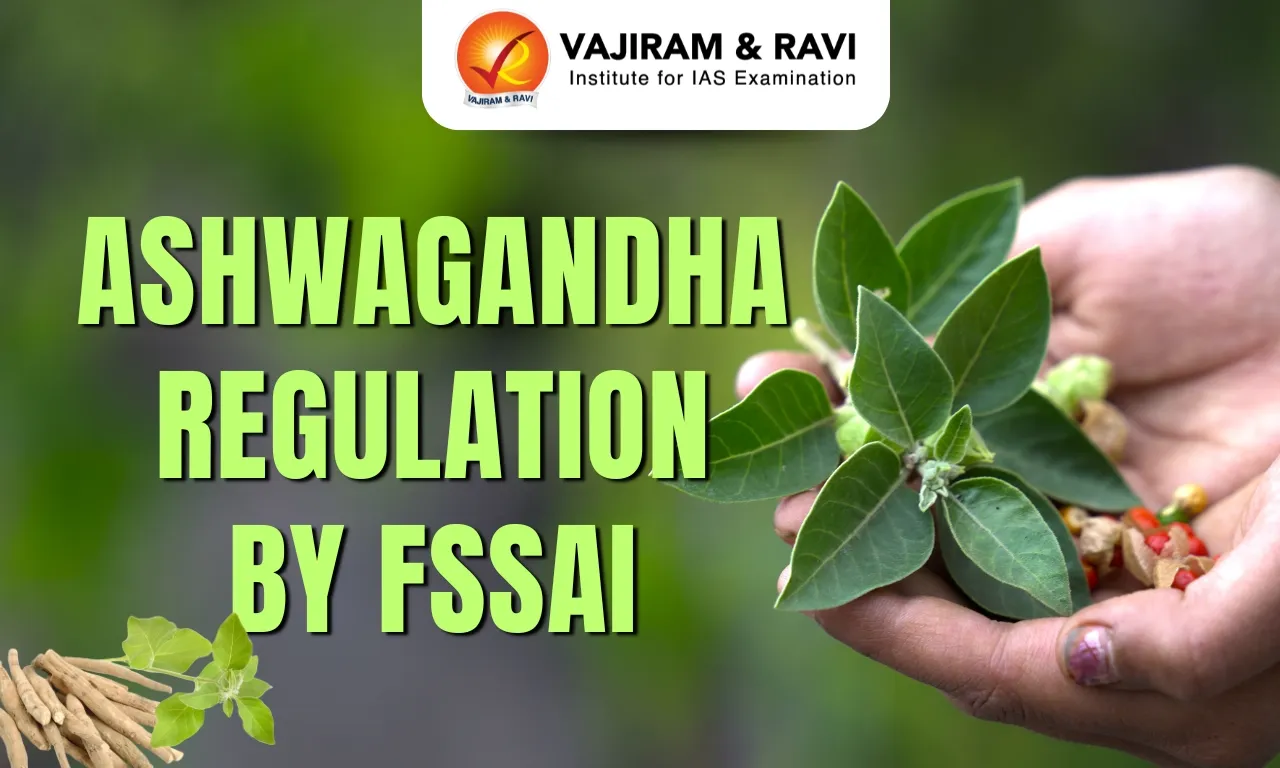
The Food Safety and Standards Authority of India issued an advisory stating that Ashwagandha leaves cannot be used in food products or supplements in any form.
FSSAI Advisory on Ashwagandha
The Food Safety and Standards Authority of India issued an advisory to clarify the permitted use of Ashwagandha in food products and supplements.
- Under the Food Safety and Standards (Health Supplements and Nutraceuticals) Regulations 2016, there is a fixed list of approved plants and their specific parts that can be used in such products.
- According to this list (Schedule IV), only the root of Ashwagandha (Withania somnifera) and its extracts are allowed, and even these must be used within prescribed safety limits.
- The authority observed that some manufacturers were using Ashwagandha leaves and leaf extracts in their products, which is not permitted under the rules.
- Therefore, the advisory clearly states that Ashwagandha leaves cannot be used in any form, whether raw, powdered, or as an extract, in food products or health supplements.
- It directs all Food Business Operators (FBOs) to strictly follow these regulations and stop using unapproved parts of the plant.
- It also warns that any violation will lead to legal action under the Food Safety and Standards Act, 2006.
- Overall, the advisory aims to ensure consumer safety, standardisation, and proper regulation of herbal ingredients in the food and nutraceutical sector.
About Ashwagandha
Ashwagandha (Withania somnifera), also known as Indian ginseng or winter cherry, is a well-known medicinal plant in Ayurveda.
- The term “Ashwagandha” comes from “ashwa” (horse) and “gandha” (smell), indicating strength and the root’s distinct aroma.
- Traditionally classified as a “rasayana” herb, it is believed to promote longevity, improve immunity, and strengthen the nervous system.
- It is widely used for its adaptogenic properties, helping the body cope with stress and restore balance.


Scientific Evidence on Ashwagandha Leaves
Emerging studies suggest that Ashwagandha leaves possess bioactive properties, but their use remains under scientific evaluation.
- Research indicates that leaf extracts contain compounds such as Withaferin D, which may show anti-cancer properties by targeting tumour cells.
- Studies also highlight potential neuroprotective, anti-inflammatory, antimicrobial, cardioprotective, and anti-diabetic effects.
- However, these findings are largely experimental and not yet fully translated into approved food safety standards.

 Last updated on Oct, 2026
→ UPSC 2027 Notification will be released on 13 January 2027 at upsconline.nic.in.
→ Check Nobel Prize 2026 Winners List here.
→ Download PIB PRiSM Monthly Magazine 2026 here.
→ Check UPSC Monthly Current Affairs Magazine The Recitals here.
→ Check out the latest UPSC Syllabus here.
→ Download UPSC Model Answers for Mains 2026
→ UPSC Mains Question Paper 2026 is out now for Essay & GS Paper 1, 2, 3 & 4.
→ UPSC Calendar 2027 has been released.
→ Enroll in Vajiram & Ravi’s UPSC Mains Test Series 2027 for structured answer writing practice, expert evaluation, and exam-oriented feedback.
→ Join Vajiram & Ravi’s UPSC Mentorship Program 2027 for personalized guidance, strategy planning, and one-to-one support from experienced mentors.
→ Go through the UPSC Mains Previous Year Papers to enhance your preparation.
→ UPSC has released UPSC Toppers List 2025 with the Civil Services final result on its official website.
→ Also check Best UPSC Coaching in India
Ashwagandha Regulation by FSSAI FAQs
Q1. What is Ashwagandha?+
Q2. Why has the Food Safety and Standards Authority of India restricted the use of Ashwagandha leaves?+
Q3. Which part of Ashwagandha is permitted in food products and supplements?+
Q4. What happens if manufacturers continue using Ashwagandha leaves?+
Q5. What is the main aim of this regulation?+
Tags: ashwagandha regulation by fssai