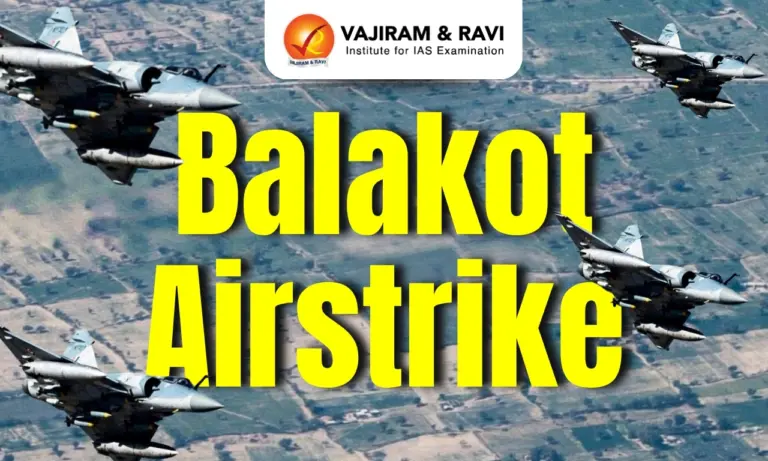
The Balakot Airstrike was a precision air operation conducted by the Indian Air Force on 26 February 2019 against a Jaish-e-Mohammed training camp at Balakot in Pakistan’s Khyber Pakhtunkhwa province in response to the Pulwama terror attack. It was the first Indian airstrike inside mainland Pakistan since the 1971 war.
Balakot Strike Background: The Pulwama Attack
On February 14, 2019, a convoy of Central Reserve Police Force (CRPF) vehicles was targeted by a suicide bomber on the Jammu-Srinagar National Highway near Pulwama, Jammu & Kashmir. The attack killed 40 CRPF personnel, making it one of the deadliest terrorist strikes on Indian security forces in decades.
The Pakistan-based terrorist organisation Jaish-e-Mohammed (JeM), led by Masood Azhar, claimed responsibility for the attack. The attacker, Adil Ahmad Dar, was a local recruit who had been radicalised and trained under JeM’s operational network operating from Pakistani soil. India’s immediate response included:
- Withdrawal of Most Favoured Nation (MFN) status granted to Pakistan under WTO framework.
- Imposition of 200% customs duty on Pakistani imports.
- Intense diplomatic outreach to isolate Pakistan internationally and build a coalition against state-sponsored terrorism.
- Demands for Pakistan to dismantle terrorist infrastructure operating on its territory.
Pakistan denied any state involvement in the Pulwama attack, a position that India and much of the international community found unconvincing given the established infrastructure of JeM on Pakistani soil.
About the Balakot Airstrike
In the early hours of February 26, 2019, the Indian Air Force (IAF) conducted a precision airstrike deep inside Pakistani territory, targeting a Jaish-e-Mohammed training camp in Balakot, located in the Khyber Pakhtunkhwa (KPK) province of Pakistan — well beyond the Line of Control (LoC). India justified the strike under Article 51 of the UN Charter, which recognises the right to self-defence in case of an armed attack.
Key Operational Facts:
- Date of strike: 26 February 2019
- Conducting force: Indian Air Force
- Aircraft used: Mirage 2000 fighter jets
- Weapons used: SPICE-2000 precision-guided munitions
- Target: Jaish-e-Mohammed training camp at Balakot
- Location: Khyber Pakhtunkhwa province, Pakistan
- Duration: Approximately 20–21 minutes operation window
Strategic Significance of Location: The choice of Balakot was deliberately significant.
- Unlike the 2016 Surgical Strikes, which targeted terror launch pads across the Line of Control in Pakistan-Occupied Kashmir (PoK), the Balakot strike penetrated internationally recognised Pakistani territory in Khyber Pakhtunkhwa.
- This was the first Indian Air Force strike inside Pakistan proper since the 1971 war, marking a qualitative escalation in India’s response threshold.
- India’s Foreign Secretary Vijay Gokhale described the strike as a “non-military pre-emptive action” — a carefully calibrated phrase designed to signal decisive intent while avoiding the language of conventional warfare, thereby limiting escalation pressure.


Pakistan’s Response to Balakot Strike
- Pakistan denied India’s claim that the Balakot airstrike caused significant damage or casualties and stated that the strike violated its airspace.
- On 27 February 2019, Pakistan carried out retaliatory air action under Operation Swift Retort, targeting Indian military positions across the Line of Control (LoC) in Jammu & Kashmir.
- This led to an aerial engagement between the Indian and Pakistani Air Forces.
- During the encounter, an Indian MiG-21 Bison was shot down and Wing Commander Abhinandan Varthaman ejected and landed in Pakistani territory.
- Pakistan claimed additional Indian aircraft were downed, which India denied.
- The episode marked a sharp escalation in India–Pakistan tensions, which was later de-escalated after Pakistan released Wing Commander Abhinandan on 1 March 2019.
International Reactions after Balakot Strike
India framed the Balakot strike as a counter-terrorism operation, not an act of war against the Pakistani state. This framing was strategically important — it sought international legitimacy under the right of self-defence while avoiding the legal and political complications of declaring a war footing.
India briefed all major powers — the United States, Russia, China, France, the United Kingdom, and Gulf states — within hours of the strike, demonstrating diplomatic preparedness alongside military action.
- United States: Called for restraint from both sides while privately acknowledging India’s right to self-defence.
- China: Urged de-escalation, reflecting its strategic partnership with Pakistan while avoiding open condemnation of India.
- Gulf States (UAE, Saudi Arabia): Played an active mediatory role, engaging both Islamabad and New Delhi to prevent further escalation.
- UNSC: No formal resolution was passed; the incident was discussed informally, with no consensus condemnation of India.
Balakot Strike Significance
The Balakot Airstrike represents the most significant shift in India’s counter-terrorism doctrine since independence. It reflected a transition from strategic restraint to proactive and calibrated military deterrence against cross-border terrorism.
- For decades after major terrorist attacks such as the 2001 Parliament attack and the 2008 Mumbai attacks, India largely relied on diplomatic and political responses. Military retaliation across the international boundary was avoided due to concerns related to nuclear escalation, international pressure, and regional stability.
- A shift began after the Uri attack in 2016, when India conducted surgical strikes across the Line of Control targeting terrorist launch pads in Pakistan-occupied Kashmir.
- The Balakot Airstrike in 2019 marked a further escalation in India’s response doctrine. By targeting a terror camp inside mainland Pakistan, India demonstrated its willingness to use air power beyond the LoC in response to major terrorist attacks, despite the risks of conventional escalation.
- The doctrinal evolution further continued with Operation Sindoor in 2025, which involved coordinated multi-domain precision strikes on terrorist infrastructure across Pakistan and Pakistan-occupied Kashmir following the Pahalgam terror attack.
- The Balakot strike also challenged the assumption that Pakistan’s nuclear capability would prevent India from undertaking military action across the international boundary.
- At the strategic level, the operation demonstrated India’s growing precision-strike capability, improved intelligence coordination, and integration of military and diplomatic responses in counter-terror operations.

 Last updated on Oct, 2026
→ UPSC 2027 Notification will be released on 13 January 2027 at upsconline.nic.in.
→ Check Nobel Prize 2026 Winners List here.
→ Download PIB PRiSM Monthly Magazine 2026 here.
→ Check UPSC Monthly Current Affairs Magazine The Recitals here.
→ Check out the latest UPSC Syllabus here.
→ Download UPSC Model Answers for Mains 2026
→ UPSC Mains Question Paper 2026 is out now for Essay & GS Paper 1, 2, 3 & 4.
→ UPSC Calendar 2027 has been released.
→ Enroll in Vajiram & Ravi’s UPSC Mains Test Series 2027 for structured answer writing practice, expert evaluation, and exam-oriented feedback.
→ Join Vajiram & Ravi’s UPSC Mentorship Program 2027 for personalized guidance, strategy planning, and one-to-one support from experienced mentors.
→ Go through the UPSC Mains Previous Year Papers to enhance your preparation.
→ UPSC has released UPSC Toppers List 2025 with the Civil Services final result on its official website.
→ Also check Best UPSC Coaching in India
Balakot Strike FAQs
Q1. What was the Balakot Airstrike?+
Q2. Why was the Balakot strike strategically significant?+
Q3. Under which legal principle did India justify the strike?+
Q4. What was Operation Swift Retort?+
Q5. How did the Balakot strike change India’s counter-terrorism doctrine?+
Tags: balakot airstrike defence defence security