India’s Diplomacy in 2026 Latest News
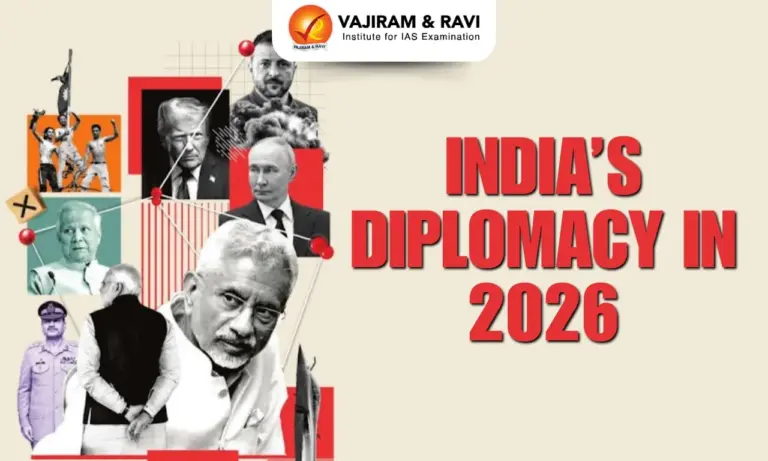
- As the world enters 2026 after a turbulent 2025, India faces a critical diplomatic moment. Global geopolitics was reshaped by wars, elections, sanctions, and leadership shifts.
- India’s foreign policy choices in 2026 will determine its global standing, regional stability, and strategic autonomy.
Backdrop: 2025 as a Global Reset Year
- 2025 witnessed the return of Donald Trump to the U.S. presidency, reshaping global trade, security, and alliance politics.
- Wars in Ukraine and Gaza, renewed great-power rivalry, and erosion of trust in multilateral institutions marked the year.
- Global politics increasingly moved towards transactionalism, tariffs, and coercive diplomacy.
India’s Position
- India navigated a year of conflicting pressures:
- Managing ties with the U.S. amid tariff threats.
- Sustaining energy and defence links with Russia.
- Maintaining stability in its neighbourhood.
- Despite tensions, India avoided strategic isolation.





India–U.S. Relations Under Trump 2.0
- Initial optimism following Trump’s re-election faded quickly.
- Trump accused India of “unfair trade practices” and imposed 50% tariffs on Indian exports.
- Pressure mounted on India to reduce Russian oil imports.
- Trade talks stalled.
- While military and strategic cooperation continued, economic friction dominated.
- 2026 will test whether the relationship stabilises or deteriorates further.
India–Pakistan: An Uneasy Pause
- A terror attack in Pahalgam led India to launch Operation Sindoor.
- Military escalation was avoided, but relations remain tense.
- Pakistan faces internal consolidation of power under Asim Munir, raising concerns over military dominance.
- Key Concern for India – Fragile ceasefire; Persistent terror infrastructure; Risk of sudden escalation.
Neighbourhood Diplomacy Challenges
- Nepal: Regime Change and Instability
- Protests and generational political churn.
- Formation of an interim government.
- Revival of monarchist sentiments and stronger army role.
- India must recalibrate engagement carefully.
- Bangladesh: Political Turmoil
- Renewed unrest after killing of youth leader.
- Student protests and fragile interim administration under Muhammad Yunus.
- Elections due in 2026 amid law-and-order concerns.
West Asia: Fragile Calm, Strategic Stakes
- Gaza War Pause
- Temporary pause after intense conflict.
- Direct Indian interests due to:
- Energy security
- Indian diaspora
- IMEC corridor prospects
- India’s Role – Advocates restraint, humanitarian aid, and regional stability; 2026 may offer limited diplomatic revival but risks remain high.
Ukraine War and Russia Factor
- War Without Resolution
- No clear end despite peace talks.
- Trump pushes for ceasefire, but core disputes persist.
- India’s Position – Continued engagement with Russia; Participation in Ukraine discussions while preserving strategic autonomy; Russian oil imports remain critical for inflation control.
China and Russia: Strategic Outreach
- India engaged both Xi Jinping and Vladimir Putin through SCO and bilateral channels.
- China remains the primary long-term challenge despite tactical engagement.
- Despite talks, 60,000+ troops remain deployed on both sides of LAC.
- Disengagement remain incomplete.
Re-engagement with China: Cautious Reset
- Trade links expanded but mistrust remains.
- India balances economic pragmatism with security concerns.
- 2026 diplomacy requires avoiding escalation without conceding core interests.
Multilateral Diplomacy in 2026
- BRICS and Quad
- India must balance participation in BRICS with its role in the Quad.
- Both forums reflect India’s strategic autonomy.
- G20 Under U.S. Presidency
- Trump’s approach may dilute multilateralism.
- India must protect G20 gains achieved during its presidency.
- Europe and Africa: Renewed Focus
- Europe
- India seeks stronger economic and strategic ties.
- Hosting visits from EU leadership expected.
- Africa
- India’s goodwill remains strong.
- Next India–Africa Forum Summit likely.
- Countering China’s growing footprint remains a challenge.
- Europe
Key Diplomatic Tests for India in 2026
- Trade
- Finalising or salvaging trade deal with the U.S.
- Managing tariff pressures.
- Energy Security
- Sustaining Russian oil imports amid pressure.
- Maintaining Middle East stability.
- Technology and AI
- Hosting global AI summit.
- Showcasing India’s tech leadership.
Conclusion: Repair, Rebuild, Rebalance
- 2026 is not about grand resets but careful repair:
-
- Repairing strained alliances.
- Rebuilding neighbourhood trust.
- Rebalancing relations among rival power blocs.
Source: TH

 Last updated on March, 2026
→ UPSC Final Result 2025 is now out.
→ UPSC has released UPSC Toppers List 2025 with the Civil Services final result on its official website.
→ Anuj Agnihotri secured AIR 1 in the UPSC Civil Services Examination 2025.
→ UPSC Marksheet 2025 is now out.
→ UPSC Notification 2026 & UPSC IFoS Notification 2026 is now out on the official website at upsconline.nic.in.
→ UPSC Calendar 2026 has been released.
→ Check out the latest UPSC Syllabus 2026 here.
→ UPSC Prelims 2026 will be conducted on 24th May, 2026 & UPSC Mains 2026 will be conducted on 21st August 2026.
→ The UPSC Selection Process is of 3 stages-Prelims, Mains and Interview.
→ Prepare effectively with Vajiram & Ravi’s UPSC Prelims Test Series 2026 featuring full-length mock tests, detailed solutions, and performance analysis.
→ Enroll in Vajiram & Ravi’s UPSC Mains Test Series 2026 for structured answer writing practice, expert evaluation, and exam-oriented feedback.
→ Join Vajiram & Ravi’s Best UPSC Mentorship Program for personalized guidance, strategy planning, and one-to-one support from experienced mentors.
→ Shakti Dubey secures AIR 1 in UPSC CSE Exam 2024.
→ Also check Best UPSC Coaching in India
India’s Diplomacy in 2026 FAQs
Q1. Why is India’s diplomacy in 2026 considered critical?+
Q2. How has Trump 2.0 affected India–US relations?+
Q3. What are India’s main neighbourhood challenges in 2026?+
Q4. How does the Ukraine war influence India’s foreign policy?+
Q5. What is India’s diplomatic strategy going forward?+
Tags: India’s diplomacy in 2026 mains articles upsc current affairs upsc mains current affairs