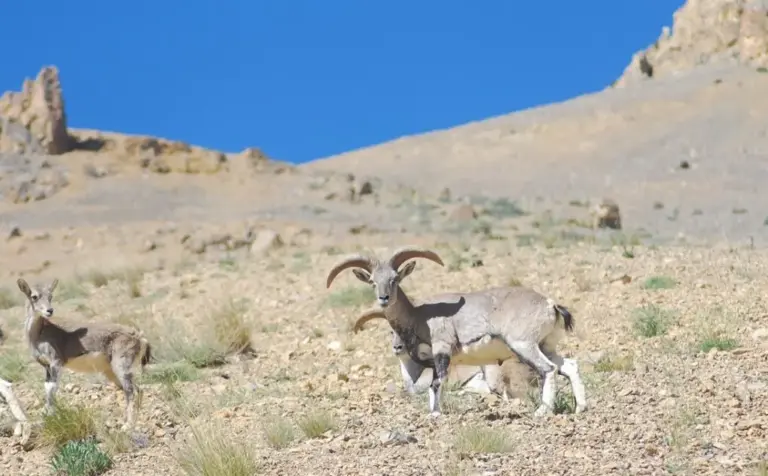
About Bharal:
- The bharal, also called the blue sheep, is a caprine native to the high Himalayas.
- Scientific Name: Pseudois nayaur
- It is the only member of the genus Pseudois.
- Distribution: It occurs in India, Bhutan, China (in Gansu, Ningxia, Sichuan, Tibet, and Inner Mongolia), Myanmar, Nepal, and Pakistan.
- Features:
- These medium-sized caprids are 115 to 165 cm (45 to 65 in) long along the head and body, with a tail of 10 to 20 cm (3.9 to 7.9 in).
- They stand 69 to 91 cm (27 to 36 in) high at the shoulder.
- Males are slightly larger than females.
- The short, dense coat is slate grey in colour, sometimes with a bluish shine. The underparts and backsof the legs are white, while the chest and fronts of the legs are black.
- It has horns that grow upwards, curve out, and then towards the back, somewhat like an upside-down.
- Bharal are active throughout the day, alternating between feeding and resting on the grassy mountain slopes.
- Conservation Status:
- IUCN Red List: Least Concern
- Wildlife Protection Act 1972: Schedule 1
About Himalayan Ibex:
- It is a subspecies of the Siberian ibex that is native to the Himalayan region of India, Pakistan, Tibet, and Nepal.
- Ibex is any of several sure-footed, sturdy wild goats of the genus Capra in the family Bovidae that are found in the mountains of Europe, Asia, and northeastern Africa.
- Scientific Name: Capra sibirica hemalayanus
- They inhabit the high-altitude regions of the Himalayas, including the Trans-Himalayan region, where they can be found at elevations between 3,000 and 5,800 meters.
- It is found in several parts of India, primarily in the states of Jammu and Kashmir, Himachal Pradesh, and Uttarakhand.
- Features:
An adult ibex weighs about 90 kgs, and stands around 40 inches tall, with huge curved horns. Males are larger than females.
- The horns have notches on the front, and grow each year.
- They have a light brown to reddish-brown coat, with a white belly and black and white markings on their legs.
- Their coat is thick and woolly in winter, and shed in early summer.
- The colour ranges from pale brown to dark brown, with a darker dorsal stripe.
- They are usually found in small herds, sometimes around 50 together.
- They can run at a speed of up to 50 km/h.
- Conservation Status:
IUCN Red List: Near Threatened
Q1: What is IUCN?
The International Union for Conservation of Nature is a global organization composed of governments, NGOs, scientists, and experts dedicated to conserving nature and promoting sustainability. Its primary role involves assessing the conservation status of species, providing data and analysis on the state of biodiversity worldwide, and offering guidance and frameworks for conservation efforts.






 Last updated on March, 2026
→ UPSC Final Result 2025 is now out.
→ UPSC has released UPSC Toppers List 2025 with the Civil Services final result on its official website.
→ Anuj Agnihotri secured AIR 1 in the UPSC Civil Services Examination 2025.
→ UPSC Marksheet 2025 is now out.
→ UPSC Notification 2026 & UPSC IFoS Notification 2026 is now out on the official website at upsconline.nic.in.
→ UPSC Calendar 2026 has been released.
→ Check out the latest UPSC Syllabus 2026 here.
→ UPSC Prelims 2026 will be conducted on 24th May, 2026 & UPSC Mains 2026 will be conducted on 21st August 2026.
→ The UPSC Selection Process is of 3 stages-Prelims, Mains and Interview.
→ Prepare effectively with Vajiram & Ravi’s UPSC Prelims Test Series 2026 featuring full-length mock tests, detailed solutions, and performance analysis.
→ Enroll in Vajiram & Ravi’s UPSC Mains Test Series 2026 for structured answer writing practice, expert evaluation, and exam-oriented feedback.
→ Join Vajiram & Ravi’s Best UPSC Mentorship Program for personalized guidance, strategy planning, and one-to-one support from experienced mentors.
→ Shakti Dubey secures AIR 1 in UPSC CSE Exam 2024.
→ Also check Best UPSC Coaching in India