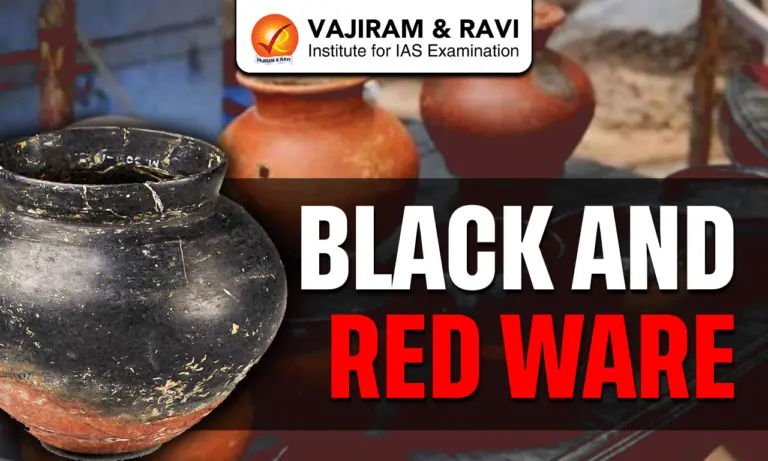
Black and Red Ware is an ancient type of pottery known for its unique two colours black on the inside and red on the outside. It was commonly used by early communities in India and shows the gradual improvement in pottery-making techniques. This pottery is important because it helps us understand the daily life and skills of people in ancient times.
About Black and Red Ware
- Meaning: Black and Red Ware (BRW) is a type of ancient pottery that is easily identified by its two colours black on the inside and rim, and red on the outside. This colour combination was not accidental but created through a special firing process.
- Time Period: BRW has a very long history in India. It first appeared in the Neolithic period and continued through the Harappan phase, Bronze Age, Iron Age, megalithic period, and even into the early historical period. This shows that it remained in use for many centuries.
- Region / Distribution: It has been found across a wide area of India, including Rajasthan, Gujarat, Madhya Pradesh, Uttar Pradesh, Bihar, and parts of South India. In the western Ganga plain (western Uttar Pradesh), it is dated around 1450–1200 BCE. In this region, it came after Ochre Coloured Pottery (OCP) and was later replaced by Painted Grey Ware (PGW).
- Cultural Association: BRW is connected with several ancient cultures. One important example is the Ahar-Banas culture of Rajasthan, where this pottery was often decorated with white painted linear designs. Its presence in different regions shows that many communities adopted and adapted this pottery style.
- Features: BRW is known for its distinct two-colour appearance. The pots are generally well-shaped, medium to fine in quality, and stronger than earlier handmade pottery. Some pieces are plain, while others have simple painted designs. The surface is often smooth, and the pottery shows better control in shaping and firing.
- Technique: The two colours were produced by a special firing method. During firing, the pot was placed in such a way that the inside received less oxygen (which turned it black), while the outside was exposed to more oxygen (which turned it red). This shows that ancient potters had developed a good understanding of firing techniques and kiln control.
- Lifestyle and Economy: The people associated with BRW were mainly settled agricultural communities. They practiced subsistence farming, growing crops like rice, barley, and legumes. This indicates a stable lifestyle with dependence on agriculture rather than hunting alone.
- Associated Findings: Excavations at BRW sites have revealed many other objects, such as ornaments made of shell, copper, carnelian, and terracotta. This shows that people were skilled not only in pottery but also in making jewellery and using different materials, indicating trade and craft specialization.
- Uses: BRW was mainly used for everyday household purposes such as cooking, storing food and water, and serving meals. Some decorated pieces might also have been used for special or ritual purposes.
- Significance: Black and Red Ware is very important for understanding ancient Indian history. It shows the development of pottery-making techniques, improvement in firing methods, and growing craftsmanship. It also reflects the lifestyle, agriculture, and cultural practices of early communities. Most importantly, it helps historians trace the transition between different cultural phases, such as from OCP to PGW in certain regions.
Also Read: Indus Valley Civilization






 Last updated on April, 2026
→ UPSC Final Result 2025 is now out.
→ UPSC has released UPSC Toppers List 2025 with the Civil Services final result on its official website.
→ Anuj Agnihotri secured AIR 1 in the UPSC Civil Services Examination 2025.
→ UPSC Marksheet 2025 is now out.
→ UPSC Notification 2026 & UPSC IFoS Notification 2026 is now out on the official website at upsconline.nic.in.
→ UPSC Calendar 2026 has been released.
→ Check out the latest UPSC Syllabus 2026 here.
→ UPSC Prelims 2026 will be conducted on 24th May, 2026 & UPSC Mains 2026 will be conducted on 21st August 2026.
→ The UPSC Selection Process is of 3 stages-Prelims, Mains and Interview.
→ Prepare effectively with Vajiram & Ravi’s UPSC Prelims Test Series 2026 featuring full-length mock tests, detailed solutions, and performance analysis.
→ Enroll in Vajiram & Ravi’s UPSC Mains Test Series 2026 for structured answer writing practice, expert evaluation, and exam-oriented feedback.
→ Join Vajiram & Ravi’s Best UPSC Mentorship Program for personalized guidance, strategy planning, and one-to-one support from experienced mentors.
→ Shakti Dubey secures AIR 1 in UPSC CSE Exam 2024.
→ Also check Best UPSC Coaching in India
Black and Red Ware FAQs
Q1. What is Black and Red Ware (BRW)?+
Q2. What is the time period of BRW?+
Q3. Where was BRW mainly found?+
Q4. What are the main features of BRW?+
Q5. How was BRW made?+
Tags: black and red ware history history notes