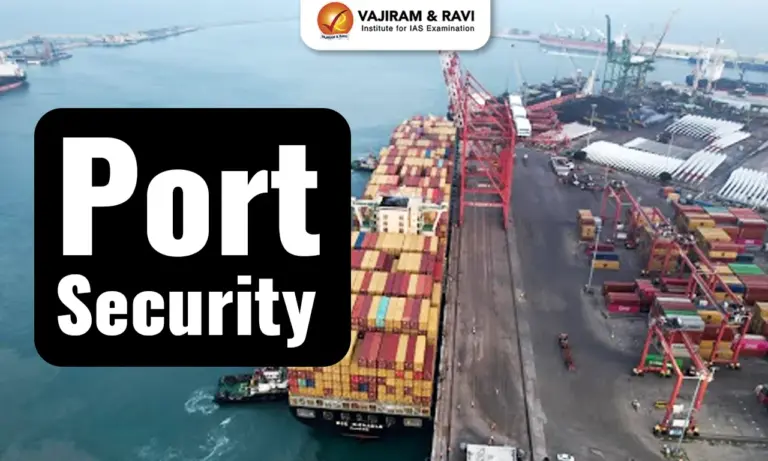
Port Security Latest News
- The Union government has constituted the Bureau of Port Security as a statutory body under the Merchant Shipping Act, 2025, to strengthen port and maritime security governance.
India’s Maritime and Coastal Landscape
- India has a long coastline of over 7,500 km and a rapidly expanding maritime economy.
- As of 2025, the country has 12 major ports and 217 non-major ports, of which 66 are cargo-handling ports, while the rest largely serve fishing and coastal activities.
- Major ports, administered by the Union government, handle more than half of India’s maritime cargo traffic.
- In recent years, India has witnessed a sharp rise in port capacity, coastal shipping, and inland waterway cargo movement.
- This growth has significantly enhanced India’s trade connectivity and logistics efficiency, but it has also increased exposure to security threats such as smuggling, terrorism, cyber intrusions, and illegal migration through maritime routes.
- Ensuring secure ports and vessels has therefore emerged as a key national security priority.





Need for a Dedicated Port Security Authority
- Until recently, India’s coastal and port security responsibilities were distributed across multiple agencies, including the Indian Navy, Coast Guard, CISF, State maritime police, and port authorities.
- While operational agencies remain crucial, the absence of a single statutory body for regulatory oversight and coordination often leads to gaps in communication, duplication of efforts, and uneven implementation of security standards.
- Recognising these challenges, the government decided to establish a specialised institution that could function as the nodal regulator for port and ship security, similar to how aviation security is governed in India.
Bureau of Port Security: Mandate and Structure
- The Bureau of Port Security (BoPS) has been constituted under Section 13 of the Merchant Shipping Act, 2025, as a statutory body.
- It functions under the Ministry of Ports, Shipping and Waterways and is modelled on the Bureau of Civil Aviation Security (BCAS).
- The BoPS is responsible for regulatory oversight relating to the security of ships, port facilities, and maritime infrastructure.
- Its role is not operational in nature but focuses on standard-setting, compliance, coordination, and supervision across both major and non-major ports.
Key Functions of the Bureau of Port Security
- The BoPS addresses a wide range of maritime security concerns.
- These include maritime terrorism, arms and drug trafficking, human trafficking, illegal migration, piracy, poaching, and other illicit activities carried out through sea routes.
- A notable feature of the BoPS is its emphasis on cybersecurity.
- With ports increasingly dependent on digital systems, the Bureau is expected to monitor and protect port IT infrastructure from cyber threats, in coordination with national cybersecurity agencies.
- The BoPS has the legal authority to ensure compliance with international obligations such as the International Ship and Port Facility Security (ISPS) Code, which mandates minimum security standards for ports and vessels engaged in international trade.
Role of CISF and Security Implementation
- Under the BoPS framework, the Central Industrial Security Force (CISF) has been designated as a recognised security organisation.
- The CISF will prepare standardised security plans, conduct security assessments, and train private security agencies deployed at ports.
- Security measures are to be implemented in a graded and risk-based manner, taking into account factors such as vulnerability, trade volume, location, and threat perception. This approach aims to balance security needs with ease of doing business.
Maritime Growth and Strategic Context
- India’s maritime sector has expanded rapidly over the last decade. Cargo handled at ports increased from 974 million tonnes in 2014 to nearly 1,600 million tonnes by 2025.
- Ship turnaround time has halved, and coastal shipping volumes have more than doubled. Inland waterway cargo movement has increased eightfold during the same period.
- The creation of the BoPS aligns with the Maritime India Vision 2030, which seeks to develop world-class port infrastructure, promote green shipping, and ensure a safe and secure maritime ecosystem.
Concerns and Criticism
- Some coastal States have expressed concerns that recent port legislation, including the Indian Ports Act, 2025, increases Union government control over non-major ports, raising questions related to maritime federalism.
- There are also criticisms regarding wide inspection powers granted to port officials under the new legal framework, though these concerns relate to legislation as a whole rather than the BoPS specifically.
Source: TH

 Last updated on March, 2026
→ UPSC Final Result 2025 is now out.
→ UPSC has released UPSC Toppers List 2025 with the Civil Services final result on its official website.
→ Anuj Agnihotri secured AIR 1 in the UPSC Civil Services Examination 2025.
→ UPSC Marksheet 2025 is now out.
→ UPSC Notification 2026 & UPSC IFoS Notification 2026 is now out on the official website at upsconline.nic.in.
→ UPSC Calendar 2026 has been released.
→ Check out the latest UPSC Syllabus 2026 here.
→ UPSC Prelims 2026 will be conducted on 24th May, 2026 & UPSC Mains 2026 will be conducted on 21st August 2026.
→ The UPSC Selection Process is of 3 stages-Prelims, Mains and Interview.
→ Prepare effectively with Vajiram & Ravi’s UPSC Prelims Test Series 2026 featuring full-length mock tests, detailed solutions, and performance analysis.
→ Enroll in Vajiram & Ravi’s UPSC Mains Test Series 2026 for structured answer writing practice, expert evaluation, and exam-oriented feedback.
→ Join Vajiram & Ravi’s Best UPSC Mentorship Program for personalized guidance, strategy planning, and one-to-one support from experienced mentors.
→ Shakti Dubey secures AIR 1 in UPSC CSE Exam 2024.
→ Also check Best UPSC Coaching in India
Port Security FAQs
Q1. What is the Bureau of Port Security?+
Q2. Which ministry oversees the BoPS?+
Q3. What international standard does the BoPS enforce?+
Q4. Which force supports BoPS in port security planning?+
Q5. Why is cybersecurity important for ports?+
Tags: mains articles port security upsc current affairs upsc mains current affairs