CAR T-Cell Therapy Latest News
The clinical trial results of India’s first CAR T-cell therapy, published in The Lancet, show that it worked for nearly 73 percent of patients.
About CAR T-Cell Therapy
- CAR T-cell therapy, or chimeric antigen receptor T-cell therapy, trains the body’s own immune cells to identify and destroy cancer cells.
- This treatment is designed for specific types of blood cancer and is given to patients whose cancer has either relapsed or not responded to first-line treatment.




How does the Therapy Work?
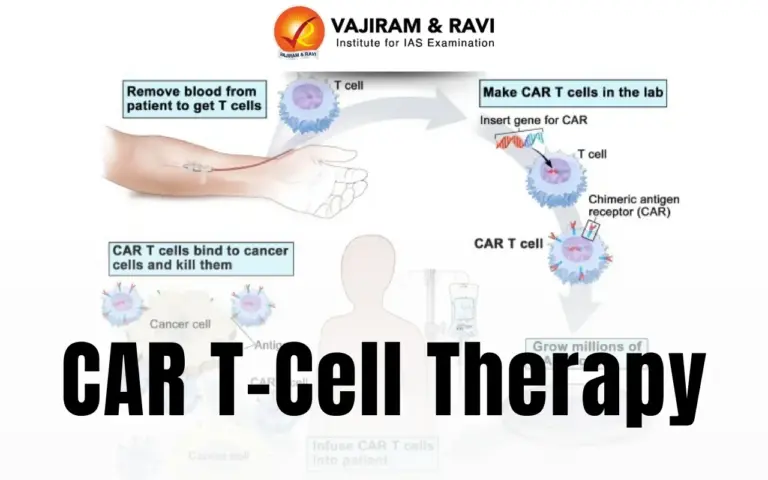
- For any CAR T-cell therapy, a patient’s immune T-cells are collected by filtering their blood.
- These cells are then engineered in a lab to add receptors that can bind with cancer cells. These cells are then multiplied and infused in the patient.
- Usually, the cancer cells are adept at evading the unmodified T cells.
- The treatment developed in India is meant for patients with two types of blood cancers that affect the B cells — acute lymphoblastic leukemia and large B cell lymphomas.
Side Effects of CAR T Therapy
- A serious immune overreaction causing hyperinflammation and organ damage, seen in 12% of participants, resulting in at least one death.
- Low red blood cell count, reported in 61% of participants, causing fatigue and weakness.
- Thrombocytopenia: Low platelet count, increasing the risk of bleeding, reported in 65% of patients.
- Neutropenia: Low neutrophil count, seen in 96% of participants, raising the risk of infections.
CAR T Therapy FAQs
Q1: What does CAR T-cell therapy do?
Ans: CAR T-cell therapy genetically modifies a patient’s immune cells (T-cells) to effectively recognize and destroy cancer cells.
Q2: What is the controversy with CAR T-therapy?
Ans: CAR T-cell therapy faces controversy due to potential risks of causing secondary cancers, such as T-cell lymphomas, through unintended genetic mutations.
Q3: What diseases can CAR T-cell therapy treat?
Ans: CAR T-cell therapy treats certain blood cancers like lymphoma and leukemia, especially when other treatments have failed.
Source: IE

 Last updated on March, 2026
→ UPSC Notification 2026 is now out on the official website at upsconline.nic.in.
→ UPSC IFoS Notification 2026 is now out on the official website at upsconline.nic.in.
→ UPSC Calendar 2026 has been released.
→ UPSC Final Result 2025 is expected to be released soon.
→ Check out the latest UPSC Syllabus 2026 here.
→ Join Vajiram & Ravi’s Interview Guidance Programme for expert help to crack your final UPSC stage.
→ UPSC Mains Result 2025 is now out.
→ UPSC Prelims 2026 will be conducted on 24th May, 2026 & UPSC Mains 2026 will be conducted on 21st August 2026.
→ The UPSC Selection Process is of 3 stages-Prelims, Mains and Interview.
→ Prepare effectively with Vajiram & Ravi’s UPSC Prelims Test Series 2026 featuring full-length mock tests, detailed solutions, and performance analysis.
→ Enroll in Vajiram & Ravi’s UPSC Mains Test Series 2026 for structured answer writing practice, expert evaluation, and exam-oriented feedback.
→ Join Vajiram & Ravi’s Best UPSC Mentorship Program for personalized guidance, strategy planning, and one-to-one support from experienced mentors.
→ Check UPSC Marksheet 2024 Here.
→ UPSC Toppers List 2024 is released now. Shakti Dubey is UPSC AIR 1 2024 Topper.
→ Also check Best UPSC Coaching in India