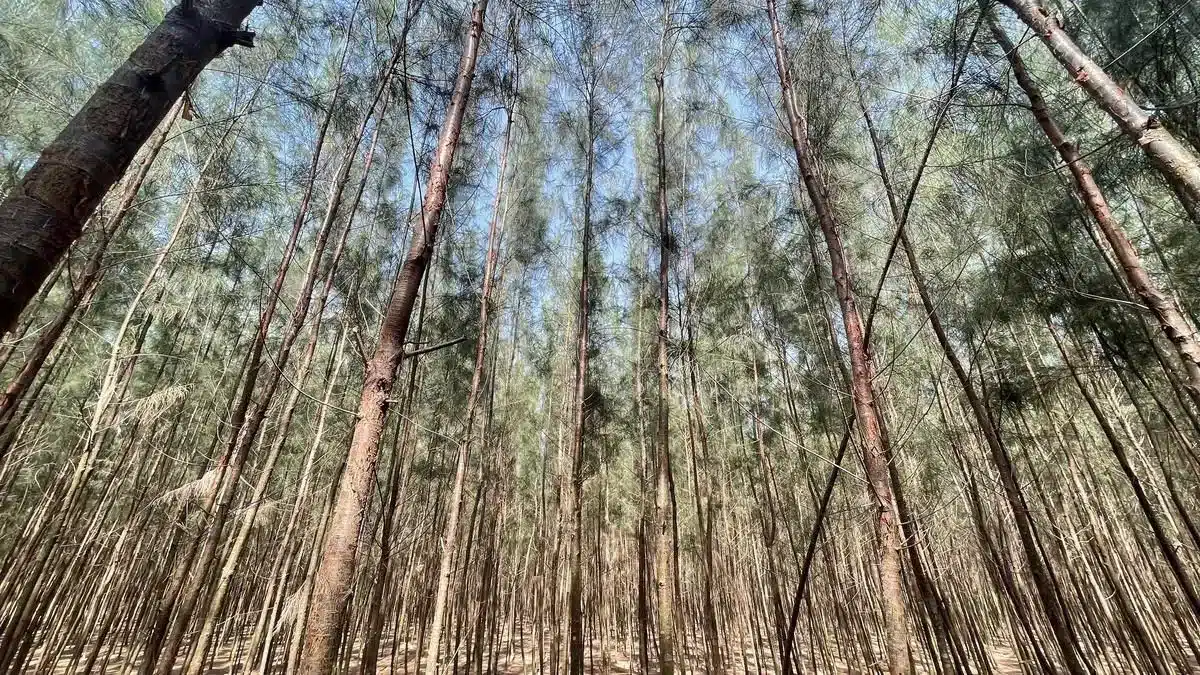
About Casuarina Tree:
- It is native to Australia and it was introduced in India around the 19th centuary.
- It is also known as kattadi and savukku.
- There are four cultivated species of casuarinas viz., Casuarina equisetifolia, Casuarina glauca, Casuarina cunninghamaina and Casuarina junghuniana.
- The nitrogen fixing ability and adaptability to grow in a wide range of soil and climatic conditions including moisture and nutrient limited sites makes Casuarina a preferred choice for commercial and environmental planting programme.
- Distribution: Casuarinas are widely planted in the tropics, subtropics and Mediterranean countries because of their ready adaptability to a variety of environmental conditions and also for their rapid growth performance.
- Climate: The trees are suited to a wide range of temperature from 10°C-33°C, from sea level upto 1500m and mean annual rainfall between 700 and 2000 mm.
- Soil: The tree is best suited to light soils. This species tolerates calcareous and slightly saline soils, but it is grown poorly on heavy soils such as clays.
- Uses
- Apart from fuel, the wood is extensively used for papermaking and of late is a preferred choice for biomass-based power generation.
- The straight cylindrical stems find use in rural house building and as scaffolds in construction sites.
- It is the principal species for developing shelterbelts in coastal areas and windbreaks for protecting agricultural crops.
- It also plays a key role in reclaiming mined areas and afforesting nutrient-poor sites.
Q1: What is the Mediterranean climate?
It is a major climate type of the Köppen classification characterized by hot, dry summers and cool, wet winters and located between about 30° and 45° latitude north and south of the Equator and on the western sides of the continents.
Source: Casuarina farming sees resurgence in Vedaranyam six years after Cyclone Gaja


 Last updated on Oct, 2026
→ UPSC 2027 Notification will be released on 13 January 2027 at upsconline.nic.in.
→ Check Nobel Prize 2026 Winners List here.
→ Download PIB PRiSM Monthly Magazine 2026 here.
→ Check UPSC Monthly Current Affairs Magazine The Recitals here.
→ Check out the latest UPSC Syllabus here.
→ Download UPSC Model Answers for Mains 2026
→ UPSC Mains Question Paper 2026 is out now for Essay & GS Paper 1, 2, 3 & 4.
→ UPSC Calendar 2027 has been released.
→ Enroll in Vajiram & Ravi’s UPSC Mains Test Series 2027 for structured answer writing practice, expert evaluation, and exam-oriented feedback.
→ Join Vajiram & Ravi’s UPSC Mentorship Program 2027 for personalized guidance, strategy planning, and one-to-one support from experienced mentors.
→ Go through the UPSC Mains Previous Year Papers to enhance your preparation.
→ UPSC has released UPSC Toppers List 2025 with the Civil Services final result on its official website.
→ Also check Best UPSC Coaching in India