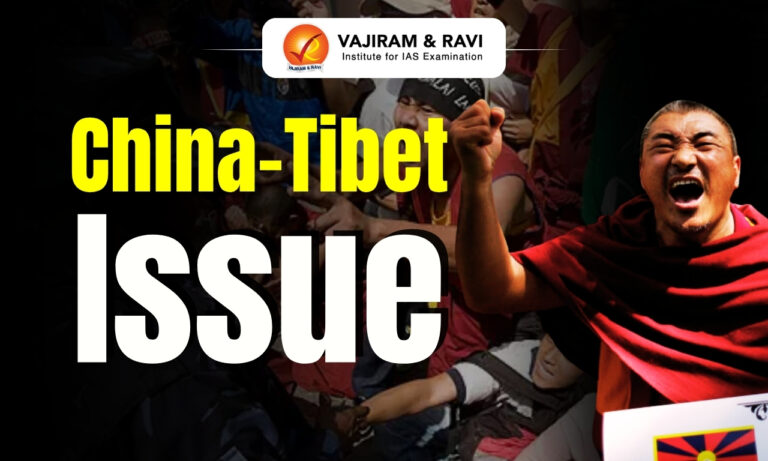
The China-Tibet issue is a long-standing political, historical, religious and geopolitical issue concerning Tibet’s political status, Tibetan autonomy and identity, Chinese governance, human rights, and the wider strategic importance of the Tibetan Plateau.
About Tibet
Tibet is a high-altitude region centred on the Tibetan Plateau, north of the Himalayas, and is currently under the administration of China.
- Tibet is a major centre of Tibetan Buddhism and is historically associated with the Dalai Lama and other Tibetan Buddhist institutions.
- The Tibetan Plateau is strategically important because it borders India, Nepal, Bhutan and other parts of Asia and contains the headwaters of several major Asian rivers.
China-Tibet Issue Historical Background
The present issue developed from Tibet’s distinct political system, changing Chinese influence, Tibet’s period of de facto autonomy and China’s consolidation of control after 1950.
- Tibet before Qing influence: Tibet developed a distinct political and religious system centred on Tibetan Buddhism, with the Dalai Lama becoming its principal religious and political authority. Tibet maintained its own administration and exercised substantial control over its internal affairs, although its relations with Mongol and Chinese rulers varied over different periods.
- Qing influence over Tibet: The Qing Dynasty expanded its influence in Tibet during the 18th century after Qing forces intervened in Tibetan affairs and expelled invading forces. The Qing emperor stationed Ambans, or imperial representatives, in Lhasa and exercised influence particularly over Tibet’s external affairs and security. However, Tibet retained its own religious and administrative institutions, and the extent of effective Qing control varied over time.
- 1911-1913: The Qing Dynasty collapsed in 1911, weakening Chinese authority in Tibet. The 13th Dalai Lama returned to Lhasa in January 1913, and in February 1913 he issued a proclamation asserting Tibet’s independence. Tibet subsequently exercised substantial de facto autonomy. This period became important for India because British India developed direct political and boundary relations with Tibet.
- 1914: The Simla Convention was negotiated among British India, Tibet and China. British India and Tibet agreed on the McMahon Line as the boundary between Tibet and British India in the eastern sector, but China rejected the agreement. The dispute later became an important basis of the India-China boundary dispute, particularly regarding Arunachal Pradesh.
- 1950: After the establishment of the People’s Republic of China in 1949, the People’s Liberation Army entered Tibet. China described the action as the “peaceful liberation of Tibet”, while the Tibetan side regarded it as the beginning of Chinese military control. For India, this changed the Himalayan security environment because Tibet had earlier functioned as a buffer between India and China.
- 1951: Tibetan representatives signed the Seventeen Point Agreement, under which Tibet was incorporated into the People’s Republic of China while China promised regional autonomy and protection of Tibetan religion and culture. The Tibetan leadership later rejected the agreement, arguing that it had been signed under military pressure.
- 1959: Growing tensions culminated in a major uprising in Lhasa. The 14th Dalai Lama, Tenzin Gyatso, fled to India and was granted asylum. The Tibetan exile administration was subsequently established in Dharamshala, Himachal Pradesh. His presence in India made Tibet an enduring issue in India-China relations.
- 1965: China formally established the Tibet Autonomous Region (TAR) as an administrative region of the People’s Republic of China. The purpose was to provide Tibet with regional autonomy within China’s constitutional and administrative system while maintaining Chinese sovereignty and control. However, the broader Tibetan cultural region extends beyond the TAR into parts of Qinghai, Sichuan, Gansu and Yunnan. This distinction is important when discussing the wider China-Tibet issue.
What is the China-Tibet Issue?
The central issue concerns China’s sovereignty and governance over Tibet versus Tibetan demands for greater autonomy and protection of their distinct identity.
- China’s position: China considers Tibet an integral part of China and rejects Tibetan independence. Beijing argues that Chinese sovereignty over Tibet has historical roots and that its rule has brought development, infrastructure, education and modernisation.
- Tibetan position: The Dalai Lama and the Tibetan exile leadership argue for meaningful political, cultural and religious autonomy for Tibetans rather than Chinese policies that, in their view, weaken Tibet’s distinct identity.
- Middle Way Approach: The Dalai Lama has moved away from demanding complete independence and advocates genuine autonomy for Tibetans within China, with Tibetans having greater control over their cultural, religious, educational and environmental affairs while China retains responsibility for defence and foreign affairs.


Other Major Issues in China-Tibet Relations
The China-Tibet dispute centres on political autonomy, religious freedom, cultural identity, demographic change, development, succession of the Dalai Lama and control over Tibet’s strategic resources.
Religious Freedom and Control over Tibetan Buddhism
Control over Tibetan Buddhist institutions is a major source of tension because religion is closely linked with Tibetan identity.
- China exercises control over monasteries, religious institutions and the recognition of senior Buddhist leaders, while Tibetan representatives object to political interference in religious affairs.
- The dispute is particularly important because the future recognition of the Dalai Lama and other high lamas could determine the religious and political direction of Tibetan Buddhism.
Cultural and Linguistic Identity
- Concerns have been raised over the increasing use of Mandarin in education, restrictions affecting Tibetan-language education and changes in traditional religious and cultural institutions.
- Tibetan representatives describe these policies as Sinicization, while China presents them as measures for education, development and national integration.
Human Rights and Political Freedoms
- Critics have raised concerns about restrictions on freedom of expression, political dissent, religious practice and movement, particularly in relation to protests against Chinese policies.
- China rejects these allegations and maintains that its policies are necessary for social stability, security and development.
Dalai Lama’s Succession and Reincarnation
The future recognition of the 15th Dalai Lama has emerged as a major potential flashpoint.
- The Dalai Lama maintains that his reincarnation is fundamentally a religious matter, while China insists that the succession process must comply with Chinese laws and receive state approval.
- The disagreement could lead to competing claims to the Dalai Lama, creating a major religious and political dispute between Beijing and the Tibetan leadership.
Development, Demographic Change and Integration
China’s development policies in Tibet have improved physical connectivity but have also generated concerns about their impact on Tibetan society.
- China has expanded roads, railways, airports, telecommunications, tourism and energy infrastructure to integrate Tibet more closely with the national economy.
- Critics argue that economic integration, migration and state-led development can accelerate demographic change and cultural assimilation, while China presents these policies as necessary for improving living standards.
Control over Tibet’s Natural Resources
China’s control over the Tibetan Plateau has created concerns about how Tibet’s land, minerals, rivers and other natural resources are being used.
- Large-scale hydropower, mining and infrastructure projects are undertaken by the Chinese state in Tibet, with limited local control over these resources.
- The Tibetan side has raised concerns that such projects can affect traditional livelihoods, cultural landscapes and fragile ecosystems.
- For India and other downstream countries, these developments also create concerns about rivers, floods, sediment flows and ecological impacts.
Why Tibet Matters to India?
Tibet is directly connected with India’s border security, water security and Himalayan geopolitics.
- Loss of the buffer: Before Chinese consolidation, Tibet separated the Indian and Chinese heartlands. Chinese control brought the two countries into direct strategic contact across the Himalayas.
- India-China boundary dispute: The historical status of Tibet is closely connected with the boundary question, particularly the McMahon Line and China’s claims over Arunachal Pradesh.
- Arunachal Pradesh and Tawang: China claims Arunachal Pradesh as “South Tibet”, while India considers Arunachal Pradesh an integral part of India. Tawang is especially sensitive because of its strategic location and importance in Tibetan Buddhism.
- Border infrastructure: China’s development of roads, railways, airports and military infrastructure on the Tibetan Plateau improves its ability to move personnel and supplies towards the Line of Actual Control (LAC).
- Water security: The Tibetan Plateau is the source region of the Brahmaputra and Sutlej, making Chinese upstream infrastructure important for India’s water and disaster-management concerns.
- Himalayan security: Developments in Tibet affect India’s strategic concerns across Ladakh, Sikkim and Arunachal Pradesh.
India’s Tibet Policy
India follows a cautious policy that combines recognition of Chinese sovereignty, humanitarian support for Tibetans and strategic protection of Indian interests.
- Recognition of Chinese sovereignty: India recognises the Tibet Autonomous Region as part of the People’s Republic of China and does not officially support Tibetan independence.
- 1954 Panchsheel Agreement: India explicitly recognised the “Tibet Region of China” in the Agreement on Trade and Intercourse between the Tibet Region of China and India (1954), while the two countries also adopted the Five Principles of Peaceful Coexistence.
- Dalai Lama and refugees: India granted asylum to the Dalai Lama in 1959 and has provided space for Tibetan refugees to preserve their religion, language and cultural traditions. The Central Tibetan Administration operates from Dharamshala, although India does not recognise it as a government-in-exile.
- Strategic preparedness: India has strengthened border infrastructure, surveillance and military preparedness because developments on the Tibetan Plateau directly affect India’s security.
- Diplomatic balance: India generally avoids supporting Tibetan independence while maintaining its right to protect its territorial integrity, security and national interests.
Global Position on China Tibet Issue
The China-Tibet issue also has an important international dimension involving human rights, diplomacy and great-power competition.
- United States: The Tibetan Policy and Support Act (2020) supports Tibetan control over the selection of Buddhist religious leaders, including the Dalai Lama, while the Resolve Tibet Act (2024) recognises the Tibet-China dispute as unresolved and supports dialogue between Beijing and Tibetan representatives.
- International concern: Several governments and international organisations have raised concerns about human rights, religious freedom and cultural preservation in Tibet.
- China’s response: Beijing rejects external interference and considers Tibet an internal matter linked to China’s sovereignty and territorial integrity.

 Last updated on Oct, 2026
→ UPSC 2027 Notification will be released on 13 January 2027 at upsconline.nic.in.
→ Check Nobel Prize 2026 Winners List here.
→ Download PIB PRiSM Monthly Magazine 2026 here.
→ Check UPSC Monthly Current Affairs Magazine The Recitals here.
→ Check out the latest UPSC Syllabus here.
→ Download UPSC Model Answers for Mains 2026
→ UPSC Mains Question Paper 2026 is out now for Essay & GS Paper 1, 2, 3 & 4.
→ UPSC Calendar 2027 has been released.
→ Enroll in Vajiram & Ravi’s UPSC Mains Test Series 2027 for structured answer writing practice, expert evaluation, and exam-oriented feedback.
→ Join Vajiram & Ravi’s UPSC Mentorship Program 2027 for personalized guidance, strategy planning, and one-to-one support from experienced mentors.
→ Go through the UPSC Mains Previous Year Papers to enhance your preparation.
→ UPSC has released UPSC Toppers List 2025 with the Civil Services final result on its official website.
→ Also check Best UPSC Coaching in India
China-Tibet Issue FAQs
Q1. What is the China-Tibet Issue?+
Q2. What was the Seventeen Point Agreement in the China-Tibet Issue?+
Q3. What is the Tibet Autonomous Region in the China-Tibet Issue?+
Q4. What is the Middle Way Approach in the China-Tibet Issue?+
Q5. What is India’s position on the China-Tibet Issue?+
Tags: china tibet issue