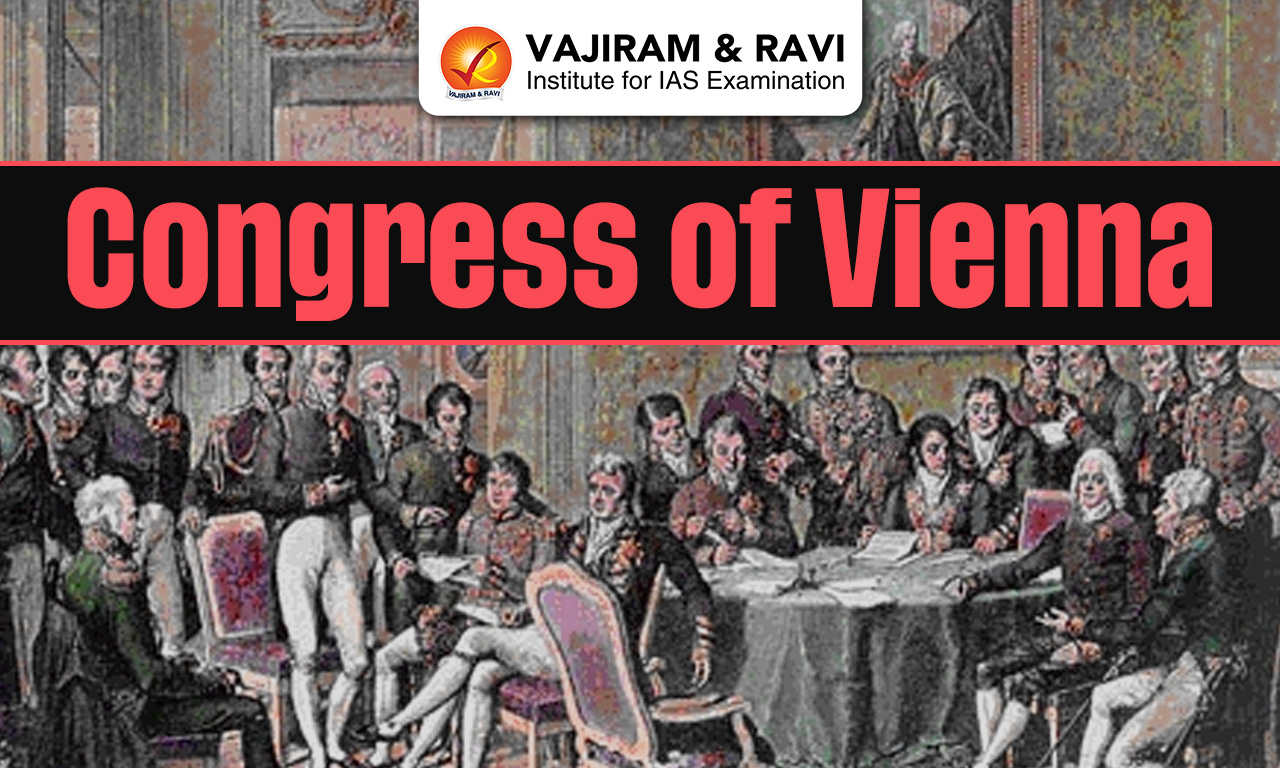
The Congress of Vienna was a meeting of important European countries held between 1814 and 1815 after the defeat of Napoleon Bonaparte. Leaders from countries like Austria, Britain, Russia, Prussia, and France came together to reorganize Europe and bring peace after years of war. Their main aim was to restore old monarchies, maintain a balance of power so that no country becomes too strong, and ensure long-term stability. The decisions taken during this meeting helped Europe avoid major wars for almost 100 years, although they also ignored and suppressed growing feelings of nationalism in many regions.
Congress of Vienna Background
- After the defeat of Napoleon Bonaparte, four major powers – Austria, Prussia, Russia, and Great Britain played the key role in defeating him. Even before his final fall, they formed an alliance through the Treaty of Chaumont (March 9, 1814). Later, peace treaties with France were signed on May 30, 1814, joined by Sweden, Portugal, and later Spain. All countries agreed to send representatives to the Congress of Vienna, but real decision-making remained with the four major powers.
- At the same time, nationalism was rising in Europe. In Germany and Italy, common language, culture, and shared history helped people unite and form independent nation-states by 1870. Though nationalism existed earlier, both countries became proper nation-states only in the 19th century.
- Their unification paths were different. Germany achieved strong economic and political unity mainly under Prussia and leadership from above, while Italy’s unification was more political and cultural, with weaker economic unity and greater involvement of common people. Language also became a political issue, leading to conflicts like Schleswig-Holstein (Danes vs Germans) and the Rhine region (Germans vs French) in the 1840s.
Congress of Vienna Objectives
- Balance of Power: The main aim of the Congress of Vienna was to make sure that no single country, especially France, becomes too powerful again and dominates Europe.
- Control over France: To stop France from expanding in the future, strong countries were placed around it, such as a stronger Netherlands and increased territory for Prussia in the west.
- Restoration of Monarchies: The Congress tried to bring back old royal families who had lost their thrones during the time of the French Revolution and Napoleon Bonaparte, so that traditional systems of rule could be restored.
- Reorganisation of Territories: The map of Europe was redrawn, and land was distributed among major powers like Austria, Prussia, Russia, and Great Britain as a reward for defeating Napoleon.
- Maintaining Peace and Stability: The Congress also wanted to ensure long-term peace in Europe, so it created a system called the “Concert of Europe,” where countries would solve problems through discussion and diplomacy instead of war.


Congress of Vienna Key Players
- Representatives from across Europe arrived in Vienna in September 1814, including many important leaders and diplomats.
- Klemens von Metternich represented Austria and played a leading role, while Alexander I of Russia personally guided Russia’s decisions.
- Frederick William III of Prussia was represented by his minister Karl von Hardenberg, and Britain was first represented by Viscount Castlereagh, later replaced by Duke of Wellington and then Lord Clancarty.
- France, under Louis XVIII, was represented by Charles-Maurice de Talleyrand, while countries like Spain, Portugal, and Sweden had less influential representatives.
- Many smaller European states also sent delegates, along with large groups of courtiers and officials who took part in the grand social life of Vienna.
- Friedrich Gentz helped manage the organisation of the Congress, but frequent social events and celebrations sometimes delayed serious decision-making.
Congress of Vienna Key Outcomes
- The Congress of Vienna faced major disagreements over regions like Poland, Saxony, and German states, with powers like Russia and Prussia often opposing Austria, Britain, and France.
- Alexander I of Russia gained control over most of Poland, while Austria got back Galicia, and Prussia received parts of Saxony and important areas near the Rhine to act as a barrier against France.
- A strong Netherlands was created (including Belgium) to check France, while Austria gained control over regions like Lombardy and Venice. Other states like Bavaria and Hanover also gained territory.
- Germany was reorganised into a loose group of states (confederation), and Switzerland was given a new constitution. Denmark lost Norway to Sweden.
- In Italy, territories were rearranged, Piedmont gained Genoa, the Pope got back the Papal States, and Naples returned to its old rulers.
- The final agreement was signed in June 1815, creating a balance of power that kept peace in Europe for many years, but it ignored people’s wishes and rising nationalism, which later caused problems.
Significance of the Congress of Vienna
- Balance of Power: European boundaries were adjusted so that no single country, especially France, could dominate again.
- Concert of Europe: Major powers began meeting regularly to solve problems peacefully and maintain stability.
- Restoration of Monarchies: Old royal families were brought back to power, guided by leaders like Klemens von Metternich.
- Long-Term Peace: The system helped Europe avoid major wars for many years until World War I.
- Territorial Settlements: Lands were redistributed Prussia gained the Rhineland, Russia got most of Poland, and Switzerland was made neutral

 Last updated on Oct, 2026
→ UPSC 2027 Notification will be released on 13 January 2027 at upsconline.nic.in.
→ Check Nobel Prize 2026 Winners List here.
→ Download PIB PRiSM Monthly Magazine 2026 here.
→ Check UPSC Monthly Current Affairs Magazine The Recitals here.
→ Check out the latest UPSC Syllabus here.
→ Download UPSC Model Answers for Mains 2026
→ UPSC Mains Question Paper 2026 is out now for Essay & GS Paper 1, 2, 3 & 4.
→ UPSC Calendar 2027 has been released.
→ Enroll in Vajiram & Ravi’s UPSC Mains Test Series 2027 for structured answer writing practice, expert evaluation, and exam-oriented feedback.
→ Join Vajiram & Ravi’s UPSC Mentorship Program 2027 for personalized guidance, strategy planning, and one-to-one support from experienced mentors.
→ Go through the UPSC Mains Previous Year Papers to enhance your preparation.
→ UPSC has released UPSC Toppers List 2025 with the Civil Services final result on its official website.
→ Also check Best UPSC Coaching in India
Congress of Vienna FAQs
Q1. What was the Congress of Vienna?+
Q2. Why was the Congress of Vienna held?+
Q3. Which countries played the main role?+
Q4. What were the main objectives of the Congress?+
Q5. What were the major outcomes of the Congress?+
Tags: congress of vienna world history