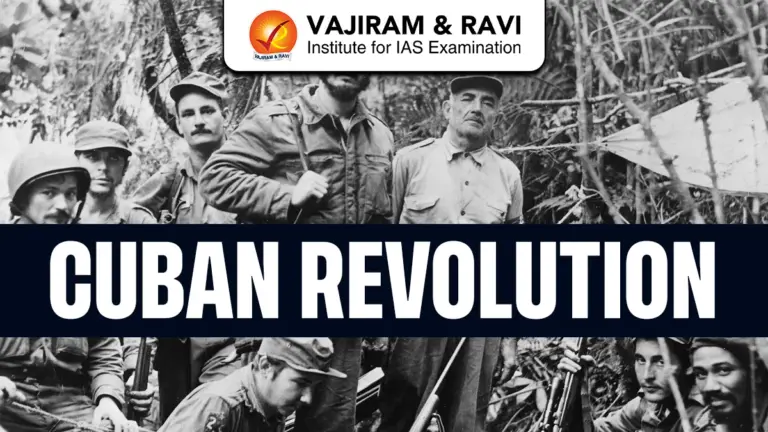
The Cuban Revolution was a major military and political event that took place between 1952 and 1959. It resulted in the overthrow of the dictator Fulgencio Batista and the rise of a new government led by Fidel Castro. The revolution started as a fight for democracy but eventually turned Cuba into a Marxist-Leninist state. It fundamentally changed Cuba’s relationship with the United States and became a symbol of resistance across Latin America. Today, the date of the first attack, July 26, is celebrated in Cuba as the “Day of the Revolution.”
26th of July Movement
The 26th of July Movement (M-26-7), also called- “The Movement”, was a revolutionary organization founded by Fidel Castro and his supporters while in detention following the failed 1953 attack on the Moncada Barracks. Named after the date of that initial assault, the movement reorganized in Mexico and later conducted guerrilla warfare from the Sierra Maestra mountains. It eventually became the primary political and military force that toppled the Batista dictatorship in 1959, later reforming into the Communist Party of Cuba in 1965.
Cuban Revolution Background
Before the Cuban Revolution, Cuba was a Republic struggling with deep seated issues that made the population ready for a major change.
- Since independence in 1902, political participation had been used by elites for wealth accumulation through bribes and illegal contracts.
- United States businesses owned most of Cuba’s industry and the American government supported Batista because he protected their financial interests.
- While sugar prices boomed, the majority of Cubans suffered from high unemployment, limited water infrastructure and poor living conditions.
- After his 1952 coup, Batista used violence, torture and censorship to suppress anyone who opposed his corrupt rule.





Cuban Revolution Historical Timeline
The Cuban Revolution followed a specific timeline from the first failed attack to the final victory and the shift to communism.
- July 26, 1953: Fidel Castro leads a failed attack on the Moncada Barracks; he is captured and sentenced to prison.
- May 15, 1955: Batista grants amnesty to political prisoners; the Castro brothers are released and flee to Mexico to reorganize.
- November 1956: The rebels return to Cuba aboard the yacht Granma, escaping into the Sierra Maestra mountains to begin guerrilla warfare.
- December 31, 1958: Rebel forces successfully topple the government and Batista flees the country as the revolution reaches its climax.
- October 1965: The revolutionary government officially reforms into the Communist Party of Cuba, establishing a one party Marxist-Leninist system.
Cuban Revolution Events
Key battles and political moves defined the success of the 26th of July Movement against the far more numerous government soldiers.
- Moncada Barracks Assault: The first armed blow against Batista; although 61 rebels were killed or executed, it sparked the nationwide revolt.
- Trial Speech: Fidel Castro’s four hour trial speech- “History Will Absolve Me” laid out his grievances and turned him into a patriotic hero.
- Guerrilla Warfare: Based in the Sierra Maestra, rebels conducted urban sabotage and covert recruitment to transform into a cohesive fighting force.
- Granma Expedition: An amphibious deployment from Mexico that, despite being met with gunfire, successfully landed the core revolutionary leaders back in Cuba.
- The Fall of Havana: In early 1959, the revolution spread throughout the island, leading to the liberation of Cuba from US influence.
Cuban Revolutionary Leaders
The Cuban Revolution was driven by a core group of individuals who brought different strategic and ideological strengths to the movement.
- Fidel Castro: The primary leader and lawyer who founded “The Movement” and became the most prominent figure of the new government.
- Raúl Castro: Fidel’s brother who was a key military commander and helped lead the attack on the Moncada Barracks in 1953.
- Ernesto “Che” Guevara: An Argentine revolutionary who met the Castros in Mexico; he became a brilliant strategist and symbol of the revolution.
- Abel Santamaría: Castro’s second-in-command during the Moncada attack; he was captured, tortured and executed by Batista’s government on the same day.
Cuban Revolution Outcomes
Winning the war was only the beginning, as the new government quickly moved to change every aspect of Cuban society. The key outcomes of the Cuban Revolution has been listed below:
- Nationalization: The government seized control of industries previously owned by US businesses, especially sugar plantations and other local natural resources.
- Political Consolidation: Castro dismantled Batista’s government, centralized the press and suppressed remaining rebellions, such as those in the Escambray Mountains.
- The Cuban Emigration: Authoritarianism and economic challenges led many Cubans to flee the country, primarily moving to the United States.
- Foreign Interventions: Cuba began intervening in foreign conflicts across Africa, the Middle East and Southeast Asia to spread its revolutionary ideas.
Cuban Revolution Impacts
The Cuban Revolution had ripples that damaged international relations and served as a blueprint for other movements in Latin America.
- Damaged US-Cuba Relations: Relations were severely damaged after nationalization and remain strained today, despite the “Cuban thaw” attempts in the 2010s.
- Cold War Violence: Cuba became the “ideological heart” of Latin America’s Cold War, deepening political divides across the entire Western Hemisphere.
- Regional Symbolism: It served as a successful blueprint for revolution, inspiring dissent in some states while causing conservative regimes to crack down.
- Marxist-Leninist State: The revolution transformed Cuba’s economy and civil society, making it the first communist nation in the Americas.

 Last updated on April, 2026
→ UPSC Final Result 2025 is now out.
→ UPSC has released UPSC Toppers List 2025 with the Civil Services final result on its official website.
→ Anuj Agnihotri secured AIR 1 in the UPSC Civil Services Examination 2025.
→ UPSC Marksheet 2025 is now out.
→ UPSC Notification 2026 & UPSC IFoS Notification 2026 is now out on the official website at upsconline.nic.in.
→ UPSC Calendar 2026 has been released.
→ Check out the latest UPSC Syllabus 2026 here.
→ UPSC Prelims 2026 will be conducted on 24th May, 2026 & UPSC Mains 2026 will be conducted on 21st August 2026.
→ The UPSC Selection Process is of 3 stages-Prelims, Mains and Interview.
→ Prepare effectively with Vajiram & Ravi’s UPSC Prelims Test Series 2026 featuring full-length mock tests, detailed solutions, and performance analysis.
→ Enroll in Vajiram & Ravi’s UPSC Mains Test Series 2026 for structured answer writing practice, expert evaluation, and exam-oriented feedback.
→ Join Vajiram & Ravi’s Best UPSC Mentorship Program for personalized guidance, strategy planning, and one-to-one support from experienced mentors.
→ Shakti Dubey secures AIR 1 in UPSC CSE Exam 2024.
→ Also check Best UPSC Coaching in India
Cuban Revolution FAQs
Q1. Who led the Cuban Revolution? +
Q2. Why did the Cuban Revolution happen? +
Q3. What was the "26th of July Movement"? +
Q4. How did the rebels win in the Cuban Revolution?+
Q5. How did the Cuban Revolution change Cuba? +
Tags: cuban revolution