About Cuscuta dodder
- It is native to North America.
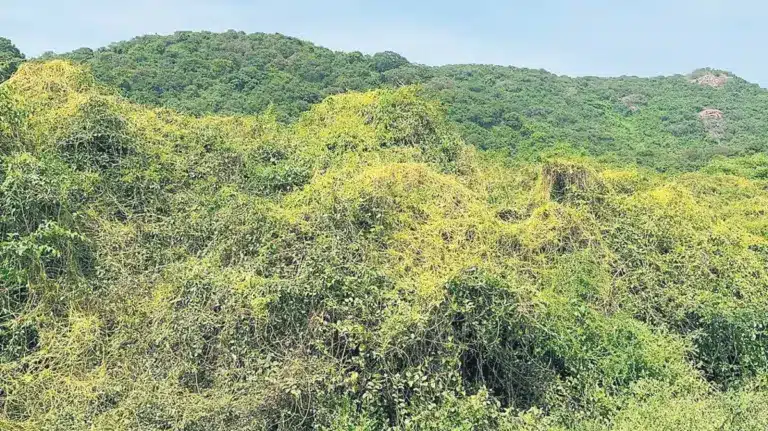
- It is a parasitic vine without roots, has already infested acres of trees in the reserve forests and has begun to spread inside India’s oldest bird sanctuary.
- It is found that plants covering the canopy of Barringtonia trees, which are preferred by migratory water birds for nesting.
- The holoparasitic plant builds a canopy on the host plant and casts thousands of tendrils to form a dense spectacle before it strangles and eventually kills it.
- As per a technical paper published by the National Research Centre for Weed Science, in India, Cuscuta poses a serious problem in oilseeds, pulses and fodder crops in the states of Andhra Pradesh, Chhattisgarh, Gujarat, Orissa, West Bengal and parts of Madhya Pradesh under rain fed as well as irrigated conditions.
- Legislation in 25 countries has listed the dodder as a ‘declared noxious weed’ with seeds and plant material denied entrance. In United States, it is the only weed seed whose movement is prohibited in every state.
- The seeds of Cuscuta are spheroid and have a hard, coat, which aids them to survive up to 50 years in dry storage and at least 10 years in the field.
- Unlike root parasites, Cuscuta seeds do not require a specific stimulant to induce germination.
Q1) What are Holoparasitic plants?
These plants are wholly dependent on host plants to survive, tapping into their xylem and phloem, gaining access to water, minerals, and other organic products. Holoparasitic plants don’t photosynthesize, but they do flower and often feature leaves that have reduced to scales and succulent stems.
Source: Parasitic creeper preys on Chengalpet forests, Vedanthangal Bird Sanctuary






 Last updated on March, 2026
→ UPSC Final Result 2025 is now out.
→ UPSC has released UPSC Toppers List 2025 with the Civil Services final result on its official website.
→ Anuj Agnihotri secured AIR 1 in the UPSC Civil Services Examination 2025.
→ UPSC Marksheet 2025 is now out.
→ UPSC Notification 2026 & UPSC IFoS Notification 2026 is now out on the official website at upsconline.nic.in.
→ UPSC Calendar 2026 has been released.
→ Check out the latest UPSC Syllabus 2026 here.
→ UPSC Prelims 2026 will be conducted on 24th May, 2026 & UPSC Mains 2026 will be conducted on 21st August 2026.
→ The UPSC Selection Process is of 3 stages-Prelims, Mains and Interview.
→ Prepare effectively with Vajiram & Ravi’s UPSC Prelims Test Series 2026 featuring full-length mock tests, detailed solutions, and performance analysis.
→ Enroll in Vajiram & Ravi’s UPSC Mains Test Series 2026 for structured answer writing practice, expert evaluation, and exam-oriented feedback.
→ Join Vajiram & Ravi’s Best UPSC Mentorship Program for personalized guidance, strategy planning, and one-to-one support from experienced mentors.
→ Shakti Dubey secures AIR 1 in UPSC CSE Exam 2024.
→ Also check Best UPSC Coaching in India