Air Pollution Latest News
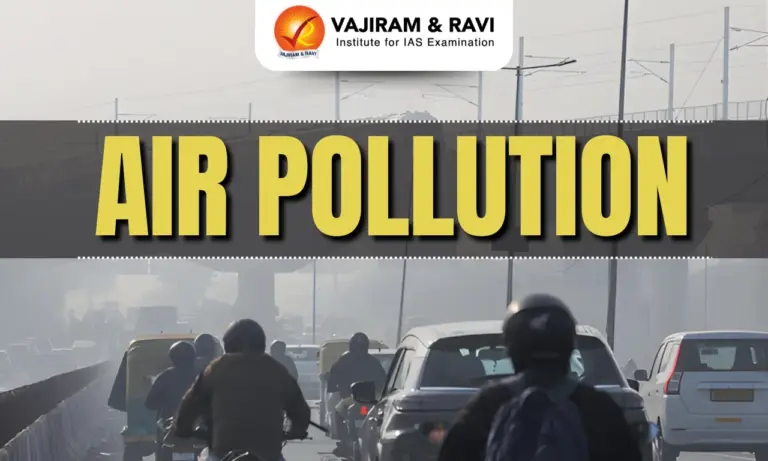
- A recent synthesis report by the Commission for Air Quality Management has identified secondary particulate matter as the single largest contributor to Delhi’s winter air pollution.
Background: Understanding Delhi’s Air Pollution Challenge
- Delhi and the National Capital Region (NCR) experience severe air pollution every winter due to a combination of meteorological, geographical, and emission-related factors.
- Low wind speeds, temperature inversion, and high moisture levels trap pollutants close to the ground, leading to persistent smog episodes.
- Over the years, multiple studies have attempted to identify dominant pollution sources, but variations in methodology often led to conflicting conclusions, complicating policy responses.
- To address this gap, the Commission for Air Quality Management (CAQM) undertook a meta-analysis of existing scientific studies to present a consolidated and evidence-based assessment of pollution sources affecting Delhi during the winter months.





Key Findings of the CAQM Meta-Analysis
- The CAQM synthesis report presents a clear source-wise contribution to winter air pollution in Delhi:
- Secondary particulate matter: 27%
- Transport emissions: 23%
- Biomass burning (including crop residue and municipal waste): 20%
- Dust (road and construction): 15%
- Industrial emissions: 9%
- The report clarifies that no new pollution sources have been identified.
- Instead, it harmonises findings from earlier studies that used differing analytical techniques, thereby offering a unified scientific basis for policymaking.
Secondary Particulate Matter as the Dominant Pollutant
- Secondary particulate matter is not emitted directly from sources such as vehicles or factories.
- Instead, it forms in the atmosphere through chemical reactions involving primary pollutants like sulphur dioxide (SO₂), nitrogen oxides (NOx), and ammonia (NH₃).
- These reactions lead to the formation of sulphates and nitrates, which together constitute nearly 25-60% of PM2.5 concentrations during winter.
- Fine particles of this nature are especially harmful as they penetrate deep into the lungs and bloodstream, aggravating respiratory, cardiovascular, and ophthalmic diseases.
- The CAQM report emphasises that focusing solely on visible emission sources may be insufficient without addressing these secondary chemical processes.
Role of Ammonia in Pollution Formation
- Ammonia plays a critical enabling role in the formation of secondary particulate matter.
- Studies cited in the report indicate that nearly 80% of ammonia emissions in India originate from agricultural activities, particularly fertiliser use and livestock excreta.
- In the atmosphere, ammonia reacts with sulphuric and nitric acids, formed from SO₂ and NOx emissions, to produce ammonium sulphate and ammonium nitrate aerosols.
- These compounds significantly increase PM2.5 levels during winter, underscoring the rural-urban linkage in Delhi’s air pollution problem.
Transport, Biomass Burning, and Dust Contributions
- Transport emissions remain the second-largest contributor, reflecting the high vehicle density, fossil fuel use, and congestion in Delhi-NCR.
- Biomass burning, including crop residue burning in neighbouring States and municipal waste burning, contributes one-fifth of winter pollution, particularly during peak burning periods.
- Dust pollution arises from unpaved roads, construction activities, and resuspension of settled particles.
- Although often overlooked, dust contributes substantially to particulate load, especially under stagnant winter conditions.
Policy Implications and Future Studies
- The CAQM report has important implications for air quality governance:
- It highlights the need for multi-sectoral interventions, including agriculture, transport, energy, and waste management.
- It calls for integrated emission inventories and updated source apportionment studies, with 2026 as the proposed base year.
- The findings will support improved Air Quality Early Warning Systems and Decision Support Systems, which had earlier faced limitations in forecasting pollution spikes accurately.
- A more science-driven approach is expected to improve both preventive and responsive policy measures.
Source: TH

 Last updated on March, 2026
→ UPSC Final Result 2025 is now out.
→ UPSC has released UPSC Toppers List 2025 with the Civil Services final result on its official website.
→ Anuj Agnihotri secured AIR 1 in the UPSC Civil Services Examination 2025.
→ UPSC Marksheet 2025 is now out.
→ UPSC Notification 2026 & UPSC IFoS Notification 2026 is now out on the official website at upsconline.nic.in.
→ UPSC Calendar 2026 has been released.
→ Check out the latest UPSC Syllabus 2026 here.
→ UPSC Prelims 2026 will be conducted on 24th May, 2026 & UPSC Mains 2026 will be conducted on 21st August 2026.
→ The UPSC Selection Process is of 3 stages-Prelims, Mains and Interview.
→ Prepare effectively with Vajiram & Ravi’s UPSC Prelims Test Series 2026 featuring full-length mock tests, detailed solutions, and performance analysis.
→ Enroll in Vajiram & Ravi’s UPSC Mains Test Series 2026 for structured answer writing practice, expert evaluation, and exam-oriented feedback.
→ Join Vajiram & Ravi’s Best UPSC Mentorship Program for personalized guidance, strategy planning, and one-to-one support from experienced mentors.
→ Shakti Dubey secures AIR 1 in UPSC CSE Exam 2024.
→ Also check Best UPSC Coaching in India
Air Pollution FAQs
Q1. What is the largest contributor to Delhi’s winter air pollution?+
Q2. Why is secondary particulate matter harmful?+
Q3. What role does ammonia play in air pollution?+
Q4. How much do transport emissions contribute to winter pollution?+
Q5. What is the significance of the CAQM report?+
Tags: air pollution mains articles upsc current affairs upsc mains current affairs