Delhi Fuel Ban Latest News
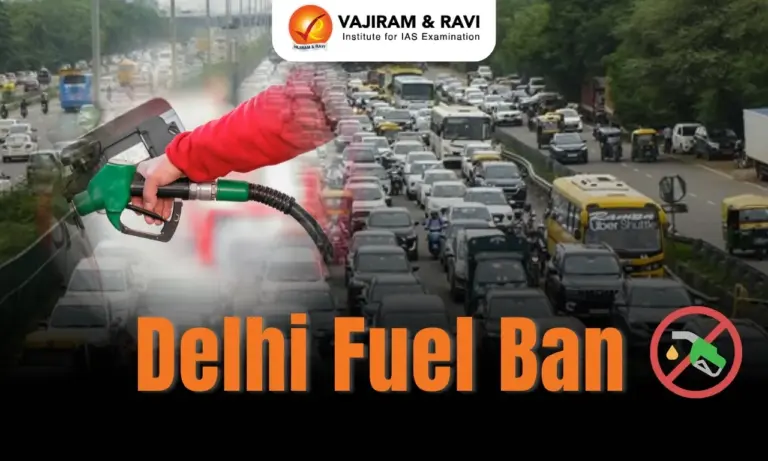
- Facing backlash over the fuel ban for old vehicles, the Delhi Government announced that end-of-life vehicles will not be impounded.
- Environment Minister of Delhi said a new system for handling old vehicles is being planned.
- The Commission for Air Quality Management (CAQM) directive to remove end-of-life vehicles from roads is based on long-standing court orders and serious environmental concerns.
Delhi’s Fuel Ban for Old Vehicles
- Starting July 1, diesel vehicles over 10 years old and petrol vehicles over 15 years old are denied fuel at Delhi’s fuel stations under the CAQM directive.
- In April 2025, the CAQM directed a phased denial of fuel to ELVs at fuel stations in the NCR:
- in Delhi from July 1,
- in high-density NCR districts from November 1, and
- in the rest of the NCR from April 1, 2026.
- In April 2025, the CAQM directed a phased denial of fuel to ELVs at fuel stations in the NCR:
Real-Time Enforcement with ANPR Technology
- 498 fuel stations and 3 ISBTs now have Automatic Number Plate Recognition (ANPR) cameras.
- These scan vehicle plates and cross-check with the VAHAN database.
- If identified as an End-of-Life Vehicle (ELV), an audio alert is triggered, and fuel is denied.
Enforcement and Penalties
- ELVs may be impounded and scrapped unless valid exemptions or documents are shown.
- Enforcement teams include the Transport Department, Traffic Police, and civic bodies.





Delhi Government Flags Premature Implementation
- Delhi Environment Minister, in a letter to CAQM, called the immediate enforcement of the fuel ban “premature and potentially counterproductive”.
- The Automatic Number Plate Recognition (ANPR) system is facing multiple issues:
- Camera misplacement
- Non-functional sensors and speakers
- Inability to detect ELVs due to HSRP-related issues
- The system lacks integration with vehicle databases of adjoining NCR districts, making it easy for vehicle owners to bypass the ban by refueling in nearby areas.
- Due to these technological and operational issues, the public is facing inconvenience, leading to widespread discontent and backlash.
Why Older Vehicles Are a Concern
- Authorities say pre-BS-VI vehicles significantly contribute to air pollution, even if maintained well.
- BS-IV vehicles emit 4.5 to 5.5 times more particulate matter than BS-VI vehicles.
- BS-VI norms became mandatory from April 1, 2020, setting stricter emission standards.
- Transport sector accounts for: 28% of PM2.5; 41% of SO₂; 78% of NOx emissions. CAQM highlights transport as a key driver of Delhi’s air pollution.
- While legal mandates for banning overage vehicles existed since 2015, lack of technology delayed enforcement.
NGT’s 2015 Ban on Old Vehicles
- In 2015, the National Green Tribunal (NGT) banned – Diesel vehicles older than 10 years; Petrol vehicles older than 15 years – from operating or being registered in Delhi-NCR.
- In 2018, the Supreme Court upheld the NGT’s directive and ordered that violating vehicles must be impounded.
New Scrapping Rules Reinforce Mandate
- In 2023, Delhi framed guidelines under the Motor Vehicles Act and Registered Vehicle Scrapping Facility (RVSF) Rules.
- The Environment Protection (End-of-Life Vehicles) Rules, 2025, effective April 1, mandate scrapping within 180 days of a vehicle’s registration expiry.
Legal Basis Under Motor Vehicles Act
- Motor Vehicles Act, 1988: Registration for non-transport vehicles valid for 15 years, renewable thereafter.
- Central Motor Vehicles Rules, 1999: After expiry, a vehicle is no longer considered validly registered.
Effectiveness of Such Measures in Dealing with Delhi’s Bad Air Problem
- Experts agree that no single measure, including the fuel ban for old vehicles, can fully resolve Delhi’s severe air quality crisis.
- The Centre for Science and Environment (CSE) cautions that age caps aren’t scalable nationwide and older vehicles aren’t the only polluters.
- Poor maintenance can make even newer vehicles highly polluting.
Multi-Pronged Approach Needed
- CSE advocates a comprehensive strategy, including:
- Upgrading fuel and emission standards
- Strict Pollution-Under-Control (PUC) enforcement
- Major expansion of public transport

 Last updated on March, 2026
→ UPSC Final Result 2025 is now out.
→ UPSC has released UPSC Toppers List 2025 with the Civil Services final result on its official website.
→ Anuj Agnihotri secured AIR 1 in the UPSC Civil Services Examination 2025.
→ UPSC Marksheet 2025 is now out.
→ UPSC Notification 2026 & UPSC IFoS Notification 2026 is now out on the official website at upsconline.nic.in.
→ UPSC Calendar 2026 has been released.
→ Check out the latest UPSC Syllabus 2026 here.
→ UPSC Prelims 2026 will be conducted on 24th May, 2026 & UPSC Mains 2026 will be conducted on 21st August 2026.
→ The UPSC Selection Process is of 3 stages-Prelims, Mains and Interview.
→ Prepare effectively with Vajiram & Ravi’s UPSC Prelims Test Series 2026 featuring full-length mock tests, detailed solutions, and performance analysis.
→ Enroll in Vajiram & Ravi’s UPSC Mains Test Series 2026 for structured answer writing practice, expert evaluation, and exam-oriented feedback.
→ Join Vajiram & Ravi’s Best UPSC Mentorship Program for personalized guidance, strategy planning, and one-to-one support from experienced mentors.
→ Shakti Dubey secures AIR 1 in UPSC CSE Exam 2024.
→ Also check Best UPSC Coaching in India
Delhi Fuel Ban FAQs
Q1. What is Delhi’s fuel ban for old vehicles? +
Q2. Why are older vehicles targeted in Delhi? +
Q3. What legal backing supports Delhi’s fuel ban? +
Q4. What issues hamper enforcement of the ban? +
Q5. Can this ban alone solve Delhi’s pollution? +
Tags: delhi fuel ban mains articles upsc current affairs upsc mains current affairs