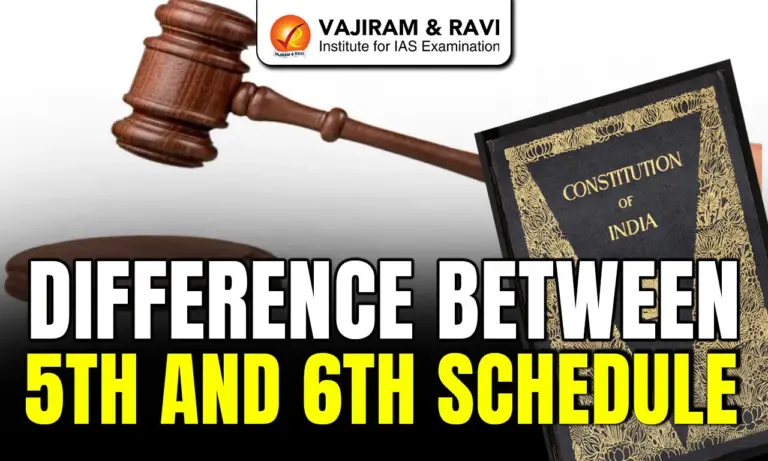
The Difference between 5th and 6th Schedule of the Constitution of India is mainly about the level of autonomy given to tribal areas. The 5th Schedule applies to tribal areas in mainland India and gives special powers to the Governor for their administration. The 6th Schedule applies to certain tribal areas in Northeast India and provides Autonomous District Councils with legislative and financial powers. Thus, the 6th Schedule grants greater self-governance compared to the 5th Schedule.
Difference between 5th and 6th Schedule
The Difference Between 5th and 6th Schedule of the Constitution of India mainly lies in the level of autonomy, administrative structure, and legislative powers granted to tribal areas which has been discussed below.
| Difference between 5th and 6th Schedule | ||
|
Basis of Comparison |
5th Schedule |
6th Schedule |
|
Constitutional Provision |
Covered under Article 244(1). |
Covered under Article 244(2) and Article 275(1). |
|
Geographical Coverage |
Applies to tribal areas in mainland India. |
Applies to specific tribal areas in Northeast India. |
|
States Covered |
10 states including Jharkhand, Chhattisgarh, Odisha, etc. |
4 states – Assam, Meghalaya, Tripura, and Mizoram. |
|
Administrative Authority |
Governor has special powers for administration of Scheduled Areas. |
Autonomous District Councils (ADCs) administer tribal areas. |
|
Autonomous Councils |
No provision for Autonomous District Councils. |
Provides for elected Autonomous District Councils and Regional Councils. |
|
Legislative Powers |
Governor can make regulations to restrict land transfer and money lending. |
Councils can make laws on land, forest, agriculture, marriage, inheritance, and customs. |
|
Judicial Powers |
No separate judicial system; regular courts function. |
ADCs can establish village courts for tribal dispute resolution. |
|
Financial Powers |
Limited financial autonomy; funds mainly through state government. |
Councils can levy and collect taxes on land, markets, tolls, etc. |
|
Tribes Advisory Council (TAC) |
Mandatory TAC to advise on tribal welfare matters. |
No Tribes Advisory Council; governance through ADCs. |
|
Level of Autonomy |
Moderate autonomy under state supervision. |
High degree of autonomy with legislative and financial powers. |
|
Objective |
Protect tribal interests and prevent exploitation in Scheduled Areas. |
Preserve tribal identity and ensure self-rule in Northeast India. |
5th Schedule of Indian Constituion
The 5th Schedule of the Indian Constitution deals with the administration and control of Scheduled Areas and Scheduled Tribes in states other than the Northeast. It provides special powers to the Governor to ensure protection of tribal land, culture, and welfare under Article 244(1) of the Constitution of India.
- Applies to tribal areas in mainland India (10 states which includes ).
- President declares Scheduled Areas.
- Governor has special powers to make regulations for peace and good governance.
- Governor can restrict transfer of tribal land to non-tribals.
- Governor can regulate money-lending activities in tribal areas.
- Mandatory establishment of Tribes Advisory Council (TAC).
- Governor submits annual report to the President regarding administration.
- Provides moderate autonomy under state government supervision.
- Aims to protect tribal communities from exploitation and displacement.





6th Schedule of Indian Constituion
The 6th Schedule of the Indian Constitution provides special autonomy to tribal areas in Northeast India. It ensures self-governance through Autonomous District Councils under Article 244(2) and Article 275(1) of the Constitution of India.
- Applies to four states: Assam, Meghalaya, Tripura, and Mizoram.
- Provides for Autonomous District Councils (ADCs) and Regional Councils.
- Councils have legislative powers on land, forest, agriculture, customs, and marriage.
- Councils can establish village courts for dispute resolution.
- Councils have financial powers to levy and collect certain taxes.
- Greater autonomy compared to the 5th Schedule.
- Protects tribal identity, culture, and traditions.
- Allows self-governance at district and regional levels.

 Last updated on March, 2026
→ UPSC Final Result 2025 is now out.
→ UPSC has released UPSC Toppers List 2025 with the Civil Services final result on its official website.
→ Anuj Agnihotri secured AIR 1 in the UPSC Civil Services Examination 2025.
→ UPSC Marksheet 2025 is now out.
→ UPSC Notification 2026 & UPSC IFoS Notification 2026 is now out on the official website at upsconline.nic.in.
→ UPSC Calendar 2026 has been released.
→ Check out the latest UPSC Syllabus 2026 here.
→ UPSC Prelims 2026 will be conducted on 24th May, 2026 & UPSC Mains 2026 will be conducted on 21st August 2026.
→ The UPSC Selection Process is of 3 stages-Prelims, Mains and Interview.
→ Prepare effectively with Vajiram & Ravi’s UPSC Prelims Test Series 2026 featuring full-length mock tests, detailed solutions, and performance analysis.
→ Enroll in Vajiram & Ravi’s UPSC Mains Test Series 2026 for structured answer writing practice, expert evaluation, and exam-oriented feedback.
→ Join Vajiram & Ravi’s Best UPSC Mentorship Program for personalized guidance, strategy planning, and one-to-one support from experienced mentors.
→ Shakti Dubey secures AIR 1 in UPSC CSE Exam 2024.
→ Also check Best UPSC Coaching in India
Difference between 5th and 6th Schedule FAQs
Q1. Which Article of the Constitution deals with the 5th and 6th Schedule?+
Q2. What is the main difference between the 5th and 6th Schedule?+
Q3. How many states are covered under the 6th Schedule?+
Q4. Does the 5th Schedule provide Autonomous District Councils?+
Q5. Which Schedule provides more autonomy to tribal areas?+
Tags: polity polity notes