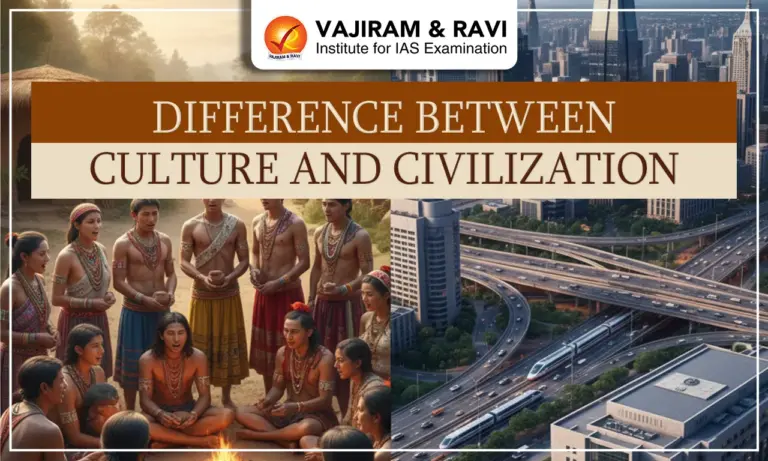
The terms culture and civilization are often used interchangeably, but they represent two distinct aspects of human society. Both are essential to understanding human progress, yet there is a Difference Between Culture and Civilization in scope, meaning, and expression. Culture reflects the values, beliefs, traditions, and artistic expressions of a society, while civilization represents its advanced stage of material, institutional, and technological development.
Difference Between Culture and Civilization
The Difference Between Culture and Civilization lies not in opposition but in purpose, culture refines the inner self, while civilization builds the outer world. Together, they form the twin pillars of human progress. India’s long history exemplifies that sustainable growth depends on harmonizing spiritual values with material advancement.
What is Culture?
Culture is the collective identity of a community. It encompasses customs, traditions, values, languages, arts, religion, food habits, and social norms that define the way people live and interact. According to Edward B. Tylor, culture is “that complex whole which includes knowledge, belief, art, morals, law, customs, and any other capabilities acquired by man as a member of society.”
In India, culture is diverse and deeply rooted in its spiritual and social fabric. Every region, from the folk dances of Rajasthan to the classical music of Tamil Nadu, represents a unique cultural expression. It is transmitted from generation to generation through socialization and education, shaping collective identity and guiding behavior.





Culture Aspects
The major aspects of the Culture has been listed below:
- Language and Literature: Examples include Sanskrit, Tamil, Hindi, Urdu, and regional literatures that preserve knowledge.
- Art and Architecture: The Ajanta caves, Mughal paintings, and temple sculptures display India’s cultural depth.
- Religious Beliefs: Hinduism, Buddhism, Jainism, Islam, Sikhism, and Christianity have coexisted and evolved harmoniously.
- Customs and Rituals: Practices like Namaste, festivals such as Diwali, Eid, and Christmas, express social unity.
- Social Values: Respect for elders, community living, and family bonding form the base of Indian culture.
What is Civilization?
Civilization represents the advanced stage of human social and material development characterized by organized governance, technology, economy, and urbanization. It is the external manifestation of human progress, visible in architecture, science, governance, and institutions.
According to Samuel Huntington, civilization is “the highest cultural grouping of people and the broadest level of cultural identity.” Civilization is, therefore, a comprehensive system where multiple cultures coexist under shared political, economic, and social structures.”
The Indus Valley Civilization (2500 BCE) is one of the earliest examples of civilization in India. It had planned cities like Mohenjo-Daro and Harappa, drainage systems, and trade networks showing the material and institutional development of human society.
Civilization Features
The major features of the civilization has been listed below:
- Urban Development: Planned cities and infrastructure.
- Political Organization: Centralized administration and laws.
- Economic Growth: Trade, agriculture, and specialized occupations.
- Scientific and Technological Progress: Innovations in metallurgy, medicine, and astronomy.
- Cultural Integration: Interaction among multiple cultural groups.
Difference Between Culture and Civilization Aspects
While culture represents the inner growth of human beings, civilization is the outward expression of that growth. Both complement each other, but their essence lies in different dimensions of human development.
| Difference Between Culture and Civilization | ||
| Aspects | Culture | Civilization |
|
Meaning |
Culture refers to values, beliefs, customs, and traditions of society. |
Civilization refers to the advanced stage of material and institutional development. |
|
Nature |
Internal and spiritual. |
External and material. |
|
Focus |
Moral, ethical, and emotional growth. |
Technological, administrative, and structural progress. |
|
Growth Source |
Grows from shared values and social interaction. |
Grows from innovation, science, and governance. |
|
Change |
Changes slowly through tradition and social reform. |
Changes rapidly through technology and modernization. |
|
Scope |
Narrower- deals with behavior and thought. |
Broader- deals with organization and systems. |
|
Dependency |
Civilization may exist without culture’s depth. |
Culture cannot sustain without civilization’s structure. |
|
Examples |
Indian spirituality, art, music, festivals. |
Indus Valley, Mesopotamian, Egyptian, Western civilization. |
|
Representation |
Expressed through customs and beliefs. |
Expressed through infrastructure and institutions. |
|
Objective |
To improve the quality of life emotionally and spiritually. |
To improve comfort and efficiency materially. |
Relationship Between Culture and Civilization
Although there is a Difference Between Culture and Civilization, they are interdependent. A civilization without cultural roots loses its identity, while culture without civilizational support struggles to survive. For instance, ancient India’s civilization thrived because of its deep cultural values of Dharma and collective ethics.
Civilization provides the framework- education, governance, and economy; while culture gives meaning and soul to those structures. The balance between both ensures sustainable progress, as seen in India’s evolution through the Vedic, Mauryan, and Gupta periods where spiritual and material advancements complemented each other.
Difference Between Culture and Civilization in India
India stands as a living example where culture and civilization have evolved together for thousands of years. Indian civilization is one of the world’s oldest, with archaeological, linguistic, and literary evidence showcasing continuity from the Indus Valley Civilization to the modern Republic of India.
- Spiritual and Philosophical Heritage: Ancient texts like the Vedas, Upanishads, and Arthashastra contributed to India’s intellectual and civilizational depth.
- Social Organization: The varna system, though later distorted, originally aimed to organize society based on functions and duties.
- Scientific Progress: Ancient India contributed in mathematics (Aryabhata’s zero), medicine (Charaka Samhita), and architecture.
- Urban Development: Cities like Pataliputra and Taxila symbolized administrative and educational advancements.
- Continuity of Values: Despite colonization, India’s civilizational ethos, unity in diversity, has remained intact.
Difference Between Culture and Civilization Philosophical Interpretations
Various thinkers have interpreted the Difference Between Culture and Civilization differently:
- Mahatma Gandhi viewed civilization as outward progress but believed that true advancement lies in moral and spiritual culture.
- Arnold Toynbee argued that civilizations rise and fall based on their moral and spiritual vitality.
- Swami Vivekananda emphasized that material progress must go hand in hand with spiritual and cultural evolution.
- These interpretations underline the idea that civilization is sustainable only when rooted in strong cultural values.
Difference Between Culture and Civilization Examples
The key examples defining the Difference Between Culture and Civilization in the World History is given below:
- Ancient Egypt: Flourished through scientific and architectural progress but declined when moral corruption spread.
- Greek Civilization: Excelled in philosophy and governance, blending culture (ethics and arts) with civilization (institutions).
- Roman Civilization: Reached heights of infrastructure but collapsed under moral and social decay, showing imbalance between culture and civilization.
- Indian Civilization: Survived multiple invasions due to its adaptable and value-based culture.
Culture and Civilization Impact of Modernization
Modernization and globalization have blurred the boundaries between culture and civilization. Technological advancements have accelerated civilizational progress, but they have also challenged traditional cultural norms. In India, while the civilizational progress is visible through urbanization and economic reforms, cultural shifts such as westernization and consumerism have raised concerns about value preservation.
Positive Impacts:
- Increased cultural exchange through digital media.
- Preservation of heritage via modern technology.
- Improvement in education, healthcare, and governance systems.
Negative Impacts:
- Erosion of traditional values.
- Homogenization of diverse cultural identities.
- Overemphasis on material success over ethical living.
Culture and Civilization in India
India’s ability to balance culture and civilization is evident through its historical resilience. Even after colonial exploitation, India revived its cultural heritage through democratic governance and socio-economic reforms. The coexistence of spirituality (culture) with modern institutions (civilization) is reflected in:
- The Indian Constitution, which upholds equality, secularism, and liberty rooted in civilizational ethics.
- National symbols like the Ashoka Chakra, representing Dharma and progress.
- Programs like Ek Bharat Shreshtha Bharat, promoting cultural unity alongside civilizational development.
Culture and Civilization Challenges
Major Challenges in balancing the Culture and Civilization has been listed below along with the suggested reforms. A balanced approach ensures that civilizational growth does not overpower cultural depth, preserving the moral foundation of society.
- Cultural Erosion: Rapid globalization has weakened traditional practices.
- Urbanization Pressure: Civilizational growth sometimes leads to loss of rural heritage.
- Language Decline: Indigenous languages face extinction due to western influence.
- Moral Crisis: Focus on material progress has led to ethical degradation.
- Technological Divide: Unequal access affects inclusive civilizational growth.
Way Forward:
- Cultural Preservation: Encourage local arts, crafts, and languages through education.
- Inclusive Development: Blend traditional wisdom with modern innovation.
- Ethical Governance: Promote values of integrity, justice, and empathy.
- Sustainable Civilization: Integrate ecological balance with technological progress.
- Education Reform: Include moral and cultural studies alongside technical education.

 Last updated on March, 2026
→ UPSC Final Result 2025 is now out.
→ UPSC has released UPSC Toppers List 2025 with the Civil Services final result on its official website.
→ Anuj Agnihotri secured AIR 1 in the UPSC Civil Services Examination 2025.
→ UPSC Marksheet 2025 is now out.
→ UPSC Notification 2026 & UPSC IFoS Notification 2026 is now out on the official website at upsconline.nic.in.
→ UPSC Calendar 2026 has been released.
→ Check out the latest UPSC Syllabus 2026 here.
→ UPSC Prelims 2026 will be conducted on 24th May, 2026 & UPSC Mains 2026 will be conducted on 21st August 2026.
→ The UPSC Selection Process is of 3 stages-Prelims, Mains and Interview.
→ Prepare effectively with Vajiram & Ravi’s UPSC Prelims Test Series 2026 featuring full-length mock tests, detailed solutions, and performance analysis.
→ Enroll in Vajiram & Ravi’s UPSC Mains Test Series 2026 for structured answer writing practice, expert evaluation, and exam-oriented feedback.
→ Join Vajiram & Ravi’s Best UPSC Mentorship Program for personalized guidance, strategy planning, and one-to-one support from experienced mentors.
→ Shakti Dubey secures AIR 1 in UPSC CSE Exam 2024.
→ Also check Best UPSC Coaching in India
Difference Between Culture and Civilization FAQs
Q1. What is the main Difference Between Culture and Civilization?+
Q2. Can Civilization exist without Culture?+
Q3. Who first defined Culture in Anthropological terms?+
Q4. How is Indian Civilization unique from others?+
Q5. What are the major challenges in balancing Culture and Civilization?+
Tags: difference between culture and civilization