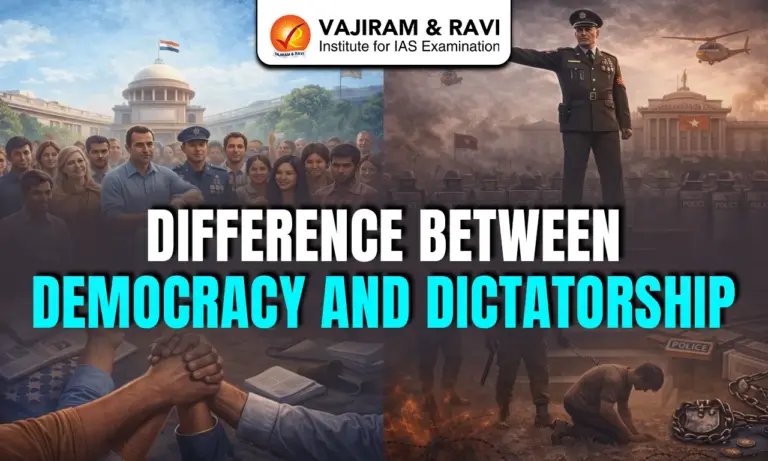
Democracy and dictatorship are two different systems of government. In a democracy, the people have the power and choose their leaders through elections, with rights and freedoms protected. In a dictatorship, power is concentrated in the hands of one person or a small group, and citizens have limited influence and fewer freedoms. The Difference between Democracy and Dictatorship is highlighted below to get a clear understanding.
Difference between Democracy and Dictatorship
Democracy and dictatorship are two opposite ways of running a country. In a democracy, people have the power to choose their leaders and participate in decision-making and individual freedoms are respected. In a dictatorship, all power rests with a single leader or group, who control the government and citizens’ lives, often without accountability. The Difference Between Democracy and Dictatorship are discussed below in detail.
| Difference between Democracy and Dictatorship | ||
| Basis | Democracy | Dictatorship |
|
Source of Power |
Power comes from the people. Citizens elect representatives who govern on their behalf (popular sovereignty). |
Power is concentrated in the hands of one person or a small group. Authority is often maintained through force, control, or manipulation. |
|
Leadership Selection |
Leaders are chosen through free and fair elections. Citizens have a voice in governance. |
Leaders often come to power without genuine elections or through manipulation. Opposition is suppressed. |
|
Political Freedoms |
Citizens enjoy rights like freedom of speech, assembly and participation in politics. |
Political freedoms are restricted. Dissent is punished and opposition is banned. |
|
Media & Information |
Free and independent media acts as a watchdog, reporting government actions and holding leaders accountable. |
The media is controlled by the government. It spreads only favorable information, suppressing criticism. |
|
Decision-Making |
Decisions are made after discussion, debate and consultation among representatives. |
Decisions are made centrally by the dictator or ruling group. Public opinion is usually ignored. |
|
Checks and Balances |
Institutions like the judiciary, legislature, and independent commissions prevent abuse of power. |
Institutional checks are weak or absent. The ruler has almost complete control. |
|
Inclusivity |
Encourages representation of minorities and diverse opinions in governance. |
Limited pluralism. Only the ruler’s decisions and ideology dominate; alternative voices are suppressed. |
|
Transparency |
Governance is open. Citizens can access information and hold leaders accountable. |
Lack of transparency. Decisions are often secret, and citizens have little understanding of government actions. |
|
Individual Rights |
Fundamental rights are protected. People can join political parties, groups and express opinions freely. |
Individual rights are often violated. Citizens may face monitoring, repression or state violence. |
|
Transition of Power |
Power changes peacefully through regular, constitutional elections. |
Power changes often through force, hereditary succession or coups. |
|
Examples |
Democracy: India, United States, Germany, Canada, Japan |
Dictatorship: North Korea, Syria, Cuba, Belarus |
Democracy
Democracy is a form of government where the people hold the real power. Citizens participate in decision-making through free and fair elections, ensuring that leaders represent the will of the people. A democratic government protects individual rights, freedoms, and the rule of law, and it aims to balance the needs of both the majority and minorities. Transparency, accountability, and inclusiveness are key features that make democracy work.
- Characteristics of Democracy
- Popular Sovereignty: People are the ultimate source of power and are encouraged to actively participate in governance.
- Elections: Free, fair and regular elections allow citizens to choose their leaders and hold them accountable.
- Individual Rights: Democracy protects personal freedoms, equality, and basic human rights.
- Rule of Law: Laws apply equally to everyone, and justice is fair and impartial.
- Transparency and Accountability: Leaders are answerable to the people, and government actions are open to public scrutiny.
- Examples of Democracy
- India: The largest democracy in the world, with elected representatives at both central and state levels in a federal parliamentary system.
- United States: A federal democratic republic where officials are elected at local, state, and national levels.
- United Kingdom: A parliamentary democracy where citizens elect Members of Parliament to represent them in the House of Commons.
- Germany: A federal parliamentary republic where citizens elect representatives to the Bundestag.
- Canada: A federal parliamentary democracy where the Prime Minister is elected indirectly through the Parliament.
- Democracy is not just about elections; it is about ensuring everyone’s voice is heard, protecting rights, and creating a government that serves the people fairly and responsibly. It encourages participation, debate, and compromise, helping societies grow peacefully and fairly.





Dictatorship
A Dictatorship is a form of government where all power is held by a single person or a small group, called the dictator. Dictators often gain power through force or manipulation rather than elections. In this system, decisions can be made quickly, but citizens have very little freedom or say in how the country is run. Political opposition is usually suppressed, and individual rights are often ignored.
- Characteristics of a Dictatorship
- Concentration of Power: One person or a small group controls all aspects of government.
- Authoritarian Rule: Power is maintained through force, threats or strict control rather than democratic processes.
- Limited Political Freedoms: Opposition parties, protests and criticism of the government are often banned or punished.
- Lack of Checks and Balances: Institutions like courts or legislatures cannot limit the dictator’s power.
- Rapid Decision-Making: Decisions are made quickly, but citizens’ participation and rights are often ignored.
- Examples of Dictatorships
- North Korea: Ruled by the Kim family in a hereditary one-party system with tight control over politics and society.
- Cuba: Led by the Communist Party with limited political freedom, historically under Fidel Castro.
- Syria: Long-term authoritarian rule under the Assad family, suppressing dissent.
- Zimbabwe: Robert Mugabe’s rule, marked by economic problems and political repression.
- Dictatorships can make decisions fast, but this often comes at the cost of people’s freedoms and equality. Unlike democracy, citizens have very little role in governance, and dissent is not tolerated.

 Last updated on March, 2026
→ UPSC Final Result 2025 is now out.
→ UPSC has released UPSC Toppers List 2025 with the Civil Services final result on its official website.
→ Anuj Agnihotri secured AIR 1 in the UPSC Civil Services Examination 2025.
→ UPSC Marksheet 2025 is now out.
→ UPSC Notification 2026 & UPSC IFoS Notification 2026 is now out on the official website at upsconline.nic.in.
→ UPSC Calendar 2026 has been released.
→ Check out the latest UPSC Syllabus 2026 here.
→ UPSC Prelims 2026 will be conducted on 24th May, 2026 & UPSC Mains 2026 will be conducted on 21st August 2026.
→ The UPSC Selection Process is of 3 stages-Prelims, Mains and Interview.
→ Prepare effectively with Vajiram & Ravi’s UPSC Prelims Test Series 2026 featuring full-length mock tests, detailed solutions, and performance analysis.
→ Enroll in Vajiram & Ravi’s UPSC Mains Test Series 2026 for structured answer writing practice, expert evaluation, and exam-oriented feedback.
→ Join Vajiram & Ravi’s Best UPSC Mentorship Program for personalized guidance, strategy planning, and one-to-one support from experienced mentors.
→ Shakti Dubey secures AIR 1 in UPSC CSE Exam 2024.
→ Also check Best UPSC Coaching in India
Difference between Democracy and Dictatorship FAQs
Q1. What is democracy?+
Q2. What is dictatorship?+
Q3. What are the main characteristics of democracy?+
Q4. What are the main characteristics of dictatorship?+
Q5. How do elections and political participation differ?+
Tags: Difference between Democracy and Dictatorship polity polity notes