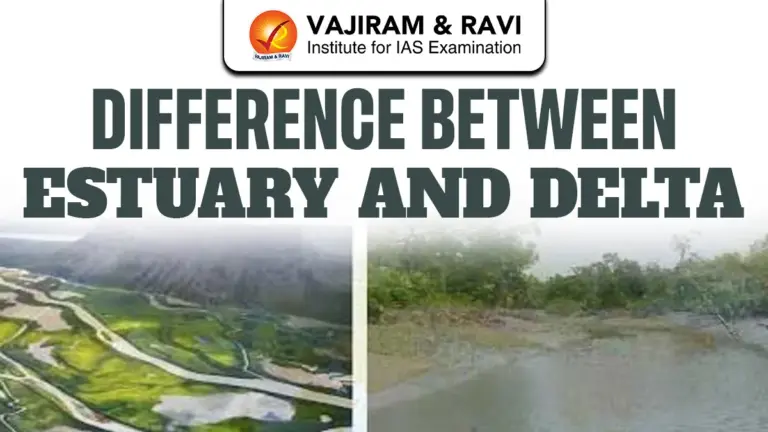
A delta is a landform formed at the mouth of a river where it deposits sand, silt, and clay, creating fertile land and often splitting into multiple distributaries. An estuary is a partially enclosed water body where freshwater from rivers mixes with seawater, forming brackish water. Deltas are shaped by sediment deposition and usually grow outward into the sea, while estuaries are shaped by tidal action and often form funnel-shaped channels. The Difference Between Estuary and Delta has been shared below in details in the article.
What is an Estuary?
An estuary is a partially enclosed coastal water body formed at the place where a river meets the sea and tidal action is strong enough to prevent sediment deposition. Unlike deltas, estuaries are dominated by erosion, tidal currents, and seawater intrusion.
Estuaries act as transition zones between river environments and marine environments. One of their most distinctive features is the presence of brackish water, created by the mixing of freshwater and saline water. This mixing results in high nutrient availability, making estuaries some of the most productive ecosystems on Earth. Estuaries often develop in:
- Regions with strong tides
- Rift valleys
- Areas affected by sea-level rise or coastal submergence
Examples: Narmada Estuary, Thames Estuary, Amazon Estuary
What is Delta?
A delta is a landform formed at the mouth of a river where it enters a sea, ocean, or lake and loses its carrying capacity, resulting in the deposition of sediments. Deltas exist only in association with rivers, as they are created entirely from the sediments transported by flowing water.
As a river approaches its mouth, its velocity decreases, causing sand, silt, and clay to settle down. Over long periods, continuous deposition leads to the outward growth of land into the sea, known as delta progradation.
The size and shape of the delta depend upon:
- The amount and type of sediment supplied by the river
- The strength of tides, waves, and coastal currents
- The geometry and depth of the receiving basin
Examples: Ganga–Brahmaputra Delta, Nile Delta, Mississippi Delta





Difference Between Estuary and Delta
The difference between Estuary and Delta have been tabulated below.
| Difference Between Estuary and Delta | |
| Delta | Estuary |
|
A delta is a landform formed by the deposition of sediments at the mouth of a river. It gradually extends the river outward into the sea, forming fertile land. |
An estuary is a partially enclosed water body where freshwater from rivers mixes with seawater. It is shaped mainly by tidal action rather than sediment deposition. |
|
Deltas are formed at the river mouth where the river loses velocity, causing it to deposit sand, silt, and clay. Over time, these deposits create new land. |
Estuaries are formed where strong tides and sea currents prevent sediment accumulation. The river’s freshwater mixes with saltwater, creating brackish water. |
|
The shape of a delta is typically triangular, fan-shaped, or bird’s-foot, depending on sediment supply, tides, and coastal currents. |
The shape of an estuary is funnel-like or elongated, widening from the river mouth toward the sea. |
|
Rivers in a delta usually split into multiple distributaries, spreading sediments over a wide area and forming fertile plains. |
In estuaries, rivers generally have a single deep channel where tidal waters flow in and out. |
|
Deltas are characterized by high soil fertility due to continuous deposition of nutrient-rich alluvial soil, making them ideal for agriculture. |
Estuary regions have moderate soil fertility. Salinity and tidal action limit agricultural potential. |
|
Deltas support dense human settlements, agriculture, and inland fisheries because of fertile land and freshwater availability. |
Estuaries are more suitable for fisheries, navigation, and ports due to their deep channels and brackish water. |
|
Deltas are generally regressive, meaning they grow seaward as sediment deposition continues over time. |
Estuaries are transgressive, indicating gradual inland encroachment by the sea due to tidal action or rising sea levels. |
|
Deltas are formed under low to moderate tidal influence, and waves are not strong enough to remove deposited sediments. |
Estuaries form in regions with high tidal influence, strong currents, or rift valleys, which maintain open water channels. |
|
Deltas are vulnerable to flooding, cyclones, and land subsidence due to low elevation and dense population. |
Estuaries are prone to tidal flooding, salinity intrusion, and habitat changes, but support rich aquatic biodiversity. |
|
Examples of Indian deltas include Ganga–Brahmaputra, Godavari, Krishna, and Mahanadi. |
Examples of Indian estuaries include Narmada, Tapi, Periyar, and Mahi. |
Similarities between Estuary and Delta
Both estuaries and deltas are formed at the mouths of rivers where rivers meet seas or oceans, representing a transition between terrestrial and marine environments. The Similarities between Estuary and Delta have been discussed below.
| Similarities between Estuary and Delta | |
| Feature | Similarity |
|
Location |
Both are found at the mouth of a river where it meets the sea or ocean. |
|
Interaction of Processes |
Both involve interaction between fluvial (river) and marine (sea) processes. |
|
Ecosystem Productivity |
Both are highly productive ecosystems, supporting diverse flora and fauna. |
|
Human Use |
Both provide resources for fisheries, navigation, and settlement. |
|
Ecological Importance |
Both act as nurseries for aquatic species and support rich biodiversity. |
|
Environmental Sensitivity |
Both are vulnerable to climate change, sea-level rise, and human activities. |

 Last updated on April, 2026
→ UPSC Final Result 2025 is now out.
→ UPSC has released UPSC Toppers List 2025 with the Civil Services final result on its official website.
→ Anuj Agnihotri secured AIR 1 in the UPSC Civil Services Examination 2025.
→ UPSC Marksheet 2025 is now out.
→ UPSC Notification 2026 & UPSC IFoS Notification 2026 is now out on the official website at upsconline.nic.in.
→ UPSC Calendar 2026 has been released.
→ Check out the latest UPSC Syllabus 2026 here.
→ UPSC Prelims 2026 will be conducted on 24th May, 2026 & UPSC Mains 2026 will be conducted on 21st August 2026.
→ The UPSC Selection Process is of 3 stages-Prelims, Mains and Interview.
→ Prepare effectively with Vajiram & Ravi’s UPSC Prelims Test Series 2026 featuring full-length mock tests, detailed solutions, and performance analysis.
→ Enroll in Vajiram & Ravi’s UPSC Mains Test Series 2026 for structured answer writing practice, expert evaluation, and exam-oriented feedback.
→ Join Vajiram & Ravi’s Best UPSC Mentorship Program for personalized guidance, strategy planning, and one-to-one support from experienced mentors.
→ Shakti Dubey secures AIR 1 in UPSC CSE Exam 2024.
→ Also check Best UPSC Coaching in India
Difference Between Estuary and Delta FAQs
Q1. What is the main difference between a delta and an estuary?+
Q2. Which one is more fertile, a delta or an estuary?+
Q3. What is the shape of a delta and an estuary?+
Q4. How do tides affect deltas and estuaries?+
Q5. Can rivers form both deltas and estuaries?+
Tags: difference between estuary and delta