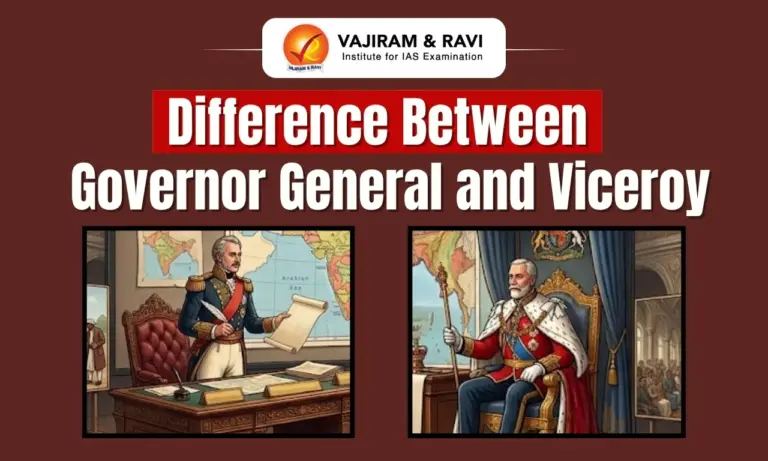
The Governor General and Viceroy were important offices in the administration of British India. Although the two terms are often used together, they belonged to different phases of British rule and reflected a change in the authority controlling India. The Governor General was associated mainly with the administration of territories under the East India Company, while the Viceroy represented the British Crown after 1858. The Difference Between Governor General and Viceroy is discussed in detail in this article.
Difference Between Governor General and Viceroy Meaning and Historical Background
- The office of Governor General was created by the Regulating Act of 1773, with Warren Hastings becoming the first Governor General of Bengal.
- The Charter Act of 1833 changed the designation to Governor General of India. Lord William Bentinck became the first Governor General of India under this arrangement.
- After the Revolt of 1857, the Government of India Act, 1858 ended the East India Company’s rule and transferred the administration of India to the British Crown.
- From 1858, the same official held both the titles of Governor General of India and Viceroy of India. Lord Canning was the first Viceroy.
- The title Governor General mainly reflected the official’s administrative role, while Viceroy highlighted his position as the representative of the British monarch in India.
- The office of Viceroy ended with Indian Independence in 1947, while the office of Governor General continued in independent India until 1950.
Difference Between Governor General and Viceroy
The Difference Between Governor General and Viceroy mainly relates to their period, authority and roles in British India. Although both titles were held by the same official after 1858, they reflected different aspects of administration and representation of British authority, as discussed below.
| Difference Between Governor General and Viceroy | ||
|
Basis |
Governor General |
Viceroy |
|
Period |
The office developed during East India Company rule, beginning in 1773. |
The title was introduced in 1858 after the transfer of power to the British Crown. |
|
Authority |
Worked under the authority of the East India Company before 1858. |
Served as the representative of the British Crown in India. |
|
Historical context |
Associated with the development and administration of British territories under Company rule. |
Emerged after the Revolt of 1857 and the beginning of direct Crown rule. |
|
First important holder |
Warren Hastings was the first Governor General of Bengal; Lord William Bentinck was the first Governor General of India. |
Lord Canning was the first Viceroy of India. |
|
Main role |
Focused mainly on the administration and governance of British-controlled territories. |
Combined administrative responsibilities with the role of representing the British monarch. |
|
Princely states |
Relations with princely states were part of the broader responsibilities of the colonial administration. |
The title Viceroy particularly emphasised the Crown’s political and diplomatic relationship with princely states. |
|
Appointment |
Before 1858, the Governor General was appointed through the East India Company’s system of authority. |
After 1858, the Viceroy was appointed by the British Crown under the new system of direct rule. |
|
End of office |
The position of Governor General continued even after 1858 and later continued in independent India until 1950. |
The office of Viceroy ended with Indian Independence in 1947. |
|
Last holder |
C. Rajagopalachari was the last Governor General of India. |
Lord Mountbatten was the last Viceroy of India. |


Governor General and Viceroy Powers and Functions
The powers and functions of the Governor-General and Viceroy evolved significantly during British rule in India. They exercised wide-ranging executive, legislative, judicial, financial and military powers, with the nature of their authority changing after the transfer of power from the East India Company to the British Crown in 1858. The major powers and functions are discussed below.
Governor General
- The Governor General was responsible for the overall administration of British-controlled territories and played a central role in implementing laws, policies and regulations.
- During the East India Company period, the Governor General exercised significant authority over the Company’s administrative and political affairs and helped consolidate British control in India.
- The office also played an important role in military and territorial expansion, including the use of wars, treaties and diplomatic arrangements to extend British influence.
- The Governor General supervised various branches of administration and worked with other senior officials to maintain revenue collection, law and order and governance.
Viceroy
- The Viceroy acted as the personal representative of the British monarch in India after the transfer of power from the East India Company to the Crown in 1858.
- The Viceroy exercised broad authority over British India’s political, administrative, military and economic affairs and implemented policies of the British government.
- A major aspect of the Viceroy’s role was maintaining relations with the princely states, making the office important in managing the political structure of British India.
- The Viceroy also worked with the Secretary of State for India and other British authorities, linking India’s administration with the government in Britain.
- In practice, after 1858, the Governor General and Viceroy were the same person holding two titles. The difference was mainly in the nature and emphasis of their roles: Governor General represented administrative authority, while Viceroy represented the British Crown.
List of Governors-General of India
The office of Governor-General evolved during British rule in India. The Regulating Act of 1773 created the post of Governor-General of Bengal, while the Charter Act of 1833 changed the designation to Governor-General of India. The following table highlights the major Governors-General and their important contributions:
|
Governor-General |
Tenure |
Major Contributions and Events |
|
Warren Hastings |
1773-1785 |
|
|
Sir John Macpherson |
1785-1786 |
|
|
Lord Cornwallis |
1786-1793 |
|
|
Sir John Shore |
1793-1798 |
|
|
Lord Wellesley |
1798-1805 |
|
|
Sir George Barlow |
1805-1807 |
|
|
Lord Minto I |
1807-1813 |
|
|
Lord Hastings |
1813-1823 |
|
|
Lord Amherst |
1823-1828 |
|
|
Lord William Bentinck |
1828-1835 |
|
|
Sir Charles Metcalfe |
1835-1836 |
|
|
Lord Auckland |
1836-1842 |
|
|
Lord Ellenborough |
1842-1844 |
|
|
Lord Hardinge I |
1844-1848 |
|
|
1848-1856 |
|
|
|
Lord Canning |
1856-1858 |
|
List of Viceroy of India
The office of Viceroy of India was introduced in 1858 after the end of East India Company rule. The Viceroy represented the British Crown and remained the highest authority in British India until independence in 1947.
|
Viceroy |
Tenure |
Major Contributions and Events |
|
Lord Canning |
1858-1862 |
|
|
Lord Elgin I |
1862-1863 |
|
|
Lord Lawrence |
1864-1869 |
|
|
Lord Mayo |
1869-1872 |
|
|
Lord Northbrook |
1872-1876 |
|
|
Lord Lytton |
1876-1880 |
|
|
Lord Ripon |
1880-1884 |
|
|
Lord Dufferin |
1884-1888 |
|
|
Lord Lansdowne |
1888-1894 |
|
|
Lord Elgin II |
1894-1899 |
|
|
Lord Curzon |
1899-1905 |
|
|
Lord Minto II |
1905-1910 |
|
|
Lord Hardinge II |
1910-1916 |
|
|
Lord Chelmsford |
1916-1921 |
|
|
Lord Reading |
1921-1926 |
|
|
Lord Irwin |
1926-1931 |
|
|
Lord Willingdon |
1931-1936 |
|
|
Lord Linlithgow |
1936-1944 |
|
|
Lord Wavell |
1944-1947 |
|
|
Lord Mountbatten |
1947-1948 |
|

 Last updated on Oct, 2026
→ UPSC 2027 Notification will be released on 13 January 2027 at upsconline.nic.in.
→ Check Nobel Prize 2026 Winners List here.
→ Download PIB PRiSM Monthly Magazine 2026 here.
→ Check UPSC Monthly Current Affairs Magazine The Recitals here.
→ Check out the latest UPSC Syllabus here.
→ Download UPSC Model Answers for Mains 2026
→ UPSC Mains Question Paper 2026 is out now for Essay & GS Paper 1, 2, 3 & 4.
→ UPSC Calendar 2027 has been released.
→ Enroll in Vajiram & Ravi’s UPSC Mains Test Series 2027 for structured answer writing practice, expert evaluation, and exam-oriented feedback.
→ Join Vajiram & Ravi’s UPSC Mentorship Program 2027 for personalized guidance, strategy planning, and one-to-one support from experienced mentors.
→ Go through the UPSC Mains Previous Year Papers to enhance your preparation.
→ UPSC has released UPSC Toppers List 2025 with the Civil Services final result on its official website.
→ Also check Best UPSC Coaching in India
Difference Between Governor General and Viceroy FAQs
Q1. What is the Difference Between Governor General and Viceroy?+
Q2. Who was the first Governor General of India?+
Q3. Who was the first Governor General of Bengal?+
Q4. Who was the first Viceroy of India?+
Q5. When was the office of Viceroy introduced in India?+
Q6. What were the powers and functions of the Governor General?+
Q7. What were the powers and functions of the Viceroy?+
Q8. Were the Governor General and Viceroy the same person?+
Q9. Who was the last Viceroy of India?+
Q10. Who was the last Governor General of India?+
Tags: difference between governor general and viceroy history history notes indian polity indian polity notes