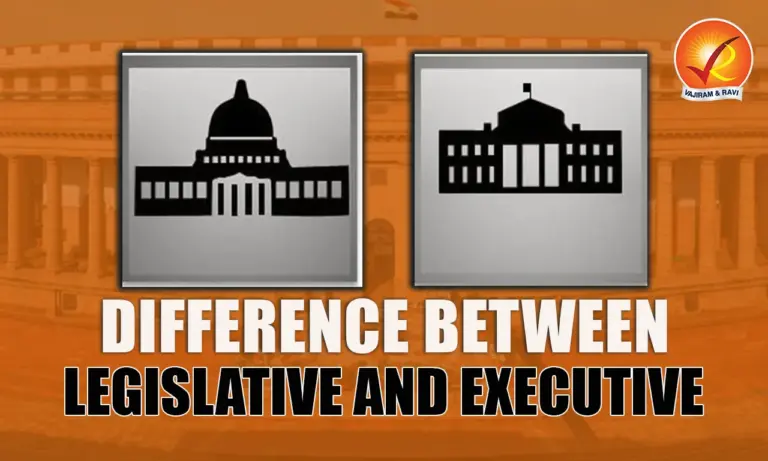
The Legislative and Executive are two important organs of government that play distinct yet complementary roles in a democratic system. While both are essential for the functioning of the state, they differ in structure, function, and responsibilities. Understanding the Difference Between Legislative and Executive is crucial for grasping the fundamentals of governance and constitutional law. This article covers the definitions, roles, comparisons, and frequently asked questions related to the Legislative and Executive branches.
Legislative
The Legislative refers to the branch of government that is primarily responsible for making laws. In a democratic setup, it reflects the will of the people and is composed of elected representatives.
Functions of the Legislature
- Law-making: Its primary role is to frame, amend, and repeal laws.
- Budget Approval: It passes the annual financial statement (budget) presented by the Executive.
- Oversight: It holds the Executive accountable through debates, questions, motions, and committees.
- Representation: It acts as a medium to represent the voice of the people.
- Amending the Constitution: In countries like India, the legislature plays a role in amending the Constitution.
Types of Legislature
- Unicameral Legislature: Consists of one house (e.g., the Legislative Assembly in states like Kerala).
- Bicameral Legislature: Has two houses, Upper House (Rajya Sabha in India) and Lower House (Lok Sabha in India).
Executive
The Executive is the branch of government responsible for implementing laws and administering the day-to-day affairs of the state. It includes the President, Prime Minister, Council of Ministers, bureaucracy, and other administrative agencies.
Functions of the Executive
- Policy Execution: Implements laws and policies made by the Legislature.
- Administration: Manages the country’s internal and external affairs.
- Law Enforcement: Ensures compliance with laws and maintains law and order.
- Appointments and Governance: Appoints key officials and governs public institutions.
- Defense and Foreign Affairs: Responsible for national defense and managing diplomatic relations.
Types of Executive
- Nominal Executive (Head of State): Ceremonial head (e.g., President of India).
- Real Executive (Head of Government): Actual decision-maker (e.g., Prime Minister of India).
- Permanent Executive: Bureaucrats or civil servants.
- Political Executive: Elected leaders like ministers.





Difference Between Legislative and Executive
The Legislative and Executive are two essential pillars of governance in India, each performing distinct yet interrelated functions. While the Executive is responsible for implementing and administering laws, the Legislature is tasked with enacting them. Their interaction and balance ensure the smooth functioning of the democratic system. The table below highlights the fundamental Difference Between Legislative and Executive across various dimensions such as composition, role, accountability, and powers.
| Difference Between Legislative and Executive | ||
| Basis of Comparison | Legislative | Executive |
|
Primary Role |
Law-making |
Law implementation and administration |
|
Composition |
Elected representatives (MPs, MLAs) |
President, Prime Minister, Council of Ministers, bureaucracy |
|
Nature of Work |
Debates, discussions, policy formulation |
Decision-making, governance, and administration |
|
Accountability |
Accountable to the public through elections |
Accountable to the Legislature |
|
Head |
Speaker (Legislative Assembly/Parliament) |
Prime Minister (India) or President (in presidential systems) |
|
Powers |
Makes laws, controls finances, amends Constitution |
Enforces laws, governs the country, appoints officials |
|
Types |
Unicameral or Bicameral |
Nominal, Real, Political, and Permanent |
|
Example |
Parliament of India (Lok Sabha + Rajya Sabha) |
Union Government, State Governments, Ministries |
|
Term |
Fixed term (e.g., 5 years in India) |
Continues as long as it has the confidence of the Legislature (in parliamentary systems) |
Relationship Between Legislature and Executive in India
India follows a parliamentary system, where the Executive is drawn from the Legislature. This means the Council of Ministers, including the Prime Minister, are also Members of Parliament. The Executive remains in power only as long as it enjoys the confidence of the Lok Sabha (Lower House). In contrast, in countries like the United States, which follow a presidential system, the Executive and Legislature are separate and independent of each other.
Important Constitutional Provisions in India
The Indian Constitution, being the supreme law of the land, lays down a comprehensive framework for the functioning of the government. It includes various articles that define the structure, powers, and responsibilities of key institutions and authorities. The table below highlights some of the most Important Constitutional Provisions in India which are central to the operation of the Indian parliamentary system, executive authority, and legislative processes.
| Important Constitutional Provisions in India | |
| Article | Provision |
|
Article 79 |
Constitution of Parliament (Legislature) of India |
|
Article 74 |
Council of Ministers to aid and advise the President |
|
Article 75 |
Appointment of the Prime Minister and other ministers |
|
Article 85 |
Sessions of Parliament |
|
Article 123 |
President’s power to promulgate ordinances |
Why Is the Separation of Powers Important?
- Checks and Balances: Prevents concentration of power in one organ.
- Efficient Governance: Each branch focuses on its core responsibilities.
- Democratic Accountability: Legislature holds the Executive accountable.
Judicial Oversight: Ensures legality of executive actions.

 Last updated on March, 2026
→ UPSC Final Result 2025 is now out.
→ UPSC has released UPSC Toppers List 2025 with the Civil Services final result on its official website.
→ Anuj Agnihotri secured AIR 1 in the UPSC Civil Services Examination 2025.
→ UPSC Marksheet 2025 is now out.
→ UPSC Notification 2026 & UPSC IFoS Notification 2026 is now out on the official website at upsconline.nic.in.
→ UPSC Calendar 2026 has been released.
→ Check out the latest UPSC Syllabus 2026 here.
→ UPSC Prelims 2026 will be conducted on 24th May, 2026 & UPSC Mains 2026 will be conducted on 21st August 2026.
→ The UPSC Selection Process is of 3 stages-Prelims, Mains and Interview.
→ Prepare effectively with Vajiram & Ravi’s UPSC Prelims Test Series 2026 featuring full-length mock tests, detailed solutions, and performance analysis.
→ Enroll in Vajiram & Ravi’s UPSC Mains Test Series 2026 for structured answer writing practice, expert evaluation, and exam-oriented feedback.
→ Join Vajiram & Ravi’s Best UPSC Mentorship Program for personalized guidance, strategy planning, and one-to-one support from experienced mentors.
→ Shakti Dubey secures AIR 1 in UPSC CSE Exam 2024.
→ Also check Best UPSC Coaching in India
Difference Between Legislative and Executive FAQs
Q1. What is the main difference between Legislature and Executive?+
Q2. Can a person be a part of both Legislature and Executive in India?+
Q3. Who is the head of the Legislature in India?+
Q4. Is the President a part of the Executive or Legislature?+
Q5. Why is the Executive accountable to the Legislature in India?+
Tags: difference between legislative and executive