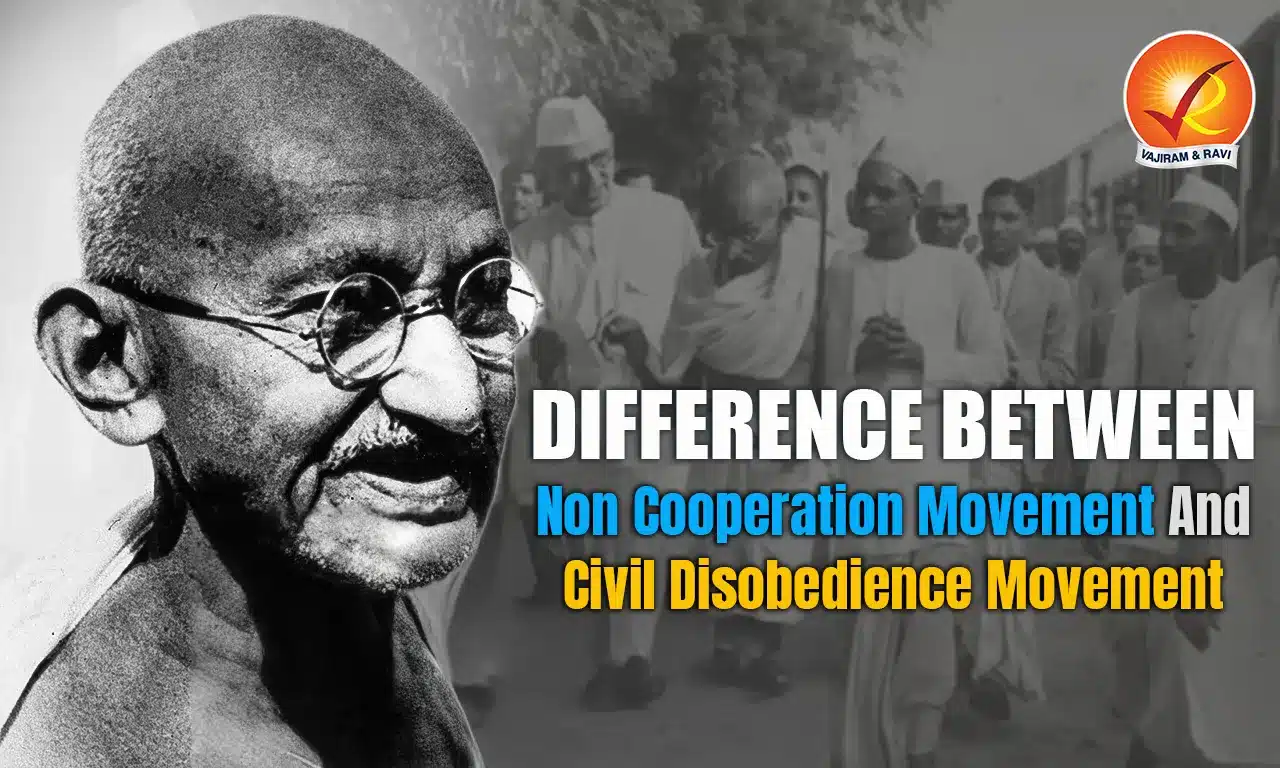
The difference between Non-Cooperation Movement and Civil Disobedience Movement is the time the event took place, the demands of both movements and their nature and intensity. While the Non-cooperation movement led to the decline in administration and operation of government, the Civil Disobedience Movement forced the British government to retrain its activities by opposing laws and policies. In this article, we are going to cover the difference between Non-Cooperation and Civil Disobedience Movement.
Difference between Non-Cooperation Movement and Civil Disobedience Movement
The Non-Cooperation and Civil Disobedience Movement are two important movements in the struggle for Indian Independence. Both the movements took place ten years apart, taking an important place in the development of the Gandhian Phase. The difference between Non-Cooperation and Civil Disobedience Movement are:
| Aspect | Non-Cooperation Movement (1920–22) | Civil Disobedience Movement (1930–34) |
|
Launched by |
Mahatma Gandhi |
|
|
Triggering Event |
Jallianwala Bagh Massacre (1919), Rowlatt Act (1919), and Khilafat Movement |
Salt Law and Gandhi’s Dandi March (1930) |
|
Objective |
Peacefully withdraw cooperation from the British government to attain Swaraj |
Actively break colonial laws and demand complete independence (Purna Swaraj) |
|
Nature of Protest |
Passive resistance: boycott-based movement without violating the law |
Active resistance: involved breaking specific colonial laws (like Salt Law) |
|
Major Tactics |
– Boycott of British schools, courts, titles, foreign cloth – Surrender of titles – Resignations |
– Salt Satyagraha – Boycott of foreign goods – Non-payment of taxes – Mass picketing |
|
Public Participation |
Wide participation, especially from urban middle classes, students, and lawyers |
Broader participation including peasants, women, and tribal groups |
|
Women Participation |
Limited |
Significant participation by women |
|
Muslim Participation |
High, due to the Khilafat Movement alliance |
Declined due to collapse of Hindu-Muslim unity |
|
Government Response |
Repression: arrests, lathi charges, and bans on gatherings |
More brutal repression, mass arrests, and violent suppression |
|
End of Movement |
Withdrawn after Chauri Chaura incident (1922) due to violence |
Suspended and resumed multiple times; lost momentum after Gandhi-Irwin Pact and arrests |
|
Outcome/Impact |
Awakening of political consciousness; first mass-scale resistance |
Strengthened demand for Purna Swaraj and showcased the strength of mass civil resistance |
|
Result |
Movement ended abruptly; Swaraj not achieved |
Created a base for future independence struggle; deepened nationalist sentiment |
Non-Cooperation Movement (1920–22)
Launched by Mahatma Gandhi, the Non-Cooperation Movement was India’s first mass civil disobedience campaign against British rule. It urged Indians to boycott British institutions, goods, titles, and promote swadeshi and khadi. Sparked by events like the Jallianwala Bagh massacre and Rowlatt Act, it united Hindus and Muslims in protest. Though it was withdrawn after the Chauri Chaura violence in 1922, the movement awakened national consciousness and marked a turning point in India’s freedom struggle.


Civil Disobedience Movement (1930–34)
Led by Mahatma Gandhi, the Civil Disobedience Movement began with the iconic Dandi March to break the Salt Law. It called upon Indians to openly defy British laws, refusing to pay taxes, boycotting foreign goods, and breaking unjust colonial rules. Unlike earlier movements, it saw broader participation from women, peasants, and tribal groups. Though it faced severe repression and was temporarily paused during the Gandhi-Irwin Pact, it reignited nationalist spirit and intensified the demand for Purna Swaraj.

 Last updated on Oct, 2026
→ UPSC 2027 Notification will be released on 13 January 2027 at upsconline.nic.in.
→ Check Nobel Prize 2026 Winners List here.
→ Download PIB PRiSM Monthly Magazine 2026 here.
→ Check UPSC Monthly Current Affairs Magazine The Recitals here.
→ Check out the latest UPSC Syllabus here.
→ Download UPSC Model Answers for Mains 2026
→ UPSC Mains Question Paper 2026 is out now for Essay & GS Paper 1, 2, 3 & 4.
→ UPSC Calendar 2027 has been released.
→ Enroll in Vajiram & Ravi’s UPSC Mains Test Series 2027 for structured answer writing practice, expert evaluation, and exam-oriented feedback.
→ Join Vajiram & Ravi’s UPSC Mentorship Program 2027 for personalized guidance, strategy planning, and one-to-one support from experienced mentors.
→ Go through the UPSC Mains Previous Year Papers to enhance your preparation.
→ UPSC has released UPSC Toppers List 2025 with the Civil Services final result on its official website.
→ Also check Best UPSC Coaching in India
Difference between Non-Cooperation Movement and Civil Disobedience Movement FAQs
Q1. What is the difference between Non-Cooperation and Civil Disobedience Movement?+
Q2. What is the difference between the Civil Disobedience Movement and the national movement?+
Q3. Is the Civil Disobedience Movement also known as the Non-Cooperation Movement?+
Q4. What is the other name for the Civil Disobedience Movement?+
Q5. What did Gandhi call the Non-Cooperation Movement?+
Tags: difference between non cooperation movement and civil disobedience movement