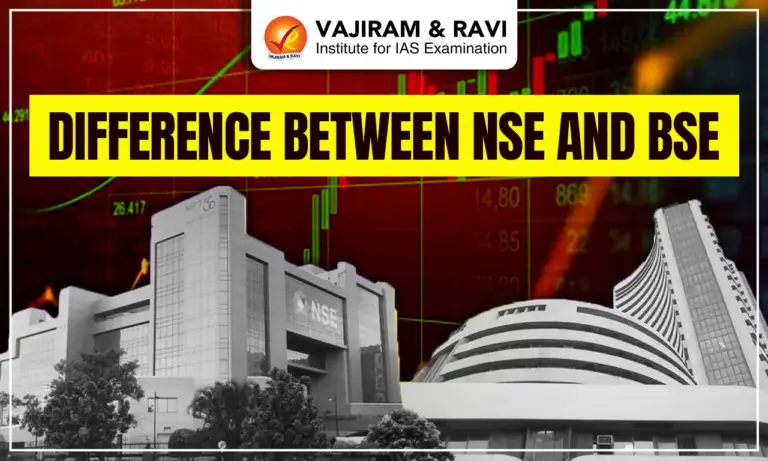
The Indian stock market is primarily dominated by two major exchanges- the National Stock Exchange (NSE) and the Bombay Stock Exchange (BSE). Both play a vital role in India’s financial ecosystem, enabling investors to trade securities, raise capital, and access transparent market data. While they share a common goal of promoting investment and economic growth, they differ in several aspects, including history, technology, market share, and indices. This article explains the key differences between NSE and BSE in a simple, detailed manner.
Difference between NSE and BSE
The Bombay Stock Exchange (BSE) is the oldest stock exchange in Asia, established in 1875, while the National Stock Exchange (NSE) was founded much later, in 1992, to bring electronic and transparent trading systems to India. Both exchanges are regulated by the Securities and Exchange Board of India (SEBI) and offer a wide range of financial products like equities, derivatives, mutual funds, bonds, and ETFs.
Despite operating in the same financial space, NSE and BSE differ in trading volume, technological advancement, listing criteria, and benchmark indices. Investors often prefer one over the other depending on their investment strategy and trading needs.
Difference between NSE and BSE Overview
Both exchanges have contributed immensely to India’s financial modernization, but NSE’s advanced electronic system and efficient trading mechanism have made it the preferred platform for active traders and institutional investors.
| Difference between NSE and BSE Overview | ||
| Particulars | NSE (National Stock Exchange) | BSE (Bombay Stock Exchange) |
|
Established Year |
1992 |
1875 |
|
Headquarters |
Mumbai |
Mumbai |
|
Benchmark Index |
NIFTY 50 |
SENSEX |
|
Ownership |
Public Limited Company |
Public Limited Company |
|
Number of Listed Companies (as of 2025) |
~2,720 |
~5,595 |
|
Average Daily Turnover (Equity Segment) |
Higher than BSE |
Lower than NSE |
|
Website |
www.nseindia.com |
www.bseindia.com |
|
Technology |
NEAT System |
BOLT System |
|
Liquidity |
Higher |
Lower |
|
Market Share (Equity Derivatives) |
~90% |
~10% |
|
Focus Area |
Institutional and High-volume Trading |
Retail and SME Market |
|
Preferred by |
Active Traders |
Long-term Investors |





Difference between NSE and BSE History
BSE, founded by Premchand Roychand in 1875, started as an informal group of brokers under a banyan tree near Mumbai’s Town Hall. Over time, it evolved into a structured exchange and became Asia’s first stock exchange. It introduced SENSEX in 1986, India’s first equity index, representing the top 30 performing companies listed on the BSE.
On the other hand, NSE was established in 1992 by leading financial institutions to promote a fully automated, screen-based trading system. In 1994, it became India’s first exchange to offer electronic trading, reducing human errors and ensuring faster trade execution. NSE launched the NIFTY 50 index in 1996, which tracks 50 of the largest and most liquid companies across sectors.
Difference between NSE and BSE Indices
Stock indices serve as indicators of market performance. NSE and BSE both have their own benchmark indices that help investors track overall market trends and sectoral growth. While NSE’s NIFTY 50 and BSE’s SENSEX are the most tracked indices in India, global investors use them as benchmarks for evaluating the Indian market’s growth and stability.
Major NSE Indices
- NIFTY 50: Tracks the top 50 large-cap companies.
- NIFTY Next 50: Covers companies ranked 51-100.
- NIFTY 500, NIFTY Midcap 100, NIFTY Smallcap 250: Represent broader and segmental indices.
- NIFTY Bank and NIFTY IT: Track performance of banking and IT sectors respectively.
Major BSE Indices
- SENSEX: Represents the top 30 large and stable companies.
- BSE 100, BSE 200, and BSE 500: Broad-based indices covering different market segments.
- BSE Midcap and BSE Smallcap: Track mid-sized and smaller firms.
- BSE Sectoral Indices: Include BSE Bankex, BSE FMCG, and BSE IT.
Difference between NSE and BSE Market Share
NSE dominates in terms of trading volume and liquidity. According to SEBI and NSE data (2024-25), over 90% of the total equity derivatives trading in India happens on NSE. Its advanced electronic trading system ensures faster execution, which attracts institutional investors and high-frequency traders.
BSE, despite being the oldest exchange, has a lower trading volume but a larger number of listed companies. It caters more to small and medium enterprises (SMEs) through platforms like BSE SME.
| Difference between NSE and BSE Market Share | ||
| Category | NSE | BSE |
|
Equity Derivatives Share |
Around 90% |
Around 10% |
|
Average Daily Turnover (2024-25) |
₹1.8 lakh crore |
₹0.3 lakh crore |
|
Total Market Capitalization (2025) |
~ ₹410.87 lakh crore (≈ US $4.8 trillion) in FY 2024-25 – (till 31 March 2025) |
“₹461 lakh crore” (~US$5.5 trillion) in June 2025 |
Difference between NSE and BSE Trading Mechanism
The NSE revolutionized India’s stock market by introducing screen-based electronic trading in 1994, replacing the traditional open-outcry system. Its NEAT (National Exchange for Automated Trading) system allows high-speed order matching and transparent price discovery.
The BSE, after initially using manual trading methods, adopted electronic trading in 1995 with the BOLT (BSE On-Line Trading) system. While both exchanges use advanced technology today, NSE’s early automation and robust risk management systems give it a technological edge.
Difference between NSE and BSE Market Segments
Both exchanges provide a wide variety of financial products and operate in several market segments. While both exchanges offer similar products, NSE handles most of India’s derivatives trading, while BSE focuses more on retail investors and SMEs.
NSE Market Segments:
- Capital Market (Equities and ETFs)
- Futures & Options (Derivatives)
- Currency Derivatives
- Debt Market
- Mutual Fund and Commodity Derivatives
BSE Market Segments:
- Equity and SME Platform
- Debt Instruments
- Derivatives
- Mutual Funds and ETFs
- Commodity Derivatives and Corporate Bonds
Difference between NSE and BSE Listing Process
BSE has more relaxed listing norms and hosts the largest number of listed companies, especially smaller and regional firms. NSE, on the other hand, follows stricter financial and governance standards, making it suitable for large and well-established companies.
| Difference between NSE and BSE Listing Process | ||
| Parameter | NSE | BSE |
|
Listing Norms |
Stricter |
Relatively lenient |
|
Ideal for |
Large-cap companies |
SMEs and regional companies |
|
Number of Listed Companies (2025) |
~2,720 |
~5,595 |
Difference between NSE and BSE Investor Accessibility
Both exchanges cater to retail and institutional investors, but NSE is preferred for active trading due to its liquidity, tight spreads, and speed. BSE is popular among long-term investors and beginners who focus on smaller or dividend-paying companies.
Difference between NSE and BSE Regulation
Both NSE and BSE operate under the supervision of the Securities and Exchange Board of India (SEBI), ensuring transparency and investor protection. They also comply with international standards for clearing, settlement, and corporate governance.
Difference between NSE and BSE UPSC
Both NSE and BSE are pillars of India’s stock market, contributing significantly to economic growth and financial inclusion. While BSE holds historical significance as Asia’s oldest exchange, NSE leads in technological innovation, trading volume, and efficiency.
For investors, the choice between NSE and BSE depends on their trading goals, liquidity preferences, and risk appetite. Both provide safe, regulated, and transparent platforms for investing in India’s growing capital market.

 Last updated on March, 2026
→ UPSC Final Result 2025 is now out.
→ UPSC has released UPSC Toppers List 2025 with the Civil Services final result on its official website.
→ Anuj Agnihotri secured AIR 1 in the UPSC Civil Services Examination 2025.
→ UPSC Marksheet 2025 is now out.
→ UPSC Notification 2026 & UPSC IFoS Notification 2026 is now out on the official website at upsconline.nic.in.
→ UPSC Calendar 2026 has been released.
→ Check out the latest UPSC Syllabus 2026 here.
→ UPSC Prelims 2026 will be conducted on 24th May, 2026 & UPSC Mains 2026 will be conducted on 21st August 2026.
→ The UPSC Selection Process is of 3 stages-Prelims, Mains and Interview.
→ Prepare effectively with Vajiram & Ravi’s UPSC Prelims Test Series 2026 featuring full-length mock tests, detailed solutions, and performance analysis.
→ Enroll in Vajiram & Ravi’s UPSC Mains Test Series 2026 for structured answer writing practice, expert evaluation, and exam-oriented feedback.
→ Join Vajiram & Ravi’s Best UPSC Mentorship Program for personalized guidance, strategy planning, and one-to-one support from experienced mentors.
→ Shakti Dubey secures AIR 1 in UPSC CSE Exam 2024.
→ Also check Best UPSC Coaching in India
Difference Between NSE and BSE FAQs
Q1. What is the full form of NSE and BSE?+
Q2. Which is the oldest stock exchange in India?+
Q3. Which exchange has a higher trading volume?+
Q4. What are the benchmark indices of NSE and BSE?+
Q5. Which is better for investors- NSE or BSE?+
Tags: difference between nse and bse