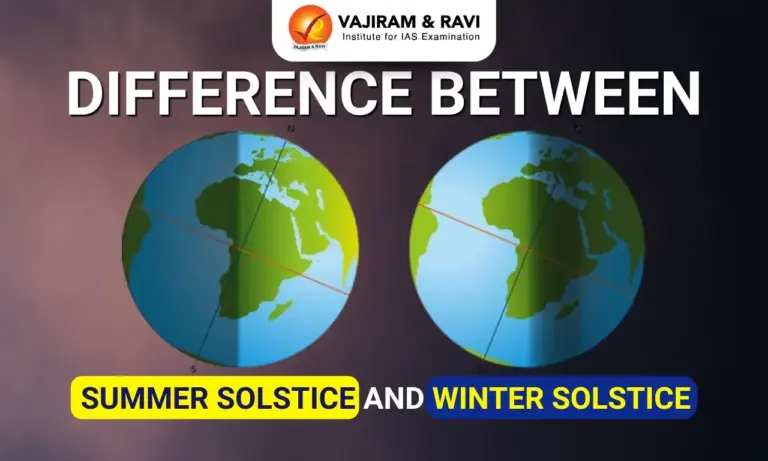
The Summer Solstice and Winter Solstice are two major astronomical events that mark the extremes of daylight duration in a year. They occur due to the tilt of the Earth’s axis (23.5°) and its revolution around the Sun, influencing seasons, climate, and natural cycles across the globe. The article below discusses the Difference Between Summer Solstice and Winter Solstice.
What is Summer Solstice?
The Summer Solstice is the day when a hemisphere experiences the longest day and shortest night of the year. It occurs when that hemisphere is tilted most directly toward the Sun, resulting in maximum solar radiation.
In the Northern Hemisphere, the Summer Solstice usually falls on 21 June, when the Sun appears directly overhead at the Tropic of Cancer (23.5° N latitude). This marks the beginning of the summer season.
What is Winter Solstice?
The Winter Solstice is the day when a hemisphere experiences the shortest day and longest night of the year. It occurs when that hemisphere is tilted furthest away from the Sun, receiving the least solar energy.
In the Northern Hemisphere, the Winter Solstice generally occurs on 22nd December, when the Sun is overhead at the Tropic of Capricorn (23.5° S latitude). This event marks the onset of winter.






Difference Between Summer Solstice and Winter Solstice
The Summer Solstice represents the peak of sunlight and warmth, while the Winter Solstice marks the lowest point of solar exposure. Below is a detailed comparison table highlighting the key differences:
| Difference Between Summer Solstice and Winter Solstice | |
| Summer Solstice | Winter Solstice |
|
Occurs when the North Pole is tilted closest to the Sun |
Occurs when the North Pole is tilted farthest away from the Sun |
|
Takes place on 21 June |
Takes place on 22 December |
|
Results in the longest day and shortest night in the Northern Hemisphere due to maximum tilt towards the Sun |
Results in the shortest day and longest night in the Northern Hemisphere due to tilt away from the Sun |
|
Southern Hemisphere experiences shorter nights |
Southern Hemisphere experiences longer days |
|
Sun’s vertical rays fall directly on the Tropic of Cancer (23.5° N) |
Sun’s vertical rays fall directly on the Tropic of Capricorn (23.5° S) |
|
Regions beyond the Arctic Circle witness continuous daylight (midnight sun) for about six months |
Regions beyond the Antarctic Circle witness continuous daylight for about six months |
|
Marks summer in the Northern Hemisphere and winter in the Southern Hemisphere due to greater solar heating in the north |
Marks summer in the Southern Hemisphere and winter in the Northern Hemisphere due to greater solar heating in the south |
|
Though it is the longest day, the earliest sunrise and latest sunset do not occur on the same date |
Though it is the shortest day, the latest sunrise and earliest sunset occur on different dates |
|
This variation occurs because the Earth follows an elliptical orbit, causing changes in orbital speed |
This variation is also explained by the elliptical orbit of the Earth and axial tilt |
|
The Sun appears at its highest position in the sky for most locations in the Northern Hemisphere |
The Sun appears at its lowest position in the sky for most locations in the Northern Hemisphere |
|
The event itself is astronomical and momentary, but the term is used for the entire day |
The solstice is also a momentary astronomical event, commonly referred to as the whole day |
|
Commonly associated with peak summer conditions in temperate regions |
Traditionally viewed as the midpoint or beginning of winter, depending on cultural calendars |

 Last updated on March, 2026
→ UPSC Final Result 2025 is now out.
→ UPSC has released UPSC Toppers List 2025 with the Civil Services final result on its official website.
→ Anuj Agnihotri secured AIR 1 in the UPSC Civil Services Examination 2025.
→ UPSC Marksheet 2025 is now out.
→ UPSC Notification 2026 & UPSC IFoS Notification 2026 is now out on the official website at upsconline.nic.in.
→ UPSC Calendar 2026 has been released.
→ Check out the latest UPSC Syllabus 2026 here.
→ UPSC Prelims 2026 will be conducted on 24th May, 2026 & UPSC Mains 2026 will be conducted on 21st August 2026.
→ The UPSC Selection Process is of 3 stages-Prelims, Mains and Interview.
→ Prepare effectively with Vajiram & Ravi’s UPSC Prelims Test Series 2026 featuring full-length mock tests, detailed solutions, and performance analysis.
→ Enroll in Vajiram & Ravi’s UPSC Mains Test Series 2026 for structured answer writing practice, expert evaluation, and exam-oriented feedback.
→ Join Vajiram & Ravi’s Best UPSC Mentorship Program for personalized guidance, strategy planning, and one-to-one support from experienced mentors.
→ Shakti Dubey secures AIR 1 in UPSC CSE Exam 2024.
→ Also check Best UPSC Coaching in India
Difference Between Summer Solstice and Winter Solstice FAQs
Q1. Why do solstices occur?+
Q2. Do Summer and Winter Solstices occur on the same date every year?+
Q3. What happens in the Southern Hemisphere during the Summer Solstice of the Northern Hemisphere?+
Q4. Are solstices the same as equinoxes?+
Q5. Why are solstices important?+
Tags: difference between summer solstice and winter solstice