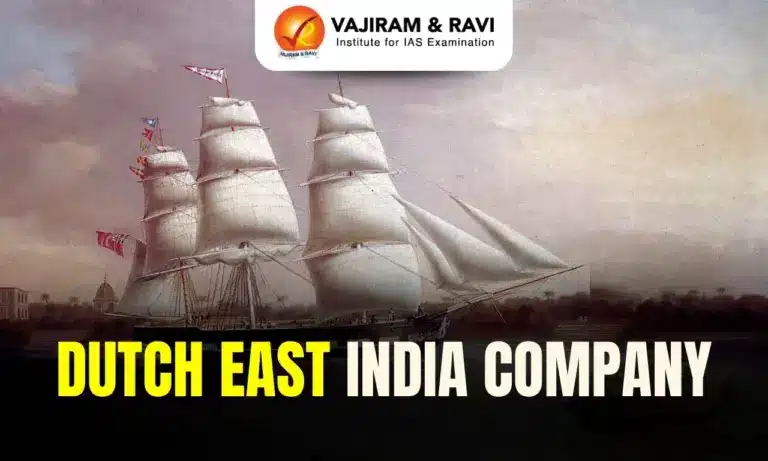
The Dutch East India Company was one of the most powerful trading corporations in world history and a defining force of early modern globalisation. It combined private capital with state authority, creating a corporate entity that could trade, wage wars, govern territories, mint coins and administer justice. It operated across Asia, Africa and the Asia-Pacific region as a result it dominated the spice trade and pioneered institutional innovations such as joint stock ownership, permanent capital and secondary share markets.
Dutch East India Company
The Dutch East India Company was founded on 20 March 1602 through a government directed merger of competing Dutch trading firms called voorcompagnieën. It was initiated by Johan van Oldenbarnevelt and authorised by the States General of the Dutch Republic (Netherlands). It was formally named the “Vereenigde Nederlandsche Geoctroyeerde Oostindische Compagnie”, popularly known as the “VOC”. Its Global Headquarter was at Amsterdam and Batavia was its Asian administrative centre. The company was granted a 21 year Trade Monopoly over Asia. It began administration with its own Flag from 1630, which bore a distinctive ‘V-O-C’ monogram that became one of the world’s earliest corporate symbols.
Dutch East India Company Timeline
The historical evolution and origin of the Dutch East India Company can be seen through the timeline given below:
- Formation in 1602: The States General consolidated pre-companies into one chartered entity to end internal rivalry and strengthen Dutch overseas trade.
- Asian expansion from 1605: The VOC established its first Asian factories and trading posts, beginning systematic penetration into Indian Ocean commerce.
- Batavia founded in 1619: Jayakarta was seized and renamed Batavia, becoming the central headquarters of Dutch operations in Asia.
- 17th Century Peak: During the 1600s, the VOC dominated spice monopolies and paid average annual dividends of around 18%.
- Late 18th Century Crisis: Rising corruption, administrative costs and declining trade competitiveness weakened the company.
- Dissolution in 1799: The VOC was formally dissolved on 31 December 1799 and its assets were nationalised as the Dutch East Indies.
Read about: British East India Company





Dutch East India Company Settlement
The settlements of Dutch East India Company functioned as fortified trading, administrative and military centres across multiple continents. Along with Amsterdam and Batavia, it had established various settlements across Java, Mauritius and various regions for trade ports in Japan,Taiwan, etc.
Dutch Settlements in India were primarily commercial in nature, designed to secure textiles, spices and strategic ports rather than territorial rule. The major Indian Settlements are listed below:
- Masulipatnam Settlement: Established in 1605, it was the first Dutch factory in India and became a key centre for textile and spice procurement on the Coromandel Coast.
- Pulicat Headquarters: Pulicat emerged as the capital of Dutch Coromandel, coordinating regional trade, warehouses, shipping and diplomatic relations with local rulers.
- Surat Settlement: Founded in 1616, Surat connected the VOC to western Indian textile markets and Indo-Persian trade routes.
- Bengal Settlements: Factories at Hugli, Chinsura, Patna, Dacca and Kasimbazar supported large scale trade in silk, saltpetre, rice and indigo.
- Malabar Coast Bases: Nagapattinam, Cochin and other ports enabled Dutch control over black pepper exports after displacing the Portuguese.
Rise of Dutch East India Company in India
The rise of Dutch East India Company in India was driven by textile demand, spice trade routes and rivalry with other European powers.
- Entry in 1605: The first Dutch factory was established at Masulipatnam, marking the start of sustained Dutch commercial presence.
- Textile driven expansion: Indian cotton, silk and indigo became crucial for VOC re-export trade across Southeast Asia.
- Bengal operations from 1627: Bengal emerged as a key centre for silk, saltpetre and textile procurement.
- Malabar dominance: The Dutch displaced Portuguese control to monopolise black pepper and spice exports.
- Defeat of Portuguese power: Strategic victories allowed the VOC to replace Portuguese trade networks in southern India.
- Gradual retreat: Anglo Dutch Agreements and British military victories reduced Dutch influence after the mid-eighteenth century.
Dutch East India Company Administration
The Dutch East India Company operated as a corporate-state with extensive political, military and economic authority.
- Heeren XVII leadership: The company was governed by the Lords Seventeen, representing six Dutch chambers.
- Quasi Sovereign powers: The VOC could wage war, sign treaties, administer justice and establish colonies.
- Governor General system: Batavia based Governors General supervised regional officials and enforced company policies.
- Joint Stock structure: Permanent capital and limited liability applied to both investors and managing directors.
- Diverse workforce: At its peak, over 25,000 employees worked in Asia and 11,000 were en route.
- Slavery practices: The Company institutionalised slavery across its colonies, relying on forced labour in agriculture, trade and logistics.
Read about: British Rule in India
Dutch East India Company Factories
Factories were commercial and logistical centres that enabled regional trade coordination.
- Masulipatnam factory: Established in 1605, it was the VOC’s first Indian trading post.
- Pulicat centre: Pulicat became the capital of Dutch Coromandel and a major textile hub.
- Surat factory: Opened in 1616, Surat facilitated cotton and silk trade from western India.
- Bengal factories: Centres at Hugli, Chinsura, Patna and Dacca supported textile and saltpetre exports.
- Malacca factory: Captured in 1641, Malacca controlled crucial Southeast Asian maritime routes.
- Dejima post: The Japanese factory ensured exclusive European access to Japanese trade under strict regulation.
Dutch East India Company Economy
The Dutch East India Company built a complex global economy integrating trade, agriculture, shipping and finance.
- Capitalisation scale: Initial capital worth reached over 6.4 million guilders, dwarfing European competitors.
- Trade volume: Nearly one million Europeans were transported on 4785 Ships between 1602 and 1796.
- Commodity diversity: Spices, silk, porcelain, tea, coffee, sugar, rice and metals formed core trade goods.
- Spice monopoly profits: Control of nutmeg, cloves and pepper generated extraordinary 17th century revenues.
- Dividend policy: Average annual dividends of about 18% attracted broad public investment.
- Slave trade role: The Dutch East India Company enslaved labour supported plantations, shipping and colonial economies across VOC territories.
Anglo Dutch Rivalry
The rivalry between the Dutch East India Company and British East India Company reshaped global trade and colonial power balances.
- Economic competition: Both powers competed intensely for spice, textile and maritime trade dominance.
- Amboyna incident: In 1623, Dutch officials executed English traders in Ambon, permanently damaging trust and escalating hostility between the two companies.
- First Anglo Dutch War: Fought between 1652 and 1654 over naval supremacy and commerce.
- Second Anglo Dutch War: The 1665 to 1667 conflict ended with the Treaty of Breda.
- Third Anglo Dutch War: From 1672 to 1674, conflicts extended to colonial possessions worldwide.
- Battle of Colachel: In 1741, Travancore’s victory over the Dutch weakened VOC power in India.
- Shift of priorities: After 1667, the Dutch gradually withdrew from India to focus on their more profitable Indonesian spice trade.
- Final confrontations: British victories, including the Battle of Hooghly in 1759, effectively ended Dutch commercial ambitions in India.
Dutch East India Company Decline
Multiple internal and external pressures led to the gradual collapse of the Dutch East India Company. The reasons behind the decline of the company has been listed below:
- Administrative corruption: Widespread graft reduced profitability and undermined central control.
- Smuggling losses: Illegal private trade eroded official revenues and monopolies.
- Rising costs: Military campaigns and colonial administration became increasingly expensive.
- Competitive pressure: British and French companies outperformed the VOC in key markets.
- Military defeats: Losses in India and Asia reduced strategic credibility.
- Bankruptcy: By 1799, insolvency forced state takeover and dissolution.
Dutch East India Company Criticism
The legacy of Dutch East India Company is deeply controversial due to exploitation, violence and environmental damage.
- Monopoly abuse: Enforced trade monopolies suppressed local economies and competitors.
- Colonial violence: Mass killings occurred in Banda Islands, Ambon, Batavia and Taiwan.
- Slave exploitation: Enslaved populations formed the backbone of VOC colonial labour systems.
- High mortality: Disease, shipwrecks and conflict caused extreme employee death rates.
- Environmental harm: Forced crop destruction and deforestation disrupted ecological systems.
- Governance failures: Bureaucratic rigidity and secrecy undermined accountability and social responsibility.

 Last updated on March, 2026
→ UPSC Final Result 2025 is now out.
→ UPSC has released UPSC Toppers List 2025 with the Civil Services final result on its official website.
→ Anuj Agnihotri secured AIR 1 in the UPSC Civil Services Examination 2025.
→ UPSC Marksheet 2025 is now out.
→ UPSC Notification 2026 & UPSC IFoS Notification 2026 is now out on the official website at upsconline.nic.in.
→ UPSC Calendar 2026 has been released.
→ Check out the latest UPSC Syllabus 2026 here.
→ UPSC Prelims 2026 will be conducted on 24th May, 2026 & UPSC Mains 2026 will be conducted on 21st August 2026.
→ The UPSC Selection Process is of 3 stages-Prelims, Mains and Interview.
→ Prepare effectively with Vajiram & Ravi’s UPSC Prelims Test Series 2026 featuring full-length mock tests, detailed solutions, and performance analysis.
→ Enroll in Vajiram & Ravi’s UPSC Mains Test Series 2026 for structured answer writing practice, expert evaluation, and exam-oriented feedback.
→ Join Vajiram & Ravi’s Best UPSC Mentorship Program for personalized guidance, strategy planning, and one-to-one support from experienced mentors.
→ Shakti Dubey secures AIR 1 in UPSC CSE Exam 2024.
→ Also check Best UPSC Coaching in India
Dutch East India Company FAQs
Q1. When was the Dutch East India Company established?+
Q2. What was the main objective of the Dutch East India Company?+
Q3. Which was the headquarters of the Dutch East India Company in Asia?+
Q4. What were the major battles fought between the Dutch East India Company and British East India Company?+
Q5. When and why did the Dutch East India Company decline?+
Tags: dutch east india company