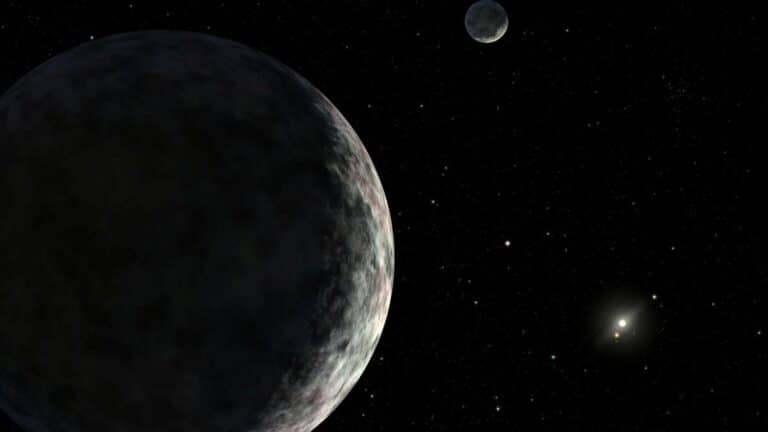
About Dwarf Planet Eris
- It was discovered on Jan. 5, 2005.
- It is named after the ancient Greek goddess of discord.
- It is a member of a group of objects that orbit in a disc-like zone beyond the orbit of Neptune called the Kuiper Belt.
- It appears to have a rocky interior below a shell of ice.
- It has about 25% more mass than Pluto.
- Eris orbits at an average of about 68 times further from the sun than Earth, taking 557 years to complete one orbit.
- It completes one rotation every 25.9 hours, making its day length similar to ours.
- It has a very small moon called Dysnomia which has a nearly circular orbit lasting about 16 days.
- Just like the Earth-moon system, tides on Eris slowly push Dysnomia away and slow down the spin of Eris and this process has gone to completion.
- Eris and Dysnomia always present the same face to the other.
- Atmosphere
- The dwarf planet is often so far from the Sun that its atmosphere collapses and freezes, falling to the surface as snow.
- As it gets closest to the Sun in its faraway orbit, the atmosphere thaws.
What is Dwarf Planet?
- It is a celestial body that -orbits the sun, has enough mass to assume a nearly round shape, has not cleared the neighborhood around its orbit and is not a moon.
Q1) What is the Kuiper Belt?
It is a vast region of the outer solar system beyond Neptune. This area is home to a significant number of icy bodies, dwarf planets, and remnants from the early formation of the solar system. It is significantly larger and contains different types of objects. It’s believed to be a relic of the early solar system, consisting mainly of icy bodies such as comets, frozen volatiles, and small rocky objects.
Source: Scientists discern the internal structure of the mysterious dwarf planet Eris





 Last updated on March, 2026
→ UPSC Final Result 2025 is now out.
→ UPSC has released UPSC Toppers List 2025 with the Civil Services final result on its official website.
→ Anuj Agnihotri secured AIR 1 in the UPSC Civil Services Examination 2025.
→ UPSC Marksheet 2025 is now out.
→ UPSC Notification 2026 & UPSC IFoS Notification 2026 is now out on the official website at upsconline.nic.in.
→ UPSC Calendar 2026 has been released.
→ Check out the latest UPSC Syllabus 2026 here.
→ UPSC Prelims 2026 will be conducted on 24th May, 2026 & UPSC Mains 2026 will be conducted on 21st August 2026.
→ The UPSC Selection Process is of 3 stages-Prelims, Mains and Interview.
→ Prepare effectively with Vajiram & Ravi’s UPSC Prelims Test Series 2026 featuring full-length mock tests, detailed solutions, and performance analysis.
→ Enroll in Vajiram & Ravi’s UPSC Mains Test Series 2026 for structured answer writing practice, expert evaluation, and exam-oriented feedback.
→ Join Vajiram & Ravi’s Best UPSC Mentorship Program for personalized guidance, strategy planning, and one-to-one support from experienced mentors.
→ Shakti Dubey secures AIR 1 in UPSC CSE Exam 2024.
→ Also check Best UPSC Coaching in India