Electoral Roll Revision Latest News
- The Special Intensive Revision of electoral rolls has led to reduced voter lists but higher turnout percentages across several states.
Electoral Roll in India: Basics and Importance
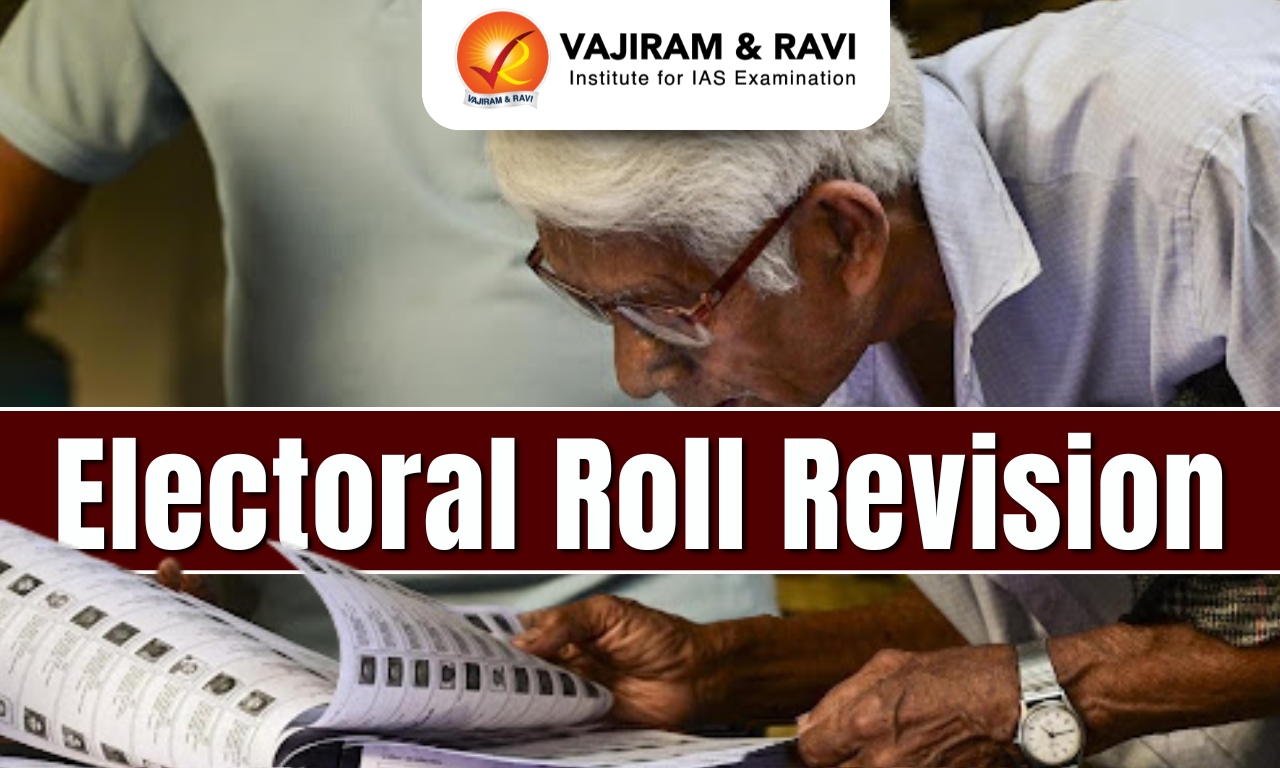
- The electoral roll is a constituency-wise list of eligible voters, maintained by the Election Commission of India.
- It forms the foundation of India’s electoral democracy, as only those registered in the roll can exercise the right to vote.
- The Constitution mandates that all citizens above 18 years of age, subject to certain disqualifications, must be included in the roll.
- Accuracy of the electoral roll is crucial for ensuring free, fair, and credible elections.


Types of Electoral Roll Revisions
- Electoral rolls are updated through two main processes.
- Summary Revision is conducted annually with limited corrections and additions.
- Special Intensive Revision (SIR) involves a comprehensive re-verification of voters, often requiring fresh enumeration and documentation.
- SIR is more rigorous and aims to eliminate inaccuracies accumulated over time.
Growth of India’s Electorate
- India’s electorate has expanded significantly since independence.
- From about 17 crore voters in 1951, it has grown to over 96 crore in recent years, reflecting population growth and improved voter registration.
- At one point, the total electorate was projected to approach 100 crore, highlighting the scale of India’s democratic system.
News Summary: Impact of Special Intensive Revision
- Reduction in Electoral Roll Size
- The SIR exercise has led to a significant trimming of electoral rolls by removing names of absent, shifted, dead, and duplicate voters (ASDD).
- Across 13 States and Union Territories, the number of electors declined from about 51 crore to below 46 crore during the revision process.
- This marks a notable departure from the usual trend of continuous growth in the electorate.
- Higher Voter Turnout Despite Smaller Electorates
- States such as Tamil Nadu recorded over 85% turnout, significantly higher than previous elections.
- Similarly, West Bengal witnessed turnout levels above 90% in certain phases.
- This trend is partly attributed to the removal of “ghost voters,” which increases turnout percentages when calculated on a reduced voter base.
- Reasons for Deletion of Names
- The primary reason for the decline in voter numbers is the removal of ASDD entries.
- Additional deletions occurred due to non-submission of enumeration forms, inability to verify identity, and failure to meet eligibility criteria.
- In many cases, the burden of proof shifted to citizens to re-establish their eligibility.
- Partial Recovery through Fresh Enrolment
- While initial drafts showed sharp reductions, final rolls witnessed some recovery due to new registrations and corrections.
- For example, Uttar Pradesh saw a drop from 15.44 crore to 12.55 crore in draft rolls, later rising to 13.39 crore in final rolls.
- This indicates that SIR is not purely a deletion exercise but also includes the re-inclusion of eligible voters.
- Possible Decline in National Electorate Size
- After covering nearly 60 crore voters, the overall electorate has already declined by around 6 crore.
- Once completed nationwide, the total electorate could fall to around 90 crore, reversing the earlier trend towards a billion voters.
- Concerns over Exclusion and Disenfranchisement
- The SIR process has raised concerns about the accidental exclusion of genuine voters, especially vulnerable groups lacking documentation.
- There are apprehensions that strict verification procedures may lead to disenfranchisement on technical grounds.
- Need for Balancing Accuracy and Inclusion
- While SIR improves the accuracy of electoral rolls, it must ensure that no eligible voter is left out.
- The Election Commission now faces the challenge of restoring confidence by focusing on inclusion alongside verification.
Source: TH

 Last updated on Oct, 2026
→ UPSC 2027 Notification will be released on 13 January 2027 at upsconline.nic.in.
→ Check Nobel Prize 2026 Winners List here.
→ Download PIB PRiSM Monthly Magazine 2026 here.
→ Check UPSC Monthly Current Affairs Magazine The Recitals here.
→ Check out the latest UPSC Syllabus here.
→ Download UPSC Model Answers for Mains 2026
→ UPSC Mains Question Paper 2026 is out now for Essay & GS Paper 1, 2, 3 & 4.
→ UPSC Calendar 2027 has been released.
→ Enroll in Vajiram & Ravi’s UPSC Mains Test Series 2027 for structured answer writing practice, expert evaluation, and exam-oriented feedback.
→ Join Vajiram & Ravi’s UPSC Mentorship Program 2027 for personalized guidance, strategy planning, and one-to-one support from experienced mentors.
→ Go through the UPSC Mains Previous Year Papers to enhance your preparation.
→ UPSC has released UPSC Toppers List 2025 with the Civil Services final result on its official website.
→ Also check Best UPSC Coaching in India
Electoral Roll Revision FAQs
Q1. What is Special Intensive Revision (SIR)?+
Q2. Why has voter turnout increased after SIR?+
Q3. What are ASDD voters?+
Q4. How much has the electorate reduced due to SIR?+
Q5. What is the key challenge after SIR?+
Tags: electoral roll revision mains articles upsc current affairs upsc mains current affairs