What’s in Today’s Article?
- Why in the News?
- About the Study
- Major Findings of the Study
- Significance of these Findings
Why in the News?
- According to a study published last week by the Council for Energy Environment and Water (CEEW), developed countries will end up emitting 38% more carbon in 2030 than they have committed to, going by current trajectories.
About the Study
- Council for Energy Environment and Water (CEEW) is a Delhi-based thinktank.
- The CEEW published a report with the objective of tracking developed countries’ Emission Trajectories.
- The study aimed to find out whether the developed countries, responsible for over 75 per cent of historical emissions, are taking deep emission reductions at an adequate pace?
- The study aimed to analyse the emission trajectories of developed countries, covering historic and projected emissions in the six decades spanning 1990–2050.
Major Findings of the Study
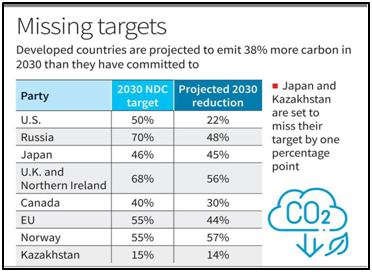
- The key findings of the study include:
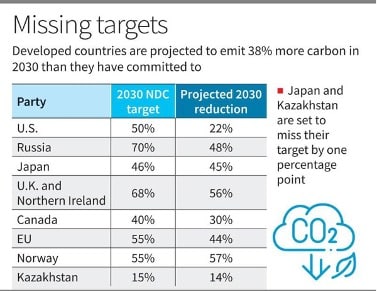
- By 2030, developed countries will overshoot carbon emission targets by 38 per cent.
- Only two developed countries—Norway and Belarus—are on track to achieve their Nationally Determined Contributions (NDCs).
- Even with post-2030 reductions, developed countries’ total emissions would still threaten 1.5°C target.
- Developed countries are projected to collectively emit around 3.7 giga tonnes extra carbon dioxide in 2030, against the reduction goals expressed in their NDCs under the 2016 Paris Agreement.
- This represents a 38 per cent emission overshoot, with the United States, European Union, and Russia responsible for 83 per cent of this.
- Further, only two developed countries—namely Norway and Belarus—are on track to achieve their reduction commitments by 2030.
- The mitigation efforts of developed countries impact the carbon budget available to developing nations, which need sufficient carbon space to address their economic and social development challenges and ensure a just transition.
- Further, currently, developed countries’ NDCs for 2030 collectively represent a 36 per cent reduction in emissions from their 2019 levels.
- This is less than the global average of 43 per cent that is required to keep the 1.5°C target alive.
Significance of these Findings
- The report makes it clear that even in this critical decade (2020-30), developed countries are not projected to meet their 2030 NDC targets.
- This failure has implications for the limited global carbon budget available now, especially for developing countries like India.
- The projections also reveal that developed countries rely on drastically ramping up emission reductions after 2030.
- Even if all developed countries were to reach net zero by 2050, they would require more than four times the average annual reductions they achieved from 1990 to 2020.
- The study recommends that instead of relying on future events, developed countries should define clear year-on-year reduction plans to meet their targets in this critical decade.
- Further, to build trust, developed countries need to be reliable and stay committed to the Paris Agreement.
Q1) When was IPCC Established?
The Intergovernmental Panel on Climate Change (IPCC) was established by the United Nations Environment Programme (UNEP) and the World Meteorological Organization (WMO) in 1988.
Q2) What is Carbon Footprint?
It is a measure of the amount of carbon dioxide released into the atmosphere as a result of the activities of a particular individual, organization, or community.
Source: Developed countries to overshoot carbon emissions goal: study | CEEW






 Last updated on March, 2026
→ UPSC Final Result 2025 is now out.
→ UPSC has released UPSC Toppers List 2025 with the Civil Services final result on its official website.
→ Anuj Agnihotri secured AIR 1 in the UPSC Civil Services Examination 2025.
→ UPSC Marksheet 2025 is now out.
→ UPSC Notification 2026 & UPSC IFoS Notification 2026 is now out on the official website at upsconline.nic.in.
→ UPSC Calendar 2026 has been released.
→ Check out the latest UPSC Syllabus 2026 here.
→ UPSC Prelims 2026 will be conducted on 24th May, 2026 & UPSC Mains 2026 will be conducted on 21st August 2026.
→ The UPSC Selection Process is of 3 stages-Prelims, Mains and Interview.
→ Prepare effectively with Vajiram & Ravi’s UPSC Prelims Test Series 2026 featuring full-length mock tests, detailed solutions, and performance analysis.
→ Enroll in Vajiram & Ravi’s UPSC Mains Test Series 2026 for structured answer writing practice, expert evaluation, and exam-oriented feedback.
→ Join Vajiram & Ravi’s Best UPSC Mentorship Program for personalized guidance, strategy planning, and one-to-one support from experienced mentors.
→ Shakti Dubey secures AIR 1 in UPSC CSE Exam 2024.
→ Also check Best UPSC Coaching in India