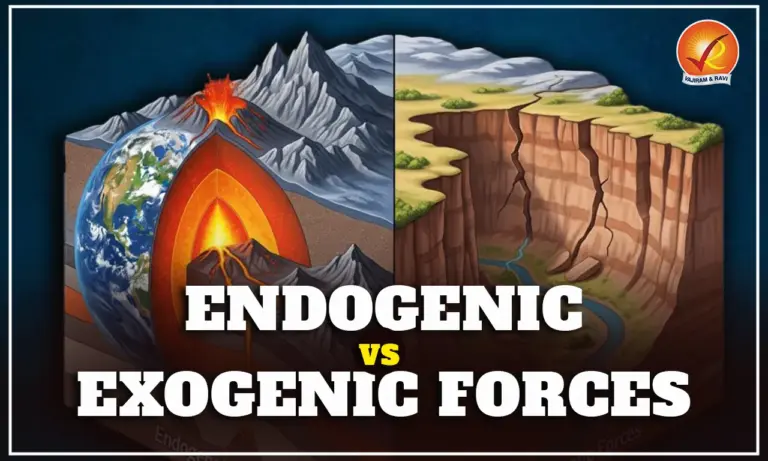
Changes that occur on the earth’s surface are the result of geomorphic processes. Broadly, these processes are grouped into two categories: exogenic and endogenic. Exogenic Forces, often called external forces, gain their energy from sources found on or above the earth’s surface, such as the atmosphere. In contrast, Endogenic Forces also known as internal forces arise from pressure and movements that originate deep within the earth’s interior.
Endogenic Forces
Endogenic Forces are those that originate from within the Earth’s interior. For this reason, they are also called internal forces. These forces are powerful enough to create some of the planet’s most dramatic features, such as mountains, volcanoes, and fault lines. They are also responsible for earthquakes, which occur when stresses inside the Earth are suddenly released.
Types of Endogenic Forces
Endogenic Forces can be grouped into two main categories: slow movements and sudden movements.
Slow Movements (Diastrophism)
Slow movements, also called diastrophic processes, involve the gradual displacement, uplift, or deformation of the Earth’s crust. Unlike sudden events like earthquakes, these movements occur over thousands or even millions of years.
Diastrophism includes activities such as folding, faulting, warping, and fracturing. Collectively, these processes build vast geological structures such as mountain ranges, plateaus, rift valleys, continents, and ocean basins. Within diastrophism, there are two important processes:
- Orogenic Processes – These are mountain-building processes caused by horizontal pressures within the Earth. Compression forces push rock layers together, causing them to fold and form Fold Mountains like the Himalayas. On the other hand, tension forces can stretch the crust, leading to fissures or faults.
- Epeirogenic Processes – Unlike orogenic movements, these involve large-scale vertical uplifts or depressions of the Earth’s crust. They are also called radial movements, as they act along the Earth’s radius. Epeirogenic movements shape entire continental blocks, creating uplands, basins, or long undulating surfaces. They can be either upward (land rising) or downward (land subsiding).
Sudden Movements
Sudden geomorphic movements occur when pressure inside the Earth is released abruptly. They mostly take place along plate boundaries where tectonic stress is high due to the movement of magma and shifting lithospheric plates. Unlike slow movements, these events are rapid and can cause large-scale destruction. The most common examples are earthquakes and volcanic eruptions.
Features of Endogenic Forces
- They originate within the Earth and act from beneath the crust.
- These forces are responsible for plate tectonics, folding, faulting, volcanic activity, and earthquakes.
- Endogenic processes can be slow and long-lasting, or sudden and violent.
- They play a key role in forming landforms like Fold Mountains, rift valleys, plateaus, and volcanoes.
- By shaping the Earth’s interior and surface, they directly influence the planet’s structure and geological evolution.
Exogenic Forces
Exogenic Forces are those that operate on the surface of the Earth, which is why they are often described as external forces. These forces are mainly responsible for processes like weathering, erosion, and deposition of rocks and sediments. Over long periods, they shape familiar landforms such as valleys, beaches, deltas, and even mountain slopes.
Types of Exogenic Forces
The major processes included under exogenic forces are weathering, mass wasting, and erosion. Collectively, they fall under the broad term denudation, which means stripping or uncovering the Earth’s surface. The natural elements that carry out these processes like wind, rivers, waves, and glaciers are called geomorphic agents.
Weathering
Weathering refers to the breaking down of rocks at or near the Earth’s surface through different natural forces such as wind, water currents, sea waves, and glaciers. It is essentially the decay or disintegration of rocks in their original place, without movement, and usually takes a very long time, sometimes hundreds or even thousands of years. Types of weathering include:
- Physical Weathering – breakdown of rocks through temperature changes, frost action, or mechanical forces.
- Chemical Weathering – decomposition of rocks due to chemical reactions, often involving water, oxygen, or acids.
- Biological Weathering – disintegration caused by plants, animals, or microorganisms.
Erosion
Erosion involves the wearing away and transportation of soil, rock, or dissolved materials from one place to another by agents like wind, water, or ice. While weathering weakens and breaks rocks in place, erosion moves the broken material, often carving out valleys, shaping riverbanks, or depositing sediments in new areas.
Mass Movements
Mass Movement is the downslope movement of large quantities of soil, mud, rock fragments, or even entire sections of bedrock under the influence of gravity. This process can occur slowly (as in soil creep) or suddenly (as in landslides, avalanches, and rockfalls). It plays a major role in reshaping steep slopes and mountainous terrain.
Features of Exogenic Forces
- They operate externally, acting on the Earth’s surface.
- Their impact is gradual, working over long periods of time.
- They cause weathering, erosion, deposition, and mass movements.
- These processes continuously modify and reshape landforms such as valleys, deltas, dunes, and coastal features.
- The landscapes we see around us are largely the result of these exogenic forces working in combination with internal forces.





Endogenic Vs Exogenic Forces
The Earth’s surface is shaped by a constant interaction between Endogenic Vs Exogenic Forces. While exogenic forces wear down and modify existing features through processes like weathering and erosion, endogenic forces build new structures by uplifting, folding, or fracturing the crust. Together, they are responsible for the creation of landforms such as mountains, valleys, volcanoes, plateaus, and rift systems.
| Endogenic Vs Exogenic Forces | |
|
Endogenic Forces |
Exogenic Forces |
|
Originate from within the Earth’s interior and draw energy from internal heat. |
Originate on or above the Earth’s surface, powered mainly by solar energy and atmospheric processes. |
|
Responsible for building new landforms such as mountains, volcanoes, plateaus, and rift valleys. |
Responsible for modifying or wearing down existing landforms through weathering, erosion, mass wasting, and deposition. |
|
Also known as constructive forces because they create relief features on the Earth’s surface. |
Often called destructive forces as they wear down or destroy existing features. |
|
Driven by convection currents in the mantle, caused by differences in temperature, pressure, and density within the Earth. |
Work due to gradients like high to low pressure, high to low temperature, or higher to lower levels of land. |
|
Include processes like mountain building (orogeny), volcanism, continent formation, and earthquakes. |
Include agents like wind, rivers, glaciers, waves, and rainfall. |
|
Their impact is often sudden and dramatic, as in the case of earthquakes or volcanic eruptions. |
Their impact is slow and gradual, becoming visible only over thousands or millions of years. |
Endogenic Vs Exogenic Forces Similarities
Endogenic Vs Exogenic Forces work in very different ways, they share some common characteristics. Both are natural processes that operate without any human involvement, and together they are responsible for shaping the Earth’s surface.
- Both forces play a role in altering landforms and relief features over time.
- Each sets in motion processes that contribute to the continuous cycle of landform development.
- Weathering, erosion, uplift, and crustal movements, though different in mechanism, all combine to reshape the Earth’s surface.
- Ultimately, both endogenic and exogenic forces ensure that the Earth’s surface is dynamic rather than static.

 Last updated on March, 2026
→ UPSC Final Result 2025 is now out.
→ UPSC has released UPSC Toppers List 2025 with the Civil Services final result on its official website.
→ Anuj Agnihotri secured AIR 1 in the UPSC Civil Services Examination 2025.
→ UPSC Marksheet 2025 is now out.
→ UPSC Notification 2026 & UPSC IFoS Notification 2026 is now out on the official website at upsconline.nic.in.
→ UPSC Calendar 2026 has been released.
→ Check out the latest UPSC Syllabus 2026 here.
→ UPSC Prelims 2026 will be conducted on 24th May, 2026 & UPSC Mains 2026 will be conducted on 21st August 2026.
→ The UPSC Selection Process is of 3 stages-Prelims, Mains and Interview.
→ Prepare effectively with Vajiram & Ravi’s UPSC Prelims Test Series 2026 featuring full-length mock tests, detailed solutions, and performance analysis.
→ Enroll in Vajiram & Ravi’s UPSC Mains Test Series 2026 for structured answer writing practice, expert evaluation, and exam-oriented feedback.
→ Join Vajiram & Ravi’s Best UPSC Mentorship Program for personalized guidance, strategy planning, and one-to-one support from experienced mentors.
→ Shakti Dubey secures AIR 1 in UPSC CSE Exam 2024.
→ Also check Best UPSC Coaching in India
Endogenic Vs Exogenic Forces FAQs
Q1. What is the difference between endogenic and exogenic forces?+
Q2. What are exogenic and endogenic forces with example class 7?+
Q3. What is the difference between endogenic and Exogenic cycles?+
Q4. What is an example of an Exogenic force?+
Q5. What are three examples for endogenic and exogenic processes?+
Tags: endogenic vs exogenic forces