EPFO Withdrawals Latest News
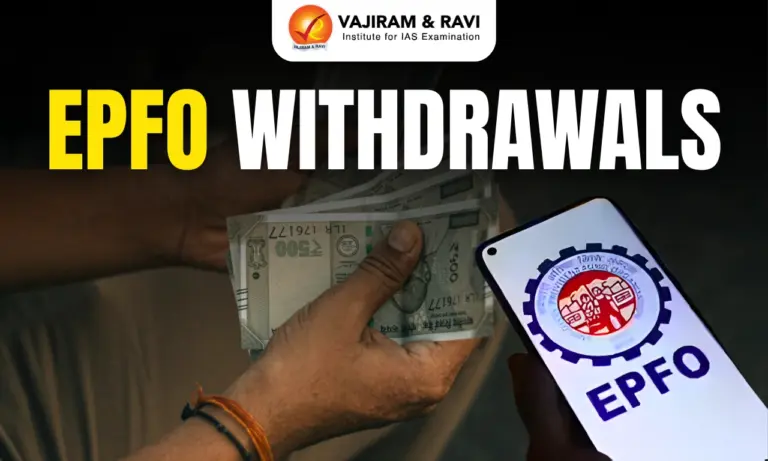
- The Employees’ Provident Fund Organisation (EPFO) is easing withdrawal rules but introducing a 25% minimum balance requirement to curb excessive withdrawals.
- Data shows that nearly half of EPFO members have less than ₹20,000 in their accounts at final settlement.
- Frequent withdrawals during employment are eroding retirement savings, prompting the EPFO to act to preserve members’ long-term corpus.
Growing Concern Over Small Retirement Corpus
- The Employees’ Provident Fund Organisation (EPFO) is introducing a 25% minimum balance requirement while liberalising withdrawals.
- A review of its data shows a worrying trend — nearly half of EPFO members have less than ₹20,000 in their accounts at the time of final settlement.
- This reflects how frequent withdrawals during employment are eroding long-term retirement savings.
Surge in Withdrawals After Job Loss
- About 95% of withdrawal claims are made immediately after unemployment, even though nearly half of these members rejoin the EPFO later.
- This suggests that many employees use the EPF corpus as a short-term financial cushion, undermining its purpose as a retirement fund.





EPFO: Key Trends
- Low-Income Dominance in EPFO Membership
- The EPFO’s data highlights the income profile of its members:
- 65% contribute based on a monthly wage of ₹15,000 or less, the ceiling for mandatory EPF coverage.
- The remaining 35% contribute voluntarily, earning above ₹15,000 per month.
- This indicates that the majority of EPFO members belong to the lower-income formal workforce.
- Overall, the organisation manages 30 crore accounts, with 7 crore active contributors and a corpus exceeding ₹26 lakh crore.
- The EPFO’s data highlights the income profile of its members:
- Most Members Have Minimal Savings at Exit
- The shortfall is widespread even at higher thresholds:
- 75% of members have less than ₹50,000, and
- 87% have under ₹1 lakh at final settlement.
- This underscores how premature withdrawals prevent employees from building a meaningful retirement fund.
- The shortfall is widespread even at higher thresholds:
- Premature Settlements on the Rise
- In 2024–25, out of 52.95 lakh final settlement claims, a massive 95% were premature withdrawals, made just two months after unemployment.
- Of these, 24.21 lakh members (46%) rejoined establishments and resumed EPF contributions later.
- Such repeated withdrawals and re-entries point to a pattern of financial insecurity and limited social safety nets among formal workers.
- Partial Withdrawals Surge
- Since 2017, the EPFO has relaxed withdrawal rules, allowing auto-processed claims and no document proof for advances.
- This has led to a surge in partial withdrawals, especially for illness, housing, and special circumstances.
Impact on Pension Eligibility and Benefits
- Most premature withdrawals by members cited unemployment under para 69(2) of the EPF Scheme, 1952, which allows full withdrawal after two months of job loss.
- Frequent or premature final settlements break EPF membership continuity, harming long-term benefits under the Employees’ Pension Scheme (EPS), 1995.
- Such breaks lead to:
- Ineligibility for family pension in case of death.
- Lower pension payouts at retirement or superannuation.
- To qualify for pension, a member must complete at least 10 years of pensionable service.
New Withdrawal Norms and Minimum Balance Rule
- To streamline and discourage excessive withdrawals, EPFO has reduced withdrawal categories from 13 to 3:
- Essential Needs – illness, education, marriage.
- Housing Needs.
- Special Circumstances.
- Key changes include:
- Introduction of a 25% minimum balance requirement.
- Increased withdrawal frequency for education (10 times) and marriage (5 times).
- Up to 3 illness-related and 2 special-circumstance withdrawals per financial year.
Backlash and Government Clarification
- The changes drew criticism from opposition leaders and EPF members.
- They argued that workers were being denied access to their own savings, calling it “a subsidy at the cost of the middle class.”
- Following the backlash, the Labour Ministry clarified:
- Members can still withdraw 75% of their corpus immediately after job loss.
- The remaining 25% must stay as minimum balance, but full withdrawal is allowed after 12 months of unemployment.
EPFO’s Concern: Long-Term Pension Security
- Officials defend the changes, saying frequent withdrawals hurt members’ pension prospects and undermine retirement security.
- They emphasised that premature withdrawals reduce future pension benefits, warning that India’s ageing population will depend heavily on their own contributions for financial stability.
Source: IE

 Last updated on March, 2026
→ UPSC Final Result 2025 is now out.
→ UPSC has released UPSC Toppers List 2025 with the Civil Services final result on its official website.
→ Anuj Agnihotri secured AIR 1 in the UPSC Civil Services Examination 2025.
→ UPSC Marksheet 2025 is now out.
→ UPSC Notification 2026 & UPSC IFoS Notification 2026 is now out on the official website at upsconline.nic.in.
→ UPSC Calendar 2026 has been released.
→ Check out the latest UPSC Syllabus 2026 here.
→ UPSC Prelims 2026 will be conducted on 24th May, 2026 & UPSC Mains 2026 will be conducted on 21st August 2026.
→ The UPSC Selection Process is of 3 stages-Prelims, Mains and Interview.
→ Prepare effectively with Vajiram & Ravi’s UPSC Prelims Test Series 2026 featuring full-length mock tests, detailed solutions, and performance analysis.
→ Enroll in Vajiram & Ravi’s UPSC Mains Test Series 2026 for structured answer writing practice, expert evaluation, and exam-oriented feedback.
→ Join Vajiram & Ravi’s Best UPSC Mentorship Program for personalized guidance, strategy planning, and one-to-one support from experienced mentors.
→ Shakti Dubey secures AIR 1 in UPSC CSE Exam 2024.
→ Also check Best UPSC Coaching in India
EPFO Withdrawals FAQs
Q1. Why is EPFO introducing a 25% minimum balance rule?+
Q2. What does EPFO data reveal about member savings? +
Q3. Why are premature withdrawals increasing? +
Q4. How do frequent withdrawals affect pension eligibility? +
Q5. What new changes has EPFO made to withdrawal norms? +
Tags: EPFO withdrawals mains articles upsc current affairs upsc mains current affairs