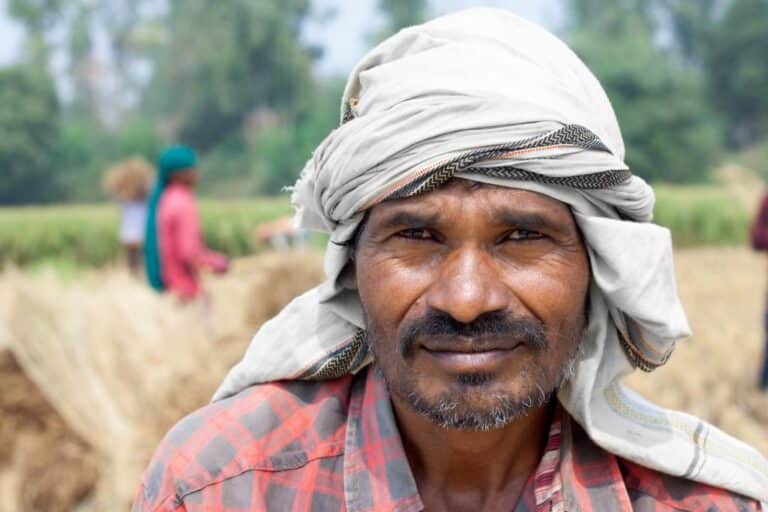
About Farmers Distress Index:
- Aim: The main aim behind creating such an index is to minimise the agrarian distress in the form of crop loss / failure and income shock.
- The index will try to anticipate this distress and prevent its spread from a few farmers to the village or block level by pre-warning different stakeholders, including central, state, local and also non-government agencies.
Methodology to track distress
- The first step will be to look for incidence of farmers distress like localised cases of issues with debt repayment, death by suicide, pest attacks, drought, floods, migration, among others.
- Following this, contacts of marginal and small farmers or tenant farmers from the area will be collected to conduct telephonic interviews, which will have 21 standardised questions to gauge early signs of distress.
- The answers will be mapped against seven indicators:
- Exposure to droughts, floods, crop failure due to pest attacks, livestock deaths
- Debt
- Adaptive capacity of farmer and local government through different schemes
- Land holding and irrigation facilities.
- Sensitivity, mitigation and adaptation strategies like growing of contingency crops if main crop fails.
- Triggers for immediate distress like health-related expenditure.
- Socio-psychological factors and impacts.
What will the index look like?
- The index will have values from 0-1. A value between 0-0.5 will indicate ‘low distress’, 0.5-0.7 will indicate ‘moderate’ distress and above 0.7 will indicate ‘severe’ distress.
- If the index is severe, it will identify which component, among the seven, is more severe and contributes maximum to farmers’ distress.
- The index is currently being worked out in the form of a mobile or desktop application.
- After completion of the ongoing work, CRIDA will be handing over the index to the central government and it will be made available to different state governments, agriculture departments, rural development departments, agriculture universities,
Q1) What is A drought?
A drought is a prolonged period of abnormally dry weather, usually resulting in a scarcity of water. It is a natural phenomenon that can occur in various regions around the world. Droughts can have significant impacts on agriculture, water supplies, ecosystems, and human communities.
Explainer: What is the Farmers Distress Index?






 Last updated on March, 2026
→ UPSC Final Result 2025 is now out.
→ UPSC has released UPSC Toppers List 2025 with the Civil Services final result on its official website.
→ Anuj Agnihotri secured AIR 1 in the UPSC Civil Services Examination 2025.
→ UPSC Marksheet 2025 is now out.
→ UPSC Notification 2026 & UPSC IFoS Notification 2026 is now out on the official website at upsconline.nic.in.
→ UPSC Calendar 2026 has been released.
→ Check out the latest UPSC Syllabus 2026 here.
→ UPSC Prelims 2026 will be conducted on 24th May, 2026 & UPSC Mains 2026 will be conducted on 21st August 2026.
→ The UPSC Selection Process is of 3 stages-Prelims, Mains and Interview.
→ Prepare effectively with Vajiram & Ravi’s UPSC Prelims Test Series 2026 featuring full-length mock tests, detailed solutions, and performance analysis.
→ Enroll in Vajiram & Ravi’s UPSC Mains Test Series 2026 for structured answer writing practice, expert evaluation, and exam-oriented feedback.
→ Join Vajiram & Ravi’s Best UPSC Mentorship Program for personalized guidance, strategy planning, and one-to-one support from experienced mentors.
→ Shakti Dubey secures AIR 1 in UPSC CSE Exam 2024.
→ Also check Best UPSC Coaching in India