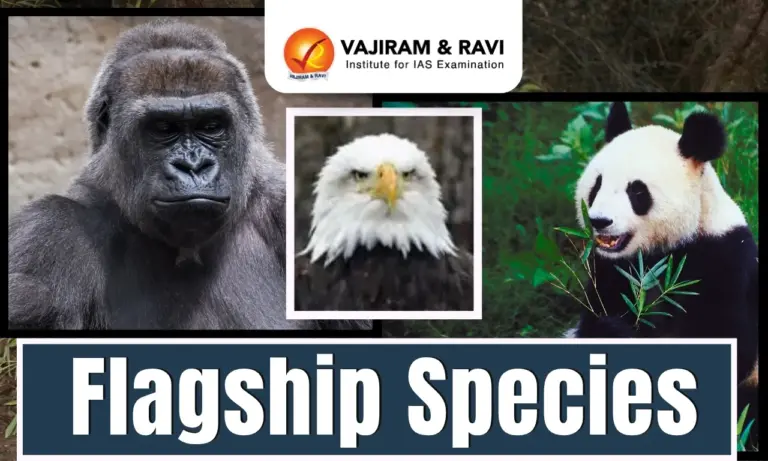
Flagship Species are special plants or animals chosen to represent and promote conservation of a particular habitat or environmental cause. These species are usually well-known, attractive, or culturally important, which helps draw public attention and support.
About Flagship Species
- Flagship Species are animals or plants chosen to represent an environmental cause or a particular habitat in a simple and relatable way.
- They are usually well-known, attractive, or emotionally appealing, which helps in gaining public interest and support.
- These species act as “ambassadors of nature” and help spread awareness about conservation.
- By protecting one popular species, many other species in the same ecosystem also get protected.
- Most Flagship Species are endangered or threatened, highlighting the urgent need for conservation.
- Different countries or regions can have their own Flagship Species based on local importance and cultural connection.
- They are selected strategically to attract funding, attention, and public support.
- A Flagship Species may not always be ecologically important, but it is very effective in influencing people.
- The main idea is that people connect more easily with a familiar species, which helps in promoting environmental protection.
- Some Examples of Flagship Species are Royal Bengal Tiger, Asian Elephant, Greater One-Horned Rhinoceros, Snow Leopard, Asiatic Lion, Ganges River Dolphin.
Categories of Flagship Species
- International Flagship Species
- International Flagship Species are globally recognized animals that are famous all over the world.
- These species are often used by international organizations to represent large-scale conservation efforts.
- Because of their popularity, they easily attract media attention, funding, and public support from different countries.
- They help in spreading awareness about global environmental issues like climate change, wildlife protection, and habitat loss.
- Their image is often used in campaigns, logos, and advertisements to connect people emotionally with conservation.
- Examples include the giant panda, African elephant, and polar bear, which symbolize global wildlife protection efforts.
- Cultural Flagship Species
- Cultural Flagship Species are those that have a strong connection with a particular community, tradition, or country.
- These species are important not just biologically, but also emotionally, historically, or spiritually for people.
- They help in promoting conservation through local pride and cultural identity.
- People are more willing to protect species that are linked to their beliefs, traditions, or national symbols.
- These species often appear in folklore, rituals, art, or national emblems.
- For example, the Royal Bengal tiger is an important cultural symbol in South Asia, and the bald eagle represents freedom in the United States.
- Ecological Flagship Species
- Ecological Flagship Species are chosen because they represent a specific ecosystem or region.
- These species are often unique (endemic) or found only in a particular area.
- Protecting them requires conserving their entire habitat, which indirectly protects many other species living there.
- They highlight the importance of biodiversity and the need to preserve fragile ecosystems.
- Even if they are not very famous globally, they play a key role in local conservation strategies.
- Examples include the Malabar grey hornbill in the Western Ghats, the Amazonian manatee, and the Malagasy baobab in Madagascar.


Flagship Species Significance
- Easy fundraising and financial support: Flagship Species are popular and emotionally appealing, so people are more willing to donate money, support campaigns, or fund conservation programs. Governments and organizations also find it easier to invest in projects linked to such species.
- Spreads public awareness in a simple way: Complex environmental issues can be hard to understand, but Flagship Species make them easy and relatable. When people hear about saving a tiger or panda, they also learn about deforestation, climate change, and biodiversity loss.
- Protection of entire habitats (umbrella effect): Saving one Flagship Species often means protecting its natural habitat like forests, grasslands, or oceans. This automatically helps many other plants and animals living in the same area, even if they are less known.
- Boosts ecotourism and local economy: Famous animals attract tourists from around the world, which creates jobs and income for local communities. This gives people a reason to protect wildlife instead of exploiting it.
- Encourages government action and policies: Because Flagship Species are widely loved, they create public pressure on governments to make stronger environmental laws, protected areas, and conservation programs.
- Builds emotional connection with nature: People tend to connect more with familiar and attractive species, which helps develop a sense of care and responsibility towards nature.
- Helps in education and awareness campaigns: Schools, media, and NGOs use Flagship Species to teach about conservation, making learning more interesting and impactful.
- Promotes long-term conservation efforts: Continuous attention on Flagship Species ensures ongoing support and monitoring, which helps in maintaining sustainable conservation practices over time.
- Improves image of conservation programs: Campaigns linked with well-known species gain more visibility and trust, making conservation efforts appear more effective and meaningful.
Challenges of Flagship Species Approach
- Unequal use of funds (fund misallocation): A large share of money and resources often goes to a few popular species like tigers or pandas. This means many less-known species such as insects, plants, and smaller animals receive very little support, even though they may be equally or more endangered.
- Too much focus on one species: Conservation efforts sometimes become centered around a single animal, ignoring the overall health of the ecosystem. Important issues like habitat loss, food chains, and biodiversity balance may not get enough attention.
- Human-wildlife conflict (“flagship mutiny”): In some areas, Flagship Species can create problems for local communities. For example, elephants may destroy crops or predators may attack livestock. This can lead to fear, anger, and resistance from people, making conservation efforts harder to sustain.
- Neglect of less attractive species: The approach often favors large, charismatic animals, while small or less attractive species are ignored. However, these overlooked species (like insects or microorganisms) are often essential for ecosystem functioning.
- Limited number of suitable Flagship Species: Only a few species meet the criteria of being popular and appealing. This limits the scope of conservation campaigns and may leave many ecosystems without proper representation.
- Risk of unsustainable tourism and disturbance: Popular species attract large numbers of tourists, which can sometimes lead to crowding, habitat disturbance, and stress on animals if not managed properly.
- Misleading conservation priorities: People may start believing that saving a single species is enough, while in reality, ecosystems are complex and require holistic protection.
- Overdependence on popularity: Conservation success becomes dependent on how famous or appealing a species is, rather than how ecologically important it is.
- Neglect of aquatic and lesser-known ecosystems: Marine life, wetlands, and other ecosystems often get less attention because they lack widely recognized Flagship Species.
Legal and Policy Framework for Wildlife Protection in India
- Wild Life (Protection) Act, 1972: This is India’s primary law for protecting wildlife, including flagship and endangered species. It bans hunting, illegal trade, and harm to animals, and also restricts destruction of their habitats. The Act helped create National Parks, Wildlife Sanctuaries, and Protected Areas, where animals can live safely.
- Classification of species into Schedules: The Act divides animals into six Schedules based on the level of protection they need. Species like the Bengal tiger and snow leopard are placed in Schedule I, which gives them the highest protection and strict punishment for poaching or illegal activities.
- Role of the Indian Constitution: Wildlife protection is not just a law but also a constitutional responsibility.
- Article 48A asks the government to protect the environment and wildlife.
- Article 51A(g) makes it a duty of every citizen to care for nature and living creatures.
This shows that conservation is a shared responsibility of both the state and people.
- Biological Diversity Act, 2002: This law focuses on protecting biodiversity as a whole, not just individual species. It promotes sustainable use of natural resources and ensures that benefits from biological resources are shared fairly, especially with local communities.
- Species-specific conservation projects: India runs many targeted programs to protect important Flagship Species. These include Project Tiger, Project Elephant, Project Lion, Project Snow Leopard, and Project Dolphin. These projects support anti-poaching teams, habitat improvement, research, and conflict management between humans and wildlife.
- Wildlife Crime Control Bureau (WCCB): This is a special agency that works to stop illegal wildlife trade and poaching. It collects intelligence, tracks criminal networks, and coordinates action across states and even internationally.
- Creation of Protected Areas network; India has developed a wide network of National Parks, Sanctuaries, Conservation Reserves, and Biosphere Reserves. These areas provide safe habitats for Flagship Species and help maintain ecological balance.
- International cooperation and agreements: India also works at the global level to protect wildlife:
- CITES ensures that international trade in wildlife does not threaten species survival.
- CMS (Convention on Migratory Species) helps protect migratory animals like birds and marine species through international cooperation.
- Focus on human-wildlife conflict management: Policies now also include steps to reduce conflicts between humans and animals, such as compensation for crop loss, awareness programs, and better land-use planning.

 Last updated on Oct, 2026
→ UPSC 2027 Notification will be released on 13 January 2027 at upsconline.nic.in.
→ Check Nobel Prize 2026 Winners List here.
→ Download PIB PRiSM Monthly Magazine 2026 here.
→ Check UPSC Monthly Current Affairs Magazine The Recitals here.
→ Check out the latest UPSC Syllabus here.
→ Download UPSC Model Answers for Mains 2026
→ UPSC Mains Question Paper 2026 is out now for Essay & GS Paper 1, 2, 3 & 4.
→ UPSC Calendar 2027 has been released.
→ Enroll in Vajiram & Ravi’s UPSC Mains Test Series 2027 for structured answer writing practice, expert evaluation, and exam-oriented feedback.
→ Join Vajiram & Ravi’s UPSC Mentorship Program 2027 for personalized guidance, strategy planning, and one-to-one support from experienced mentors.
→ Go through the UPSC Mains Previous Year Papers to enhance your preparation.
→ UPSC has released UPSC Toppers List 2025 with the Civil Services final result on its official website.
→ Also check Best UPSC Coaching in India
Flagship Species FAQs
Q1. What is a Flagship Species in simple terms?+
Q2. Why are Flagship Species important for conservation?+
Q3. What are some examples of Flagship Species?+
Q4. What are the benefits of Flagship Species?+
Q5. What are the challenges of the Flagship Species approach?+
Q6. What laws protect Wildlife in India?+
Tags: environment environment notes flagship species