India-Middle East-Europe Economic Corridor Latest News
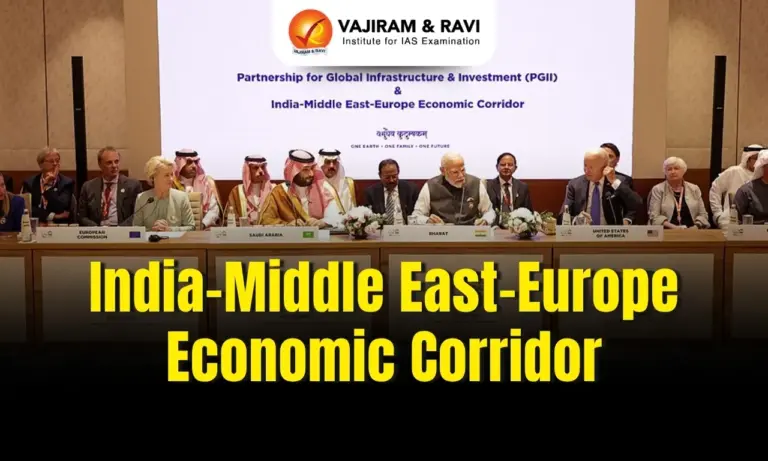
- India’s National Security Council Secretariat recently hosted officials from the U.S., UAE, Saudi Arabia, France, Italy, Germany, Israel, Jordan, and the EU to review progress on the India-Middle East-Europe Economic Corridor (IMEC).
- This article deals with the corridor’s ambitions, challenges, and future prospects.
About India-Middle East-Europe Economic Corridor (IMEC)
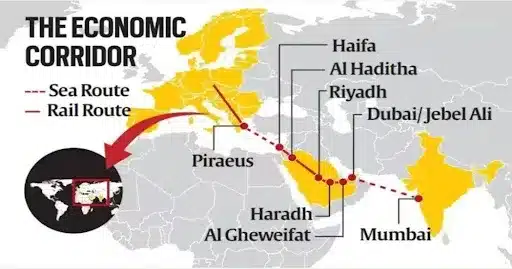
- Announced at the 2023 G20 Summit in New Delhi, the IMEC aims to boost economic development through enhanced connectivity between Asia, the Arabian Gulf, and Europe.
- It consists of two segments:
- the India-Gulf corridor, linking India’s western ports to the UAE and then via high-speed freight rail through Saudi Arabia and Jordan to Haifa, Israel; and
- the Gulf-Europe corridor, connecting Haifa to Greece and Italy by sea, followed by onward transport through Europe’s rail networks.
- Expected to reduce India-Europe shipping times by about 40% compared to the Red Sea route, the project has seen limited progress since its launch.





IMEC’s Promise and the Geopolitical Opening That Enabled It
- The IMEC was conceived during India’s G20 Presidency in September 2023, at a rare moment of Middle East stability following years of regional rivalries.
- Arab normalisation with Israel, which Saudi Arabia was poised to join, created conditions for India, Middle Eastern states, the U.S., and Europe to envision a corridor connecting India to Europe.
- The economic case was strong — the EU is India’s largest trading partner, with FY 2023-24 bilateral trade at $137.41 billion, and non-oil trade with the UAE and Saudi Arabia rising significantly.
- Planned as more than a trade route, IMEC aimed to integrate electricity and digital connectivity cables, clean hydrogen pipelines, and measures to boost efficiency, reduce costs, create jobs, and cut emissions.
- It sought to address persistent trade challenges, including lack of tariff standardisation, low financial integration, limited corridor-wide insurance, and varying port capacities, while building a cross-Saudi/UAE railway to link its sea legs.
- Although these were considered manageable through investment and cooperation, the project stalled when, less than a month later, the region was plunged into ongoing conflict, preventing the first stakeholder meeting from taking place.
Gaza War Turns IMEC’s Challenges into Fundamental Obstacles
- While the IMEC’s economic rationale remains strong, its hurdles have shifted from manageable to fundamental due to Israel’s ongoing war on Gaza, which has strained regional ties.
- The corridor’s key Middle East-Europe link depends on Jordan-Israel cooperation, now at a low point amid tensions over Palestinian displacement.
- Prospects for Saudi-Israel normalisation have also diminished, with Riyadh demanding Palestinian concessions that Israel is unwilling to make.
- The war’s expansion into Lebanon, Yemen, Syria, Iraq, and tensions with Iran heightens insurance costs for regional trade, further complicating implementation.
- Ironically, despite hindering progress, Israel sees the IMEC as crucial to deepening its economic integration with the Arab world, excluding Palestine.
- Prime Minister Netanyahu has termed framed of the project as a geopolitical blessing for participating states.
IMEC’s Future Hinges on Middle East Stability and Conflict Resolution
- While the IMEC’s western leg faces uncertainty, India’s strong strategic and economic ties with the UAE and Saudi Arabia keep prospects for its eastern leg alive.
- Initiatives like UPI integration enhance digital connectivity potential, but intra-Gulf economic rivalries, such as Saudi measures to counter Emirati dominance, hinder unified corridor planning.
- For the IMEC to match its 2023 vision, the regional stability that enabled its conception must be restored — a goal tied to resolving the Palestinian statehood issue.
- Growing global recognition of the need to end Israel’s Gaza war, reflected in actions like Germany halting certain arms shipments to Israel, underscores this reality.
- Until lasting peace is achieved, IMEC remains a “day-after” project, with current efforts limited to planning and trade facilitation.
Source: IE

 Last updated on March, 2026
→ UPSC Final Result 2025 is now out.
→ UPSC has released UPSC Toppers List 2025 with the Civil Services final result on its official website.
→ Anuj Agnihotri secured AIR 1 in the UPSC Civil Services Examination 2025.
→ UPSC Marksheet 2025 is now out.
→ UPSC Notification 2026 & UPSC IFoS Notification 2026 is now out on the official website at upsconline.nic.in.
→ UPSC Calendar 2026 has been released.
→ Check out the latest UPSC Syllabus 2026 here.
→ UPSC Prelims 2026 will be conducted on 24th May, 2026 & UPSC Mains 2026 will be conducted on 21st August 2026.
→ The UPSC Selection Process is of 3 stages-Prelims, Mains and Interview.
→ Prepare effectively with Vajiram & Ravi’s UPSC Prelims Test Series 2026 featuring full-length mock tests, detailed solutions, and performance analysis.
→ Enroll in Vajiram & Ravi’s UPSC Mains Test Series 2026 for structured answer writing practice, expert evaluation, and exam-oriented feedback.
→ Join Vajiram & Ravi’s Best UPSC Mentorship Program for personalized guidance, strategy planning, and one-to-one support from experienced mentors.
→ Shakti Dubey secures AIR 1 in UPSC CSE Exam 2024.
→ Also check Best UPSC Coaching in India
India-Middle East-Europe Economic Corridor FAQs
Q1. What is the IMEC?+
Q2. When was IMEC announced? +
Q3. How much can IMEC reduce shipping time? +
Q4. What halted IMEC’s progress? +
Q5. Which countries are key IMEC partners? +
Tags: India-Middle East-Europe economic corridor mains articles upsc current affairs upsc mains current affairs