Genome Latest News
Researchers recently sequenced the first whole ancient Egyptian genome from an individual who lived 4,500 to 4,800 years ago — the oldest DNA sample from Egypt to date.
About Genome
- A genome is an organism’s complete set of genetic information.
- A genome includes all of the hereditary instructions for creating and maintaining life, as well as instructions for reproduction.
- The human genome, like all other cellular life forms, consists of DNA (deoxyribonucleic acid) and includes both the nuclear and mitochondrial DNA. This is in contrast to ribonucleic acid (RNA) viruses, whose genome is composed of RNA.
- From Genome to Genes:
- The instructions in our genome are made up of DNA.
- Within DNA is a unique chemical code that guides an organism’s growth, development and health.
- This code is determined by the order of the four nucleotide bases that make up DNA: adenine, thymine, cytosine, and guanine.
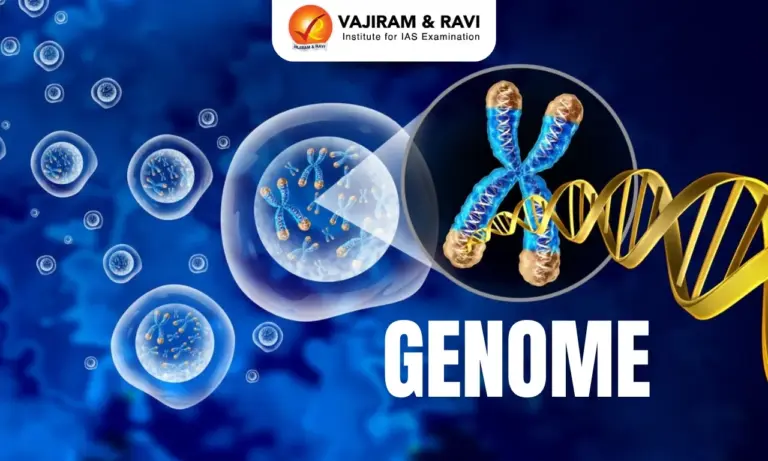
- DNA has a twisted structure in the shape of a double helix.
- Single strands of DNA are coiled up into structures called chromosomes.
- Within chromosomes, sections of DNA are organised into genes.
- Genes control different characteristics such as eye colour and height.
- All living things have a unique genome.
- There are 23 pairs of chromosomes in the human genome.
- Between 1990 and 2003, all twenty-three pairs were fully sequenced through an international research undertaking known as the Human Genome Project.
- The study and analysis of genomes is called genomics.





Where is the Genome Found?
- In organisms known as eukaryotes (which includes humans, other mammals, plants and fungi), most of the genome is contained within a membrane-bound structure called the nucleus.
- In humans and other complex multicellular organisms, a copy of the genome is found in nearly every cell in the body.
- The exception to this is mammalian red blood cells, which do not contain a genome as they do not have a nucleus or mitochondria.
- Furthermore, human reproductive cells (eggs and sperm) each contain half the DNA from that person’s genome, which then combines to form a whole genome at fertilisation.
- Organisms known as Prokaryotes, which contain no inner membranes, store their genome in a region of the cytoplasm called the nucleoid.
How long is a genome?
- The length of the genome varies between species and doesn’t necessarily reflect the size of the organism from which it came.
- The human genome is approximately 3 billion base pairs (3.2 to be exact) in length.
- While 3 billion is a big number, the rare Japanese flower called Paris japonica has a genome size of roughly 150 billion nucleotides, making it 50 times the size of the human genome.
Source: TH

 Last updated on March, 2026
→ UPSC Final Result 2025 is now out.
→ UPSC has released UPSC Toppers List 2025 with the Civil Services final result on its official website.
→ Anuj Agnihotri secured AIR 1 in the UPSC Civil Services Examination 2025.
→ UPSC Marksheet 2025 is now out.
→ UPSC Notification 2026 & UPSC IFoS Notification 2026 is now out on the official website at upsconline.nic.in.
→ UPSC Calendar 2026 has been released.
→ Check out the latest UPSC Syllabus 2026 here.
→ UPSC Prelims 2026 will be conducted on 24th May, 2026 & UPSC Mains 2026 will be conducted on 21st August 2026.
→ The UPSC Selection Process is of 3 stages-Prelims, Mains and Interview.
→ Prepare effectively with Vajiram & Ravi’s UPSC Prelims Test Series 2026 featuring full-length mock tests, detailed solutions, and performance analysis.
→ Enroll in Vajiram & Ravi’s UPSC Mains Test Series 2026 for structured answer writing practice, expert evaluation, and exam-oriented feedback.
→ Join Vajiram & Ravi’s Best UPSC Mentorship Program for personalized guidance, strategy planning, and one-to-one support from experienced mentors.
→ Shakti Dubey secures AIR 1 in UPSC CSE Exam 2024.
→ Also check Best UPSC Coaching in India
Genome FAQs
Q1. What do you mean by genome?+
Q2. What is a genome vs. gene?+
Q3. What are the four nucleotide bases that make up DNA?+
Q4. In eukaryotic cells, where is most of the genome located?+
Q5. How many base pairs are in the human genome (approx.)?+
Tags: genome prelims pointers upsc current affairs upsc prelims current affairs