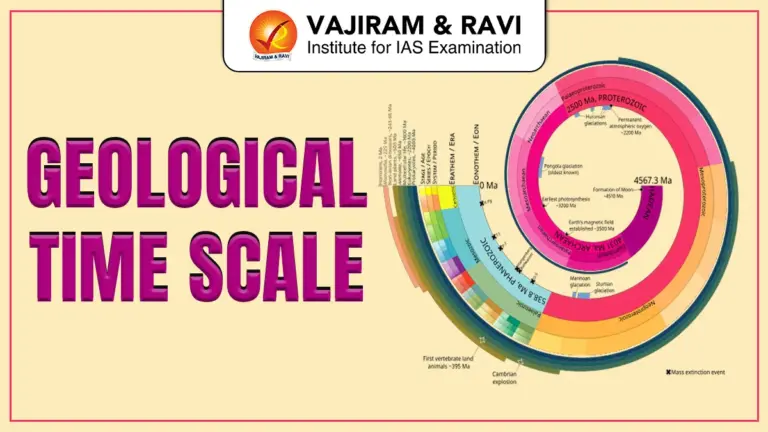
The Geological Time Scale is a scientifically developed framework that explains Earth’s history using evidence preserved in rocks, fossils, and geochemical signatures. It helps scientists understand when major changes occurred, including the formation of mountains, climate shifts, mass extinctions and the evolution of life. It is maintained by the International Commission on Stratigraphy under the International Union of Geological Sciences.
Geological Time Scale
The Geological Time Scale is based on chronostratigraphy, which relates rock strata to time intervals and geochronology and assigns numerical ages using methods such as radiometric dating, paleomagnetism and fossil correlation. The scale expresses deep time in ‘million years ago’ and provides a universal reference for Earth history studies. Geological ages are expressed in billion years (Ga), million years (Ma) and thousand years (ka).
Also Read: Solar System
Geological Time Scale Principles
The Geological Time Scale is built on fundamental stratigraphic principles that establish relative ages of rocks and events. The list of major principles involved in the determination of Geologic Time are:
- Law of Superposition: In undisturbed sedimentary sequences, older rock layers occur below younger layers, forming the basic rule for determining relative ages of strata.
- Principle of Original Horizontality: Sediments are originally deposited in horizontal layers, and any tilting or folding occurred after deposition due to tectonic forces.
- Principle of Lateral Continuity: Sedimentary layers initially extend laterally until they thin out or encounter a barrier, allowing correlation of rock units across distances.
- Principle of Faunal Succession: Fossil assemblages follow a consistent vertical order, enabling correlation of rock layers even across continents.
- Chronostratigraphic Correlation: Rock units are matched globally using fossils, lithology, paleomagnetism, and isotope data to establish standardized time boundaries.





Geological Time Scale Divisions
The Geological Time Scale divides Earth’s 4.54 billion year history into hierarchical units that reflect major geological and biological changes documented in the rock record.
1. Eon (Largest Division)
Eons represent the broadest phases of Earth history, each marked by major changes in Earth’s crust, atmosphere, and life forms.
- Hadean Eon (≈ 4.6 – 4.0 billion years ago): Formation of Earth and Moon, molten surface, intense meteorite bombardment, no confirmed life record.
- Archean Eon (≈ 4.0 – 2.5 billion years ago): Stabilization of continental crust, formation of oceans, first prokaryotic life, stromatolites, oxygen poor atmosphere.
- Proterozoic Eon (≈ 2.5 billion – 538.8 million years ago): Rise of atmospheric oxygen (Great Oxidation Event), eukaryotes, multicellular life, Snowball Earth glaciations.
- Phanerozoic Eon (538.8 million years ago – Present): Abundant fossil record, complex plants and animals, major evolutionary radiations and extinctions.
2. Era (Subdivision of Eon)
Eras divide eons based on dominant life forms and major global events. Eras within the Phanerozoic Eon are:
- Paleozoic Era (538.8 – 251.9 million years ago): Explosion of marine life, first land plants and animals, formation of Pangaea, ends with largest mass extinction.
- Mesozoic Era (251.9 – 66 million years ago): Age of reptiles and dinosaurs, breakup of Pangaea, origin of birds and flowering plants.
- Cenozoic Era (66 million years ago – Present): Age of mammals, development of grasslands, cooling climate, evolution of humans.
3. Period (Subdivision of Era)
Periods mark significant geological, climatic, and biological transitions. Each period is defined by fossil assemblages, tectonic events, or mass extinctions. Major Periods of the Phanerozoic:
- Paleozoic Periods: Cambrian, Ordovician, Silurian, Devonian, Carboniferous, Permian
- Mesozoic Periods: Triassic, Jurassic, Cretaceous
- Cenozoic Periods: Paleogene, Neogene, Quaternary
4. Epoch (Subdivision of Period)
Epochs capture finer scale changes, especially climate shifts and evolutionary developments. Example of Epoch under the Quaternary Period are:
- Pleistocene Epoch (≈ 2.58 million – 11,700 years ago)- Ice ages, megafauna
- Holocene Epoch (11,700 years ago – Present)- Stable climate, human civilization
5. Age (Smallest Formal Unit)
Ages represent the most precise divisions, often spanning thousands to a few million years. It is defined using climatic evidence of a global drought event. Example: Meghalayan Age (since ~4,200 years ago).
Also Read: Interior of the Earth
Extraterrestrial Geological Time Scale
Extraterrestrial Geological Time Scale classifies the geological evolution of solid celestial bodies using surface features, impact records, and volcanic history.
Lunar (Selenological) Time Scale
The lunar time scale is based on impact cratering, volcanism, and surface erosion without implying fundamental process changes.
- Pre – Nectarian: Oldest crust formation and intense early bombardment.
- Nectarian: Large basin forming impacts dominate surface evolution.
- Imbrian: Major volcanism and extensive basaltic lava flows.
- Eratosthenian: Marks the period fro 3.2 to 1.1 million years ago
- Copernican: It defines the period after 1.1 million years till today with presence of craters.
Martian Geologic Time Scale
Mars’ geologic history is reconstructed using crater density and mineral alteration evidence.
- Pre – Noachian: Earliest crust formation (~4,500 – 4,100 Ma).
- Noachian: Heavy bombardment and widespread water related features.
- Hesperian: Volcanism and surface drying (~3,700 – 3,000 Ma).
- Amazonian: Cold, dry conditions continuing to the present.

 Last updated on March, 2026
→ UPSC Final Result 2025 is now out.
→ UPSC has released UPSC Toppers List 2025 with the Civil Services final result on its official website.
→ Anuj Agnihotri secured AIR 1 in the UPSC Civil Services Examination 2025.
→ UPSC Marksheet 2025 is now out.
→ UPSC Notification 2026 & UPSC IFoS Notification 2026 is now out on the official website at upsconline.nic.in.
→ UPSC Calendar 2026 has been released.
→ Check out the latest UPSC Syllabus 2026 here.
→ UPSC Prelims 2026 will be conducted on 24th May, 2026 & UPSC Mains 2026 will be conducted on 21st August 2026.
→ The UPSC Selection Process is of 3 stages-Prelims, Mains and Interview.
→ Prepare effectively with Vajiram & Ravi’s UPSC Prelims Test Series 2026 featuring full-length mock tests, detailed solutions, and performance analysis.
→ Enroll in Vajiram & Ravi’s UPSC Mains Test Series 2026 for structured answer writing practice, expert evaluation, and exam-oriented feedback.
→ Join Vajiram & Ravi’s Best UPSC Mentorship Program for personalized guidance, strategy planning, and one-to-one support from experienced mentors.
→ Shakti Dubey secures AIR 1 in UPSC CSE Exam 2024.
→ Also check Best UPSC Coaching in India
Geological Time Scale FAQs
Q1. What is the Geological Time Scale?+
Q2. Who developed the Geological Time Scale?+
Q3. What are the main divisions of the Geological Time Scale?+
Q4. Which Eon are we currently living in?+
Q5. Why is the Geological Time Scale important?+
Tags: geological time scale