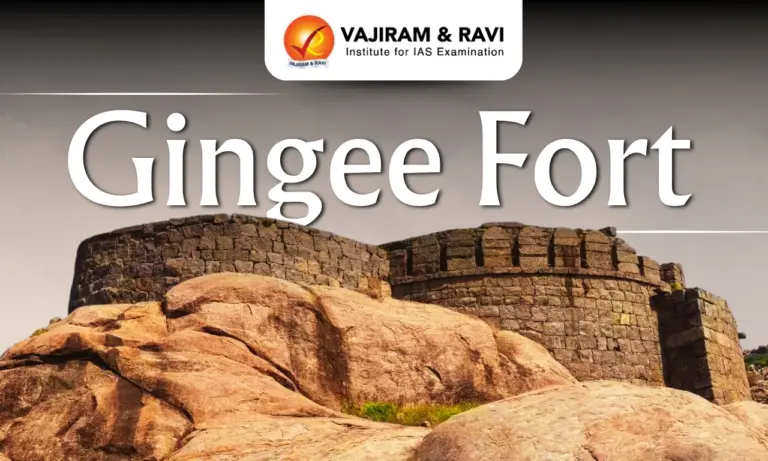
Gingee Fort, also known as Senji Fort, is one of the most magnificent hill forts in India, located in the Villupuram district of Tamil Nadu. Renowned for its strong fortifications and strategic location, the fort earned the title “Troy of the East” due to its seemingly impregnable defenses. Today, Gingee Fort is recognized as part of the Maratha Military Landscapes of India, which has been included in the UNESCO World Heritage list.
Gingee Fort History
ingee Fort has a rich and fascinating history spanning over 800 years, during which it was ruled by several dynasties and played a crucial role in South Indian politics and military affairs.
- 1200 CE: Gingee Fort was originally constructed by Ananta Kon of the Konar Dynasty on the rocky hills of present-day Tamil Nadu.
- 13th Century: The fort came under the control of the Kurumba chiefs, who further strengthened its defenses.
- Vijayanagar Period: The Vijayanagar Empire renovated and expanded the fort, adding new fortifications, temples, and military structures.
- 1677 CE: Chhatrapati Shivaji Maharaj captured Gingee Fort and transformed it into a major Maratha stronghold in South India.
- Maratha Capital: Shivaji extensively fortified the fort and made it the southern capital of the Maratha Empire.
- Mughal Siege: The fort gained fame when the Marathas successfully resisted a nine-year Mughal siege, demonstrating its extraordinary defensive strength.
- 1698 CE: After prolonged resistance, the fort was eventually captured by the Mughal Empire.
- Carnatic Nawabs: Following Mughal rule, Gingee Fort came under the administration of the Carnatic Nawabs.
- 1750 CE: During the Carnatic Wars, the fort was captured by the French, highlighting its continued strategic importance.
- 1761 CE: The British East India Company seized Gingee Fort from the French and brought it under British control.
- Colonial Period: The fort gradually lost its military significance but remained an important historical landmark.
- Modern Era: Gingee Fort is preserved as a protected monument and is recognized as part of the UNESCO-listed Maratha Military Landscapes of India.
Gingee Fort Architecture
The architecture of Gingee Fort is a remarkable blend of military engineering, strategic planning, and artistic craftsmanship. Built across three rocky hills: Rajagiri, Krishnagiri, and Chandragiri, the fort was designed to withstand enemy attacks while ensuring the self-sufficiency of its inhabitants.
- Protected by massive stone walls, ramparts, and gateways.
- Surrounded by an 80-foot-wide moat that acted as a defensive barrier.
- Fortified with a 60-foot-wide rampart to strengthen security.
- Utilized natural rocky terrain as part of its defense system.
- Included watchtowers and observation points for monitoring enemy movements.
- Designed with interconnected pathways and fortified entrances.
- Featured advanced rainwater harvesting and water storage systems.
- Contained large granaries for storing food during prolonged sieges.
- Combined elements of Dravidian, Vijayanagar, Maratha, and Indo-Islamic architectural styles.


 Last updated on Oct, 2026
→ UPSC 2027 Notification will be released on 13 January 2027 at upsconline.nic.in.
→ Check Nobel Prize 2026 Winners List here.
→ Download PIB PRiSM Monthly Magazine 2026 here.
→ Check UPSC Monthly Current Affairs Magazine The Recitals here.
→ Check out the latest UPSC Syllabus here.
→ Download UPSC Model Answers for Mains 2026
→ UPSC Mains Question Paper 2026 is out now for Essay & GS Paper 1, 2, 3 & 4.
→ UPSC Calendar 2027 has been released.
→ Enroll in Vajiram & Ravi’s UPSC Mains Test Series 2027 for structured answer writing practice, expert evaluation, and exam-oriented feedback.
→ Join Vajiram & Ravi’s UPSC Mentorship Program 2027 for personalized guidance, strategy planning, and one-to-one support from experienced mentors.
→ Go through the UPSC Mains Previous Year Papers to enhance your preparation.
→ UPSC has released UPSC Toppers List 2025 with the Civil Services final result on its official website.
→ Also check Best UPSC Coaching in India
Gingee Fort FAQs
Q1. What is Gingee Fort?+
Q2. Why is Gingee Fort called the "Troy of the East"?+
Q3. Where is Gingee Fort located?+
Q4. Who built Gingee Fort?+
Q5. What is the UNESCO status of Gingee Fort?+
Tags: art and culture gingee fort history history notes