About Globba tyrnaensis and Globba janakiae:
- These delicate plants, often referred to as “dancing girls”, named for the way their flower structures appear to move in the wind, belong to the genus Globba, a group of ornamental plants in the ginger family (Zingiberaceae).
- Globba species are native to tropical regions such as Southeast Asia, India, and the Eastern Himalayas, and are known for their intricate, colorful flowers.
- The first species, Globba tyrnaensis, was found in the famed Double Decker Living Root Bridge area of Tyrna village, located in the East Khasi Hills district, Meghalaya, at an elevation of 731 meters.
- A smaller population was also identified near Thangkharang Park in Cherrapunji.
- It is distinguished by its short inflorescence, orange flowers, and large anthers.
- It also produces bulbils that aid in propagation.
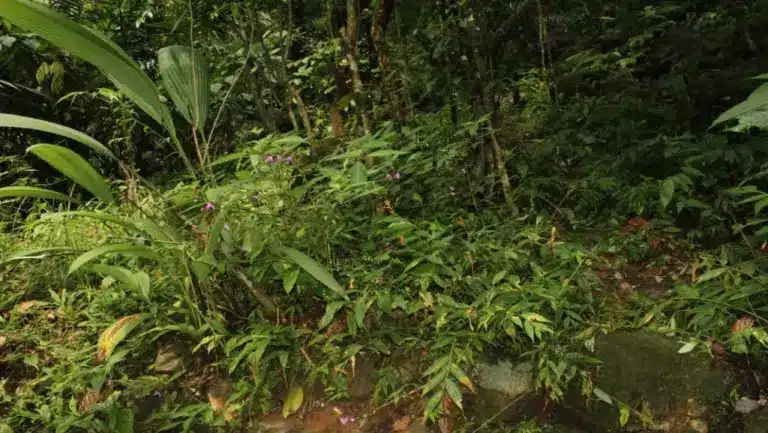
- It thrives in the moist, shaded forest understory.
- Its flowers attract bees, contributing to the local ecosystem.
- The species has been informally classified as endangered, according to International Union for Conservation of Nature (IUCN) guidelines.
- Globba janakiae was also discovered in the Tyrna village area, though it has an even smaller population, with fewer than 10 mature individuals recorded.
- It stands out due to its shorter inflorescence and the absence of inflorescence bracts.
- Its flowers are orange, and the species has distinctive heart-shaped labellum structures with small horn-like appendages.
- Named in honor of EK Janaki Ammal, a pioneering Indian botanist known for her advocacy of native plants and opposition to deforestation, Globba janakiae has been assessed as critically endangered.
Q1: What is IUCN?
The International Union for Conservation of Nature is a global organization composed of governments, NGOs, scientists, and experts dedicated to conserving nature and promoting sustainability. Its primary role involves assessing the conservation status of species, providing data and analysis on the state of biodiversity worldwide, and offering guidance and frameworks for conservation efforts.
Source: 2 new ginger species discovered in Living Root Bridge area






 Last updated on April, 2026
→ UPSC Final Result 2025 is now out.
→ UPSC has released UPSC Toppers List 2025 with the Civil Services final result on its official website.
→ Anuj Agnihotri secured AIR 1 in the UPSC Civil Services Examination 2025.
→ UPSC Marksheet 2025 is now out.
→ UPSC Notification 2026 & UPSC IFoS Notification 2026 is now out on the official website at upsconline.nic.in.
→ UPSC Calendar 2026 has been released.
→ Check out the latest UPSC Syllabus 2026 here.
→ UPSC Prelims 2026 will be conducted on 24th May, 2026 & UPSC Mains 2026 will be conducted on 21st August 2026.
→ The UPSC Selection Process is of 3 stages-Prelims, Mains and Interview.
→ Prepare effectively with Vajiram & Ravi’s UPSC Prelims Test Series 2026 featuring full-length mock tests, detailed solutions, and performance analysis.
→ Enroll in Vajiram & Ravi’s UPSC Mains Test Series 2026 for structured answer writing practice, expert evaluation, and exam-oriented feedback.
→ Join Vajiram & Ravi’s Best UPSC Mentorship Program for personalized guidance, strategy planning, and one-to-one support from experienced mentors.
→ Shakti Dubey secures AIR 1 in UPSC CSE Exam 2024.
→ Also check Best UPSC Coaching in India